Beijing at Night

Credits:  Kitschy Digital (You are awesome kit) Chevron and Yellow Houndstooth papers, Knotty girl’s pp1 paper;  Caro 752 Marquee 1 & 2 brushes, KPertiet Grungy clusters and LivE Sing for Spring Page overlay;  LivE TW01 Tag;  K Pertiet Academic Alphas.

A “Snack Street” and a “Bar Street”, both alive till the wee hours of the morning, both swarming with street food – some made me squeamish while some whetted my appetite.  Two popular night scenes not to be missed when in Beijing.

Wangfujing Night Food Market

Just off Wangfujing St., located pretty much in the center of Beijing and a 10-minute walk from where we stayed.

After a hotpot dinner at a nearby mall, we walked along Wangfujing St., a portion of it is off limits to cars and other motor vehicles.

The food market was crowded with people, but they say this is quite normal as it is a famous snack street among locals and foreigners alike.  I was not prepared for what’s to come though.

The first few food stalls had as displays bugs and scorpions on a stick, bizarre foods that would probably delight Andrew Zimmern no end but not me.

Even beautiful sea creatures such as seahorses and starfishes.  I was horrified.  Poor creatures.  I now know that there are foods that I cannot eat, what a revelation!!  But not all food stalls are alike,

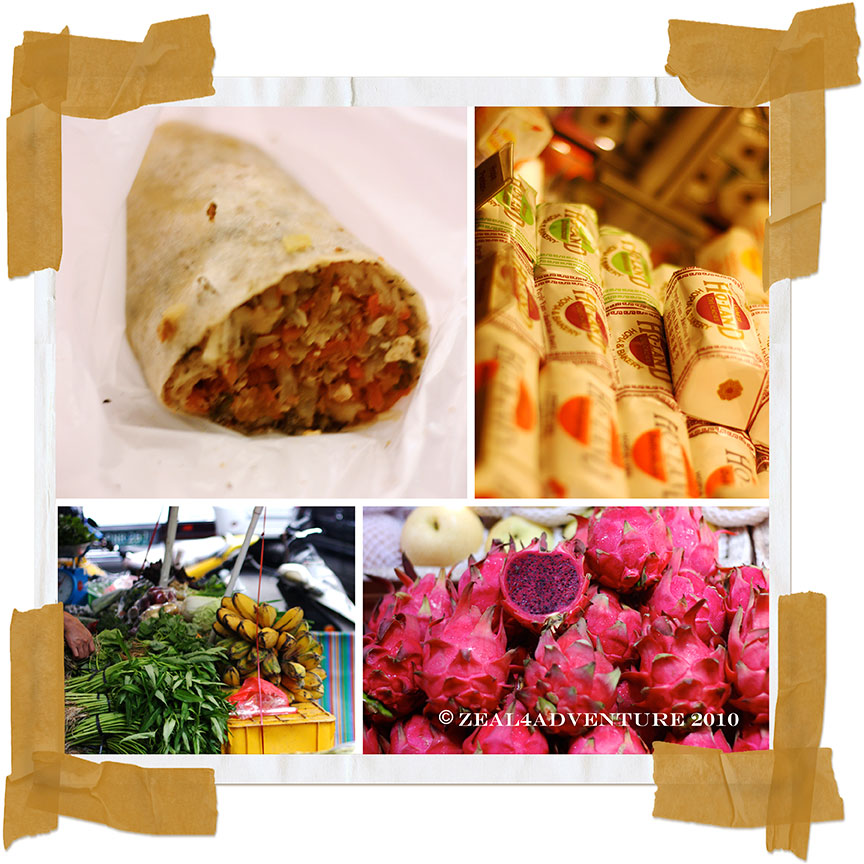
Candied fruits

there were others that had me wish we skipped the hotpot meal and went straight here.

Lamb Shawarma

There were wonderful smells of lamb kebabs, shawarmas, grilled meats, roasted chestnuts and many, many more.
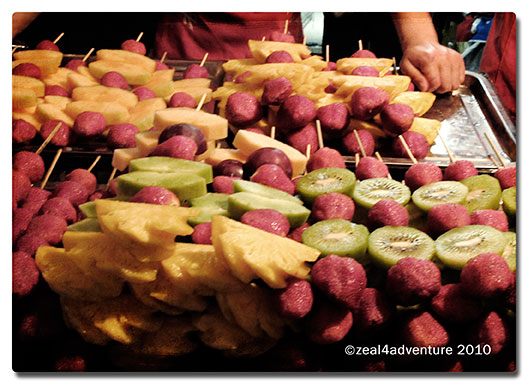
A great place for a cheap sumptuous dinner, sans the bizarre foods of course.

Sanlitun Bar Street

One of the best known bar street in Beijing, Sanlitun is located in Eastern Beijing in the Chaoyung District.
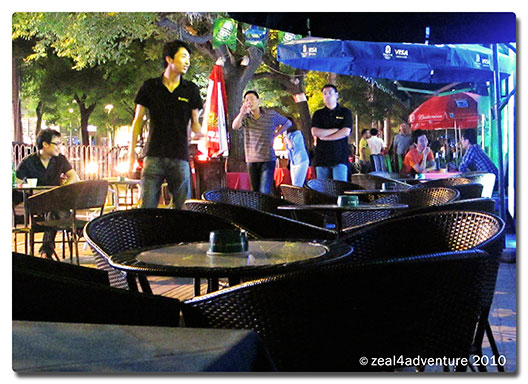
Hidden away in the small alleys of Sanlitun are many small bars and cafes.

This has been one of the most popular entertainment area for foreign expats, recounts my brother who used to work in Beijing in the late ‘90s.  What used to be a small street with bars has turned into stretches of bars and trendy restaurants.  Hardly recognizable, he says, as we weave through the streets in search of his favorite hangout spot 12 years ago.

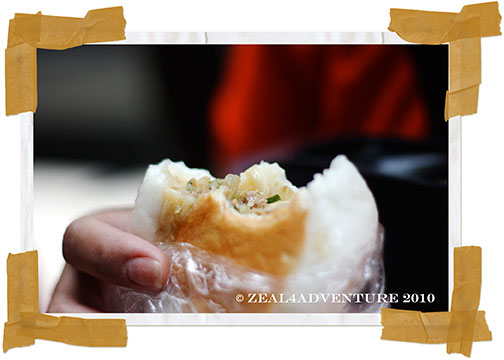
Before taking a cab back to our hotel, we came across this stall selling some sort of a wrap

made up of char siu pork and fried egg with some sort of sweet-savory sauce and lettuce to finish off.
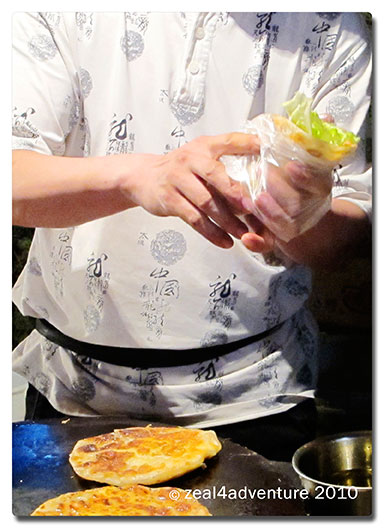
Better then the breakfast offerings at the hotel.
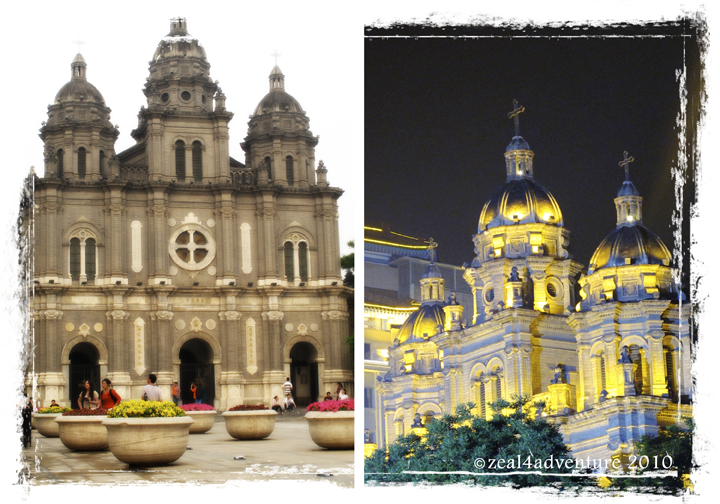
Beijing : The Old Meets New

If the last time you were in Beijing was 15 years ago,

you’d also be surprised at how they have managed to preserve its ancient past even while it transforms into a modern metropolis.

Walking along Wangfujing Avenue, I notice a smattering of bicycles reminiscent of the Beijing I last saw, still pedaling down the streets but is more and more being replaced by cars and buses.

Modern buildings and malls line the streets of Beijing along side stunning ancient eastern architectures. The capital of China with 3,000 years of history is today a dynamic city where the old and new intermingles and is a magnet for local and foreign visitors. It remains the People’s Republic of China’s center of politics, culture and economics.

Great Wall

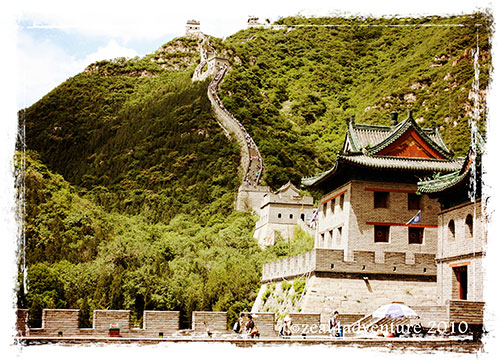
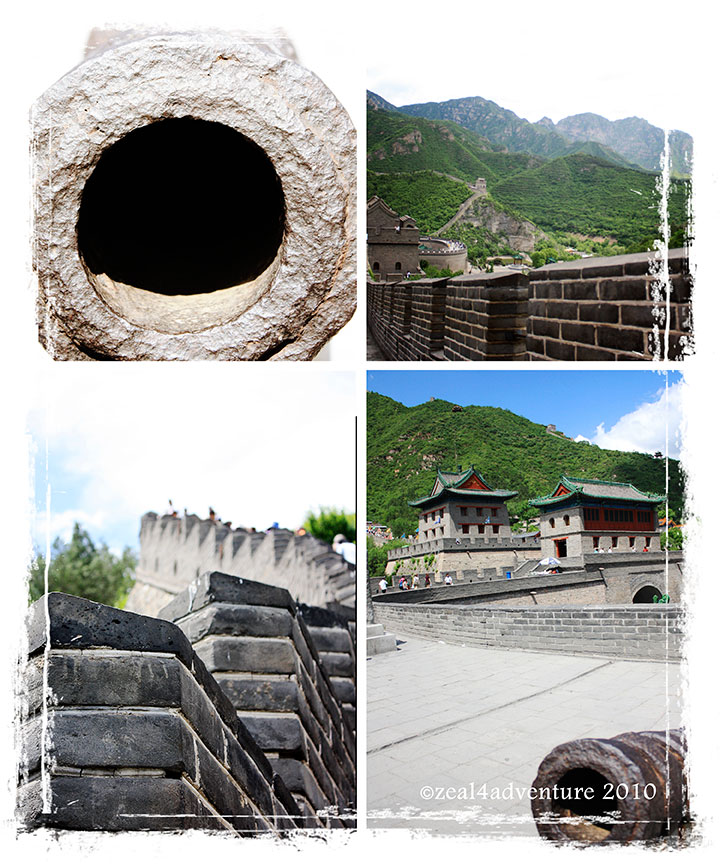
Great Wall – Juyongguan Pass

A visit to Beijing will never be complete without the imperative call to the Great Wall.  It was the reason for this trip putting aside the good eats, that is.  My nephew wanted to see the Great Wall, after taking it up in school and thus a family vacation was mounted.
Packed with tourists

So to Juyongguan Pass (also called Juyong Pass) we went one morning.  It is the nearest section of the Great Wall to Beijing, a little nearer than Badaling, the most popular section of the Great Wall.

Juyong Pass does not however escape the same glut of souvenir shops and a number of other tourist traps that Badaling has.  But if convenience, keeping transportation simple and time management is of importance, both these passes are the best places to get a feel of the walls’ more than 2,000 years history.  In fact, as early as the 13th century, the area of Juyong Pass was known for its beauty and was listed as one of the eight “great sights of Yanjing”.

Aside from its easy access, its steps starts off from the same level as the parking lot so there is no need to climb or take a cable car to reach the wall.

It however rises steeply on both sides of the gate

The view from mid-way to the 1st watchtower

Our goal that never was.

– a reason why we never even reached the first watchtower.

Once a strategic military garrison, this 20 kilometer-long valley,

stretching along the ridge of incredibly steep mountains was considered important in the defense of Beijing in the ancient China.  These mountains that flanks the valley can definitely be credited for the beauty of the pass.

If you are looking to see authentic “Ming Dynasty” walls though, this is not the place to be as a short expanse of the wall has been recently restored.  Simitai might be a better option since it is virtually unreconstructed and is listed as a UNESCO’s World Heritage Site.

More of Beijing in my next posts.   🙂

Scenic Sunday

PB&J and Oatmeal

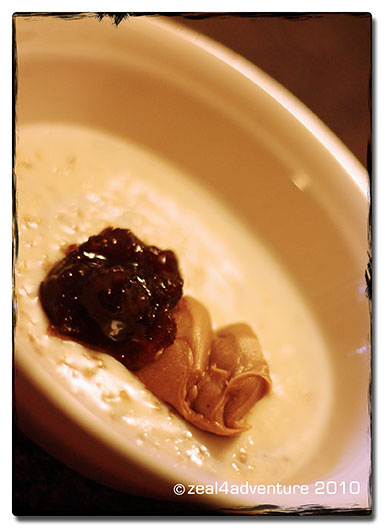
So I love oatmeal.  I didn’t always but learned to love it when I discovered this and this (available at Healthy Options).  Unlike the oatmeal my mom forced on me every single school day of my elementary years, these provided some texture that took my fancy when I first tried it.  I’ve acquired the taste for oats since my recent illness.   It’s supposed to be good for me.   😉

Also available at Healthy Options

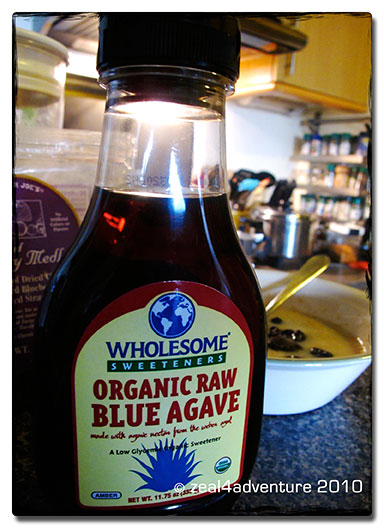
Sweetened with some kind of sweetener – honey, muscovado or a recent discovery, agave syrup and a sprinkling of some dried fruit, that’s how I normally like my oatmeal.

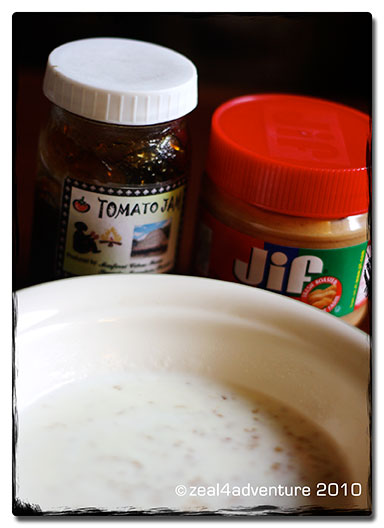
I recently uncovered though a liking for peanut butter and jelly to go with it. Guava is a favorite but I so happened to have an opened bottle of tomato jam – it worked for me too!  Don’t judge until you’ve tried it.  It can be very addicting!  Umm, that is if you love PB&J as much as I do.  Aside from the sweet-savory taste, the PB adds a certain richness to the oatmeal while the J takes care of sweetening it in a special kind of way.  I would add more liquid than usual so not to end up with oatmeal that is too thick when mixed with the peanut butter.

So go ahead, give it a try – this might just end up becoming a favorite too.   🙂

The Binondo “Wok”ing Tour

Possibly, no definitely the best way to see Manila “on foot” as their leaflet suggests and I completely agree.  It’s literally experiencing Binondo or Chinatown one bite at a time.

I am of Chinese descent but I don’t really know my way around Chinatown.  My parents would occasionally take us there for lunch or dinner when we were growing up but really, I am clueless as to their whereabouts.

An “old-time” favorite of the family

Binondo is like a maze, although the street names are all very familiar, I have no sense of where they are in relation to each other.  Leave me there and I am helpless.

I grew up with home cooked Chinese food.  Not the stuff that you eat in “Cantonese-style” Chinese restaurants in the metro, but simple home cooked meals that really is more everyday stuff to me than “Chinese”.

So taking this tour was somewhat nostalgic and enlightening.  We journeyed through old and new adventures.  There were food that I grew up with and there are those I encountered for the first time.  The places we walked through were likewise familiar, yet unfamiliar.

Binondo Today and Yesterday

Ivan showing the group a “grandma” slipper that is almost in the brink of deletion.

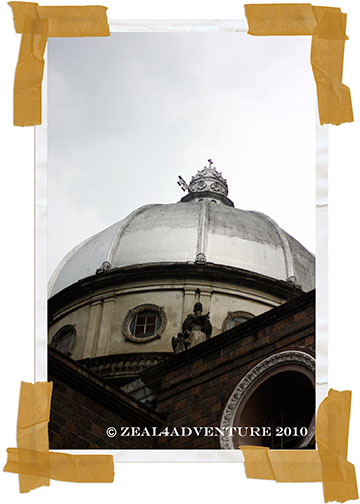
Our gracious host, Ivan Man Dy met us at the Binondo Church located across the Plaza Calderon dela Barca along Quentin Paredes St.

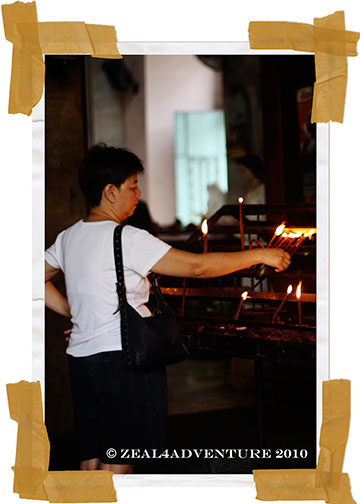
It is today a well-known landmark in Chinatown.  Because the saint once served there as an altar boy, it is also known as Minor Basilica of St. Lorenzo Ruiz.

At the Plaza across the church, we talked briefly about how the early Hokkien (Fookien) immigrants arrived from Fujian province in China during the Spanish rule and the time when Binondo was the main center of business and finance in Manila with mainly the Chinese, Chinese mestizos, and Spanish Filipinos anchoring the bustling banking and financial community many decades ago.

Today, the community is still vibrant as ever and continues to keep alive its heritage.

Café Mezzanine

After a brief reminder of our history, we walked over to a café above Eng Bee Tin where we were served a bowl of “kiampung”, which literally translates to salty rice.

This rice dish is a mixture of pork, chicken, dried shrimps, mushrooms and peanuts mixed together in soy sauce and topped with caramelized and spring onions – a simple dish that reminded me of my childhood, my grandmother, actually.  Opened and run by a group of volunteer firemen headed by Gerry Chua, all of its proceeds go to the Binondo and Paco Volunteer Fire Search and Rescue Brigade.  So if you find yourself in the area, head on to Café Mezzanine and eat up a storm, every bite you take is a contribution to a noble cause.  Located at the corner of Ongpin and Yuchengco (former Nueva St) Sts., it opens its doors at 7am and closes at 10pm.

Dong Bei Restaurant

Fried Kutchay Pancake

We then walked over to a hole in a wall that serves perhaps the best dumplings in town.

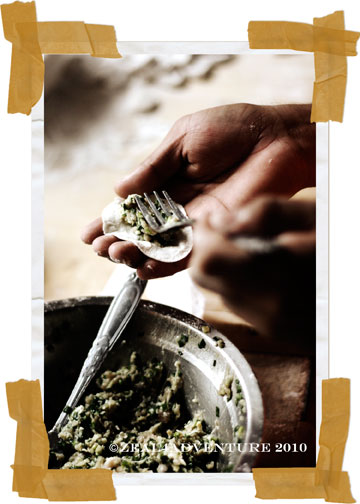
At the storefront (as you enter) there will be someone making fresh dumplings by hand for everyone to see.

Owned by new immigrants Ivan calls “bagong salta” (new arrivals) from Northern China, they serve prominent dishes from that region.

Heavenly with the sauce!

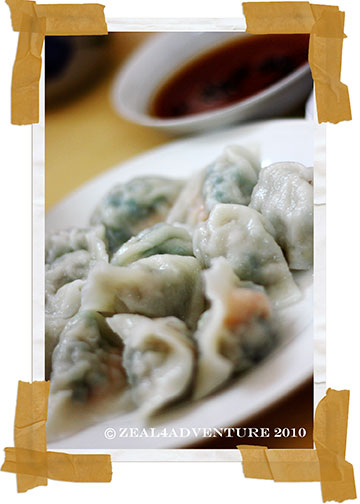
The steamed Kutchay dumpling is a blend of minced pork, kutchay and fresh shrimps – juicy pork dumpling flavored with kutchay and fresh crisp shrimp adding another dimension to the taste of the dumpling.  This is truly a wonderful blend of flavors and is heavenly with the soy-vinegar sauce.   I loved it so much, I bought some frozen ones to savor more of it at home.  Heard that they also make a mean dish of hand-made noodle with Soybean sauce.  Must get myself back there to try it.

Fried Siopao

Another favorite and a first for me is fried siopao from a small take-out stall along Benevidez St. Yes folks, this siopao is not steamed but pan-fried.  This might be the best tasting siopao I had ever tasted in my life.  Not the typical asado filling, this is more like bola-bola siopao but much more tastier.   Definitely a must-try.

Aside from the siopao, I also bought to munch some sugar sprinkled bicho-bicho (Chinese crullers).  This was a favorite and truly a blast from my past!

There’s more and best to experience it first hand.  The Big Binondo Food Wok.  Go book a tour today.  And oh… make sure you’re hungry.

My take on Kalbijim

A and I love Korean beef stew or Kalbijim as they call it in Korea.  For some reason – with all the delectable authentic Korean dishes we had during our 4 days stay – Kalbijim was surprisingly not part of the menu.  Don’t ask me why, it’s a mystery to me as it may be to you.  So in the spirit of my visit to Korea and missing out on the authentic taste of this wonderful tasting beef stew, I’ve decided one evening to look up a recipe and reminisce the taste of Korea just one more time.

Korean Beef Stew

  • 1 Kilo short ribs or beef flank
  • 4 slices ginger
  • 2 tsps. garlic, chopped
  • 1 pc. onion, sliced
  • ¼ tsp. chili powder
  • 2 tbsps. brown sugar
  • 6 tbsps. Kikkoman Soy Sauce
  • 3 cups beef stock
  • 1 pc. carrot, cubed
  • 2 pcs. raddish, cubed
  • 1 tbsp. Manjo Mirin
  • 1 tbsp. sesame oil
  • sesame seeds, toasted
  • leeks

Here’s what you do:

  • Boil beef in 3 cups water seasoned with salt and pepper for 30 minutes.  Set aside.
  • Saute ginger, garlic, onion, chili powder.  Add sugar and beef.  Make sure to cook until slightly brown.
  • Pour soy sauce and beef stock.  Cook until beef is tender.
  • Add carrots, raddish, mirin, sesame oil.  Garnish with toasted sesame seeds and leeks.

I had some mushrooms so I threw that in which explains the inclusion in the photo.  Totally optional, just wanted to use up the remaining mushrooms I had and add more veggies onto the dish.  If you want a truly authentic beef stew, omit the mushrooms.

Maa Shee Saw Yo (Delicious!)

Credits:  Kitschy Digitals – You Are Awesome Kit Plain and Yellow Houndstooth papers; JSprague Awesome Scallop tag

Twenty years ago, Korea to me meant underground shopping where overruns of well-known brands abound.

Itaewon

Today, these so-called underground shops albeit scarce still exists but no longer rule my interest.  More than lovely sceneries (which I only discovered on this trip), it’s the cuisine that got me fired up.  Korean food ranked high on my list of favorites ever since I stepped foot on their soil some twenty years ago.  The proliferation of Korean restos in my neck of the woods nurtured that fondness.  Lucky for us, we had great Korean hosts and night after night, we were treated with authentic Korean cuisine and more. And contrary to some reports, Koreans are very courteous people.   🙂

Some of my favorite dishes came to life and once again, I got to taste it from its source.

Bibimbap

Rice, meat, vegetables, an egg and chili paste.  Mixed together and I’m in heaven.  What I love best about this is the crusty rice at the bottom.  So better make sure that it is served in a hot stone bowl.

Chapchae

Usually served as a side dish in Korea but I can have it as a main dish anytime.  It can truly make my day.

Galbi Gui

The first time I tried this was in a small restaurant in Itaewon and I’ve never looked back.  A must have in every Korean dinners.  It is short ribs marinated in Korean Soy Sauce, garlic and sugar and then grilled, usually at the table.   Typically served with lettuce, which is used to wrap the beef in.  The hot bean paste called ssamjang sealed the deal for me.

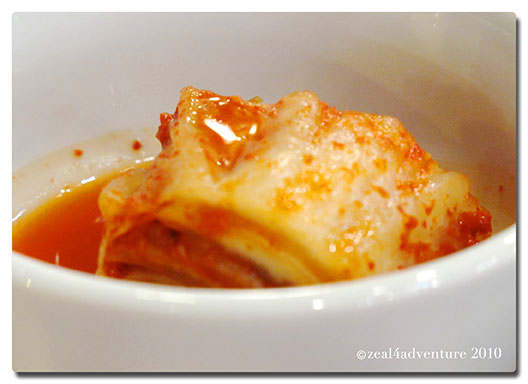
Kimchi

Funny how I sometimes crave for this when it wasn’t love at first taste…  nope, not at all!  It actually took a while for me to even like this stuff.  But what is Korean food without kimchi?

A Colorful Platter of 9 ingredients in Thin Crepe

This was interesting and a first encounter.  The platter came with thinly sliced fresh and pickled vegetables and mushrooms.  Gather a few of each and wrap with the crepe.  Maa shee saw yo!

It was a great trip to Korea even if it was actually work (and a bit of play).  The food capped it all, as usual.