El Nido… Here I Come

But first, let me talk about Puerto Princesa.  Not exactly the paradise Palawan promises to be, it is however the gateway to the promise.   The capital of Palawan is the jump off point to many beautiful beaches, lush rainforests, stunning limestone cliffs and the clearest water teeming with marine life.  And just like many of my trips to Puerto Princesa, we made it our jump-off to El Nido, a favorite part of Palawan and our destination.

Always in transit, never really staying, Puerto Princesa managed to endear itself a few years back when we decided to stay a few days more after a live-aboard trip to Tubbataha and Cagayancillo.  A clean, quiet city that is best known today for its Underground River, a UNESCO World Heritage site featuring a spectacular karst landscape and an extensive underground river system.

And because the van to El Nido leaves early morning, we thought it best to spend a night and enjoy a bit of its good food.  If you know me by now, you know that good food is never far behind.

As soon as we touched down, before we even checked in to our inn, we headed straight to our favorite Vietnamese eatery in PP – Rene’s Saigon Restaurant.
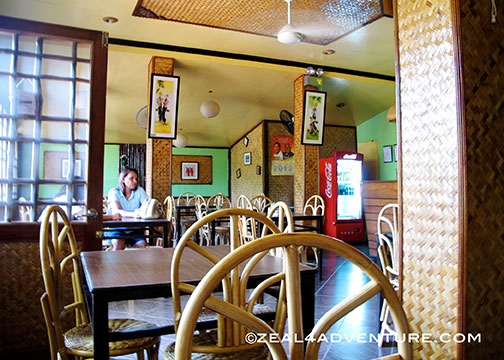
They serve the best Beef Pho in town.  That’s Beef Stew Noodle soup and locals call it Chao Long.  Once a United Nations Vietnamese Refugee Center in the ‘70s, the capital had been introduced to Vietnamese culture and its food its greatest reward and keepsake.

Even on a hot summer’s day, this soup provides great satisfaction.  A bowl each and a shared Beef Bahn Mi – yes we love beef – is one fulfilling “welcome to Puerto Princesa” meal.

If you are to walk to Baywalk like we did, late afternoon (or early morning) is best during the hot summer.
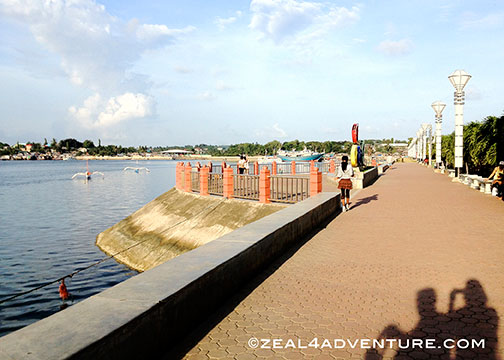
A seafront strip that (sort of) reminds of Dumaguete’s Rizal Boulevard.  This strip, unlike that of Dumaguete’s, is tucked away from the road just beside the seaport.
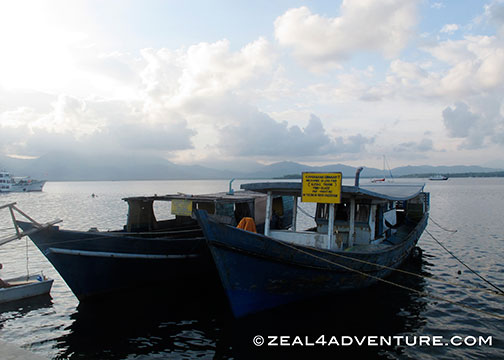
Detained fishing boats for using illegal fishing methods.

Puerto Princesa Bay, a main port for smaller ship boats is likewise the main gateway to the many islets of Palawan by sea.  This is also where one would take a boat to watch the dolphins frolicking the bay early in the morning.

Long nose snouted spinner dolphins abound in the waters off Puerto Bay.
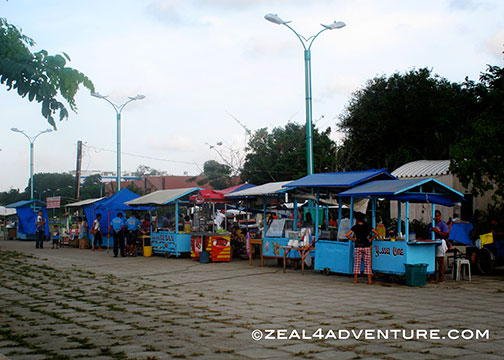
Many food stalls line the Baywalk strip offering various kinds of street food.

Trying a Tok Neneng — it really is just hard boiled eggs coated with an orange batter then fried.  It is flavored with the sauce of your choice ranging from sweet and sour to hot and spicy.
Some sort of a spicy cheese roll, the green pepper providing the heat.  Yum.

Seated near a stall enjoying our beer, our tok nenengs and the likes, the stall owner asked if we would be interested in some tamilok – a woodworm, sometimes also known as a shipworm.

It may look like a worm and called a worm, it is however not one.  It is a marine mollusk that tastes very much like fresh oysters, I found out.
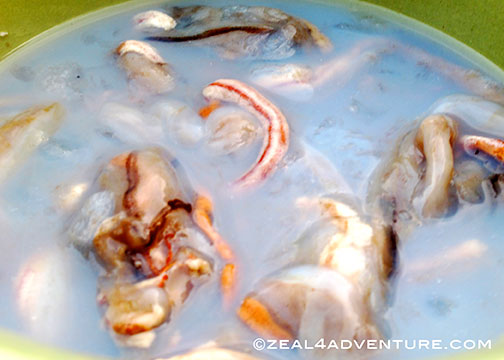
Curious that Andrew Zimmern found it fabulous, I should give it a try myself, don’t you think?  Now, fabulous it is not (for me), but it definitely would pass as not bad.

The more popular restaurants were either closed or fully booked, we ended up trying a new kid on the block.

Blue Ginger serves Asian cuisine that is quite impressive but the one that had us all nodding our heads was this Texas Style Pork Ribs.
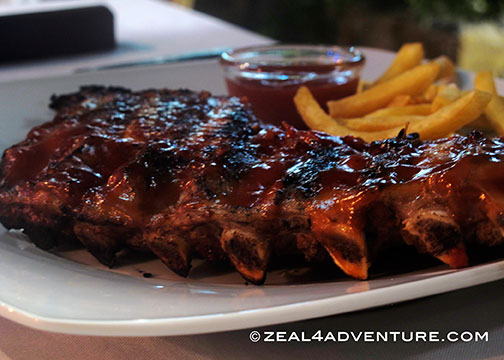
The chef’s American, that’s why.  In my books, this place is a serious addition to the many wonderful eats Puerto has to offer so far.

Satisfying day.  Tomorrow we’re off to my favorite Palawan getaway.
Useful Info

Rene’s Saigon Restaurant
Rizal Avenue Extension,
Puerto Princesa3
(048) 433-5255
 
Blue Ginger
Rizal Avenue,
Puerto Princesa
(0927) 545-5847

Random Travel Snaps: Spotted Eagle Ray

Photo courtesy of R.Rellosa

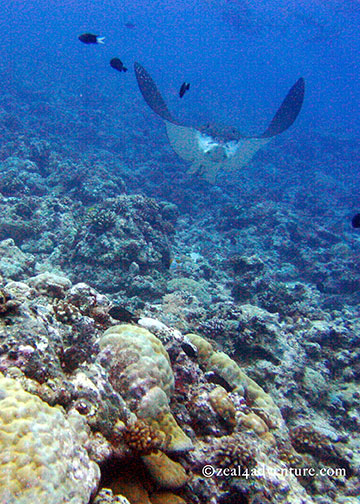
Somewhere near Blue Corner off the waters of Palau, a creature gracefully glided its way towards us.  It was my first encounter with rays and it was intoxicating.  Stupefied, I watched its flat disk-shape body with its soaring wings fly towards us.  It was identified as a Spotted Eagle Ray because it has white spots on its deep blue body.  Their long rounded snout, almost like a pig’s snout, distinguishes it from other rays.  The one encountered was quite big but it is said that a Spotted Eagle Ray can grow to nearly nine feet (3M) from wingtip to wingtip.

Rays are some the most fascinating creatures to soar through the world’s ocean and they are found worldwide in tropical waters, most commonly in shallow inshore waters, around reefs.  To come across them in Palau is quite common, thanks to the island formation and currents.  Made up of over 100 islands with low-lying oval islands ringed by barrier reefs, it is world renown for its marine bio-diversity.  Outside of the pelagic (such as sharks and rays), the water is teeming with barracuda, jacks and tuna.  Over 600 coral species smother the reefs overflowing with small fish.  Definitely a must for every diver.

As a new diver in 2007, my trip to Palau was a series of firsts – it was my first time to dive outside of the Philippines, to drift in strong currents, to use a reef hook, to see big fishes like sharks and rays…  And these firsts gave me the confidence underwater.  But truth be known, that Spotted Eagle Ray made my Palau dive experience impossible to forget.

Spelunking

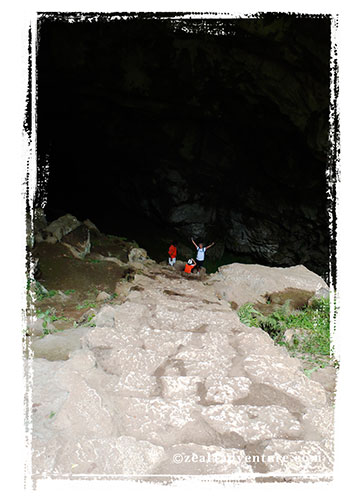
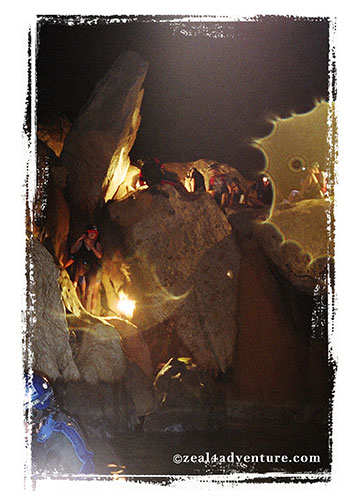
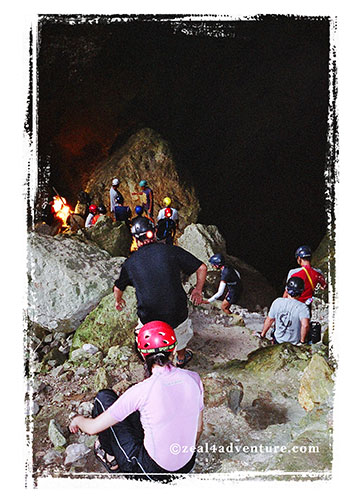
Many, many years ago, 1994 I think it was, we made a day trip to Sagada from Banaue.  We found ourselves a guide and he suggested that we do the caves.  That was 18 years ago, I was not the same person I am today.  I hesitated, “I’ll stay in the jeep”, I told my friends.  They looked at me, “that’s a 3-hour wait”.  “But my shoes (a trekking boots) will get dirty”, I said.  Bewildered, they just looked at me and started walking down the steep stairs leading to the opening of Sumaging.  A friend stayed with me but when the last of them disappeared from our sight, she convinced me to do it as she has already decided to go for it.  Long story short, I gave in.

Slippery step after slippery step, I was cursing.  “I will never EVER listen to you guys again”.  But at least I didn’t cry like one of our companions.  I was too angry to cry.  Yes, it was terrifying, especially for a first timer.

But it gets better as you walk pass the guano covered rocks.  Yes again, those rocks aren’t only slippery, they’re stinky as hell too.

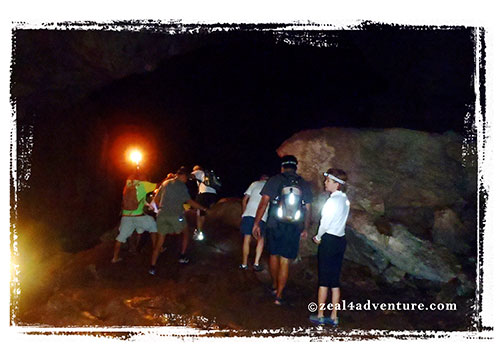
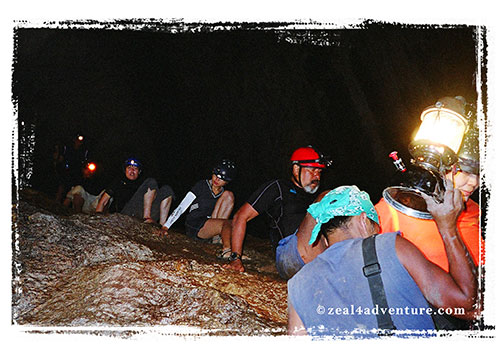
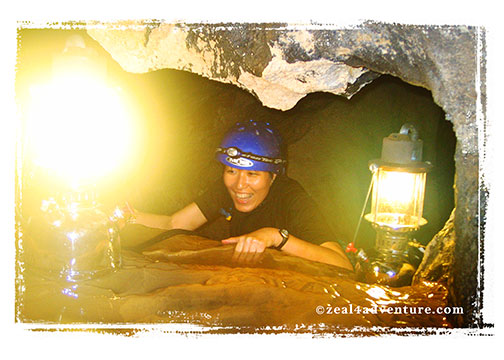
As we walk those boulders with only a gasera (gas lamp) lighting our way, I would imagine slipping and falling into a deep pit – for all you know, it ain’t that deep but the surroundings were pitch dark so imaginations can get wild, believe me.

At a certain point, we were asked to take off our shoes.  Well, at least my (trek) boots won’t get wet, I thought.  But my next worry though was how on earth are we to manage those slippery rocks barefooted.  Best. Thing. Ever.

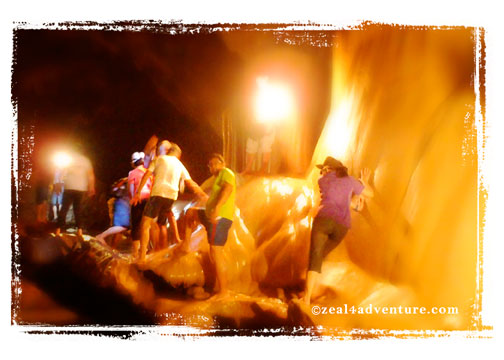
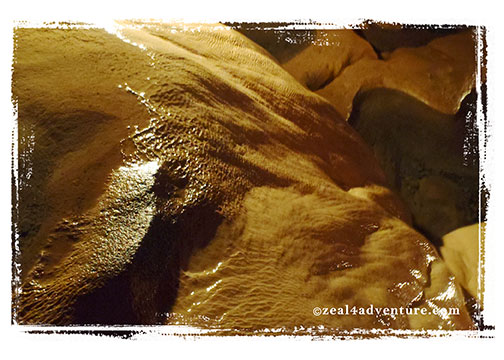
The pumice-like rocks had enough traction that your feet practically stick to those boulders.  Amazing.

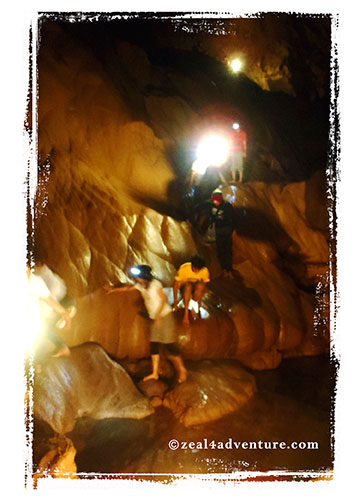
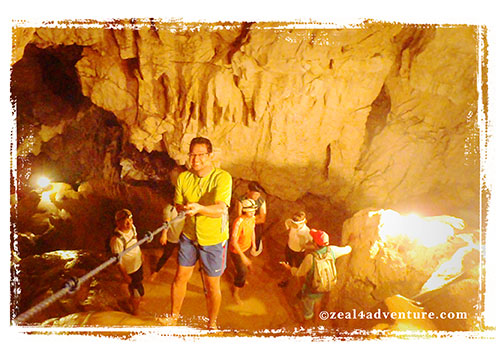
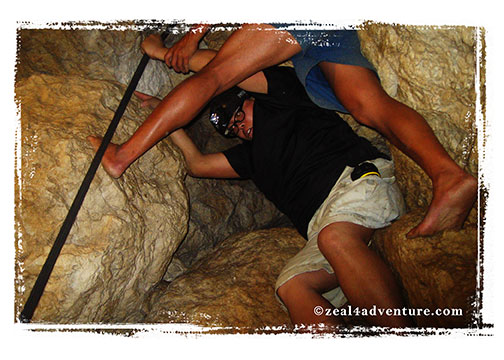
Still cursing though as we not only rappel up and down to get to other chambers, we had to step on our guides too, if no other options will do (shoulders or thighs lang naman).

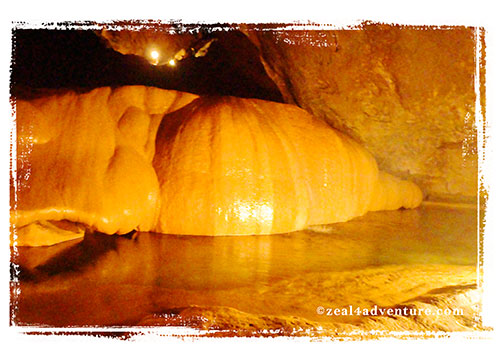
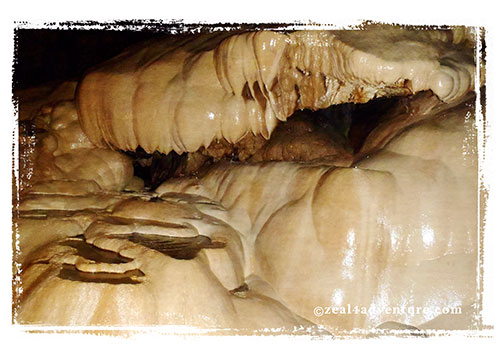
Beautiful stone formations with names like King’s curtain, pig pen, pregnant woman, rice terraces formation etc. are found in those chambers.

It was definitely the saving grace of this “craziness”, truth to tell.

Recounting our adventure that evening, I started with “Next time we do this again, I will…”, they all looked at me, “I thought you will never EVER do this again?”  Oh well.

I was somewhat true to my word, I never entered Sumaging since.  Not saying though that I haven’t done Cueba de Oro, San Carlos, Sierra, Baggao caves since that fateful day.  Unbeknownst to me then, Sumaging would be my intro to the outdoors and life has never been the same since.  Although caving or spelunking, as they call it, will never really be a favorite activity but if push comes to shove, I’ll do it.  Anything for camaraderie.

Fast forward to 2005, I heard of the Lumiang-Sumaging traverse.  Curious and not wanting anything new to pass me by, I ventured once more to the uncomfortable with friends in tow.

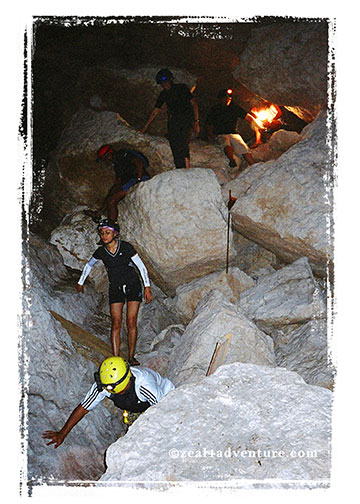
We started early as this would take us 4-5 hours, they said.  More experienced this time, it wasn’t as daunting but to say it was challenging might be an understatement.

Not recommended for the faint of heart or the inexperienced.  That said, many of the friends with me that day had never experienced Sumaging or any caves for that matter… so who am I to discourage.  Did they ever enter another cave?  No.

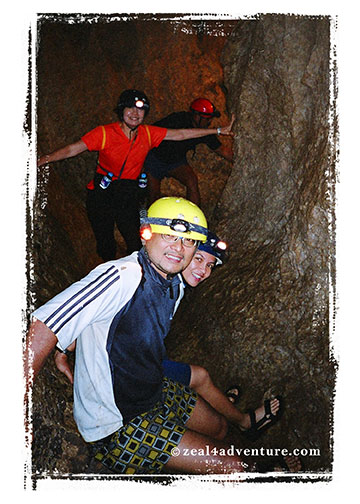
The obstacles that we went through would consist of rappelling down small openings with the use of ropes – squeezing and contorting sometimes,

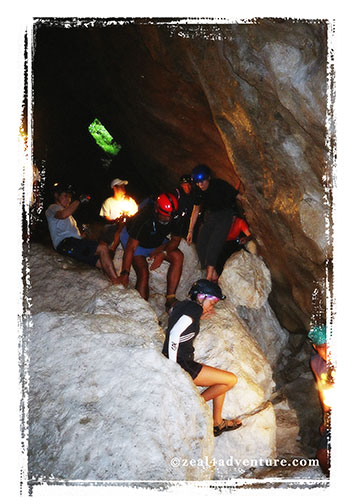
sitting on our butts and inch our way down if ropes were unavailable, hugging rocks,

walking along narrow ridges with only a rope to hold on to –this I can guarantee are steep cliffs and falling can be fatal, and a lot of listening and following (mostly the guides’ instructions).

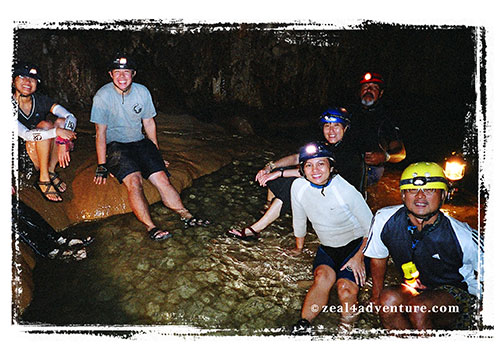
Halfway and nearing Sumaging, the chambers would have icy cold pools where one can take a dip or rest on the banks.

Like Sumaging, Lumiang is beautiful, breathtaking even but unlike Sumaging, it can really test your limits.  A bragging right of sort, me think.

Would I do it again?  Perhaps.  I always believe though that the first time is always the most memorable.  It stays vivid in your memory like it was yesterday.  I remember more my first descent on Sumaging 18 years ago than the more recent Lumiang-Sumaging traverse.

Early this year, I accompanied friends to Sumaguing.  These friends of mine have never gone into a cave ever.  It was as I remembered it but less intimidating – I didn’t have to step on anyone’s shoulders, to say the least.

I didn’t push Lumiang… Sumaging was bittersweet for them – challenging yet a source of pride for finishing.  Exactly my sentiments each time – Sumaging or Lumiang.

Useful Tips:

1.  Aquasocks or river shoes proves best inside the cave.  I used my Five Fingers on my last trip and I didn’t have to take them off.  But sandals are good too.

2.  Wear quick drying shirts. Rash guards would keep you warmer.

3.  Never go in the cave without a guide.  Register for a guide at the Tourist Information Center at the Municipal Hall.

4.  Best is to bring headlamps and helmets (for Lumiang).

5.  Water and towel is likewise advised.

6.  Always follow your guide’s instructions.  They know best.

Random Travel Snaps: Threatened Heirlooms

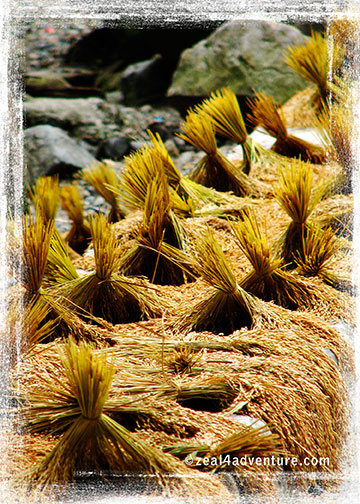
Upland palay (unhusked rice grains) left on the road to dry —  somewhere between Kiangan and Banaue, Mt. Province.

Kalinga Unoy Sun Dried Rice – Red heirloom rice from the terraced fields of the Philippines.

Kalinga Unoy is a rusty-red, speckled colored rice grown with organic methods on ancient terraces in the Philippines, then naturally sun-dried for three days.

Cook Kalinga like you would other rice. A delicate, sweet, nutty aroma lifts off it when it’s cooking and follows right through to the flavor of the finished dish. Great as a side or even as a focus of the meal. Its aroma and flavor will get you excited, I guarantee.  

~ As described on Zingerman’s Mail Order, an on-line shop

Kalinga Unoy, Ulikan Red, Tinawon Fancy, Tinawon White – these are some the varieties of traditional upland rice grown in the Cordillera region, cultivated by their ancestors for hundreds of years.  For generations, planting, cultivating, harvesting of rice have been the foundation of their culture.  But in the last decade or so, both the terraces and the indigenous culture have been slowly losing its durability.  The century old rice terraces are gradually deteriorating brought about by man’s carelessness, disuse and the changing weather. The terraces are too steep for machineries and the absence of which makes terrace farming back-breaking and hard.  It has lost its appeal to the younger generation who are leaving the mountains, abandoning strenuous farming for “greener pastures” elsewhere.

Rice supply of late comes mostly from lowland rice as upland or heirloom rice are low-yielding due to low tilling capacity.  Besides this, various problems related to changes in weather and infliction of rodents, pests and diseases, have had traditional rice farmers replacing traditional rice with high yielding, early maturing hybrid varieties.  Heirloom seeds and terraces however are considered a connection to their ancestors and the elders are anxious of losing this heritage.

Through upgraded technology provided by Department of Agriculture and the International Rice Research Institute (IRRI), farms in the uplands see hope of becoming self-sufficient once again.

Upland rice holds its own characteristics, uniquely ingrained through farming traditions that has been protected for thousands of years.  It has formed a niche in the world market given its distinct delectable taste and health benefits particularly from the organic conscious consumers.  Through the help of the Revitalized Indigenous Cordillera Entrepreneurs, Inc (RICE), Kalinga’s Unoy Red rice is now being sold in the US.   There’s light at the end of the tunnel for the threatened heirlooms, it seems.