I’ve been remiss in my posts because real world has taken over for now. It’s planning season. I am swamped. Not swamped enough though to give up a weekend trip to Macau. While in Macau, we received news that Manila was under water and many of our friends were stranded or flooded in. The extent of it did not sink in until I went to work on Tuesday. Some employees were rendered homeless and more than 60 of them were flooded in, some to the roof. The recent devastation that hit Manila chose no one and struck all social stratum. But for those nowhere to go, no roof on their heads, it is devastating. Red Cross is accepting donations to help those that were battered by Typhoon Ondoy. Click here to help.
Author: Jenn
Medicine Lake: The Lake that isn’t

There are lots of glorious lakes within Jasper National Park but there is one lake that lured us no end. Medicine Lake, just approximately 20km southeast of the townsite. A geological rarity. Why? you ask. We all assume that Medicine Lake is a normal mountain lake but it isn’t. It is perhaps best described as a sinking lake that has holes in the bottom like a bathtub without a plug. During intensified runoff of summer, too much water flows into the lake filling the drain. Before long, the lakebed begins to fill and by late spring, early summer (which was about the time we were there), Medicine Lake is in its full glory.

Medicine Lake is located along the road to Maligne Lake, a lake almost synonymous with Jasper. On our way to Malign Lake one evening, the still water perfectly reflecting the mountains and the sky caught our attention. And so we stopped and admired its glory.

A great road route to spot wildlife, we were told, was also probably the main reason why we ply that route more often than once during our stay in Jasper. It is Caribou land and we got word from a tourist we met earlier that there were caribous and bears (ok maybe he was exaggerating and there was only one) lurking around. More than enough reason to go back again and again even if we were out of luck as far as caribous and bears were concerned. It is, after all, a glorious lake, er, body of water(?) during the summer months.

Wordless Wednesday: Of Horns and Antlers

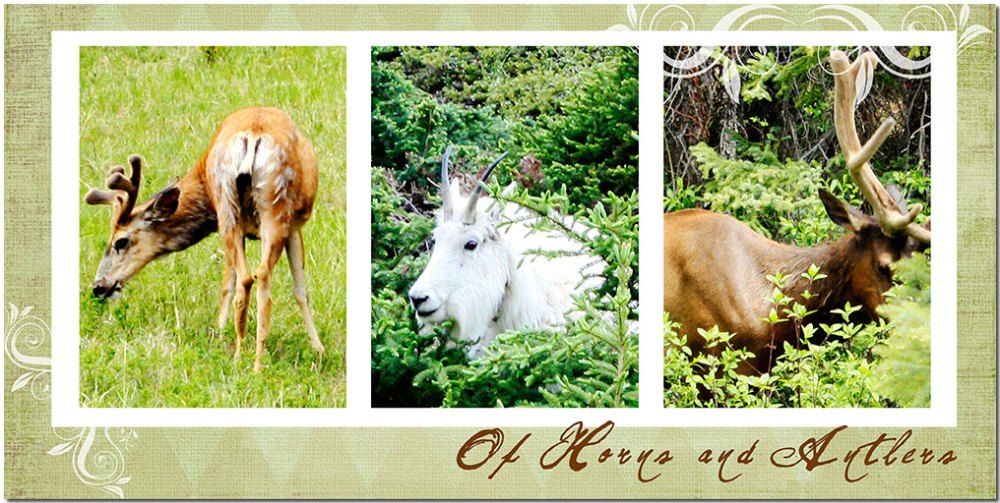 Credits: Paper – Jessica Sprague Green Diamond paper (Grand Intentions Kit)
Athabasca Falls

After the breathtaking Sunwapta Falls, we took another turn and found ourselves in yet another dramatic and powerful waterfall.

Considered among the most impressive falls in the Rocky Mountain, it is not surprising to note that Athabasca Falls could quite possibly be the most popular in the Canadian Rockies. Lucky for us, we were there at a time where visitors, sometimes overflowing, were few.

A short access trail surrounds the falls and allows for a glimpse of park. A lookout spot and a bridge provide vantage points for photos.

Speaking of which, the falls is a deafening combination of sound and spray and even if it is not raining, a rain-jacket might be a good idea. Not because we were soaked but I worried more about my camera lens and wished I brought something to cover up.
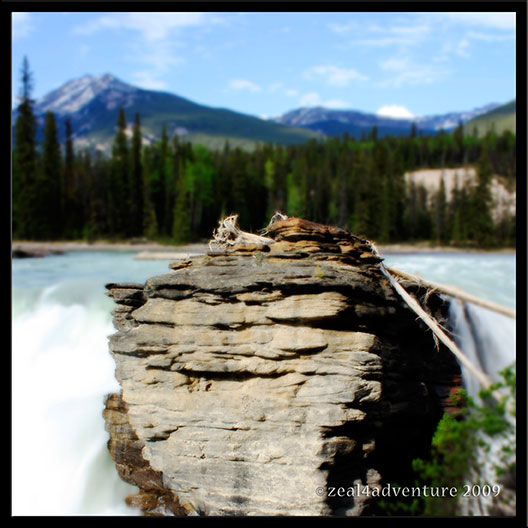
The Athabasca River is the largest river system in Jasper National Park and the heavy flow of volume from that river pours over a hard layer of rock, cutting deeply into the soft limestone below creating potholes and medicine bowls.
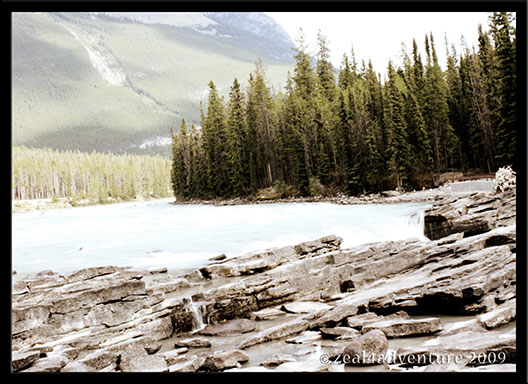
This odd rock formations thousand of years in the making is also a take off point for white water rafting. Sadly though, A’s 18 day stint in the Colorado River left him with no desire to be in cold water any time soon. Oh well… 😦
Visit more Scenic Sundays here.
Sunwapta Falls: Turbulent Waters


Not far from the Icefields Parkway, south of Jasper, is the aptly named Sunwapta Falls meaning “turbulent waters” in the native tongue of the Stoney Indians.

Originating from the Athabasca Glaciers, the volume of water caused by the glacial meltdown was high in early summer, when we were there.

The small island in the middle of the Sunwapta River just up stream of the falls is, in my opinion, what makes the upper Sunwapta Falls beauteous.

Make sure to detour to this falls when in the area. For more Sepia Scenes, click here.
Downtown Jasper
A photo gallery of downtown Jasper:
 Our B&B
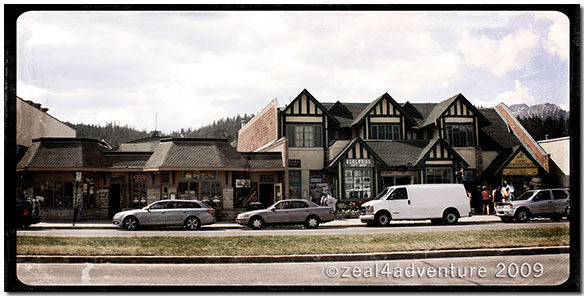 Shops
Shops
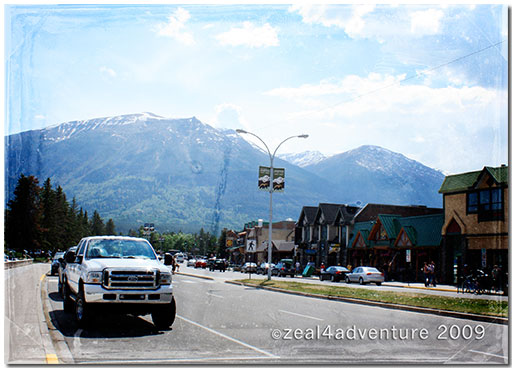 Mountain backdrop
 Flora
Flora
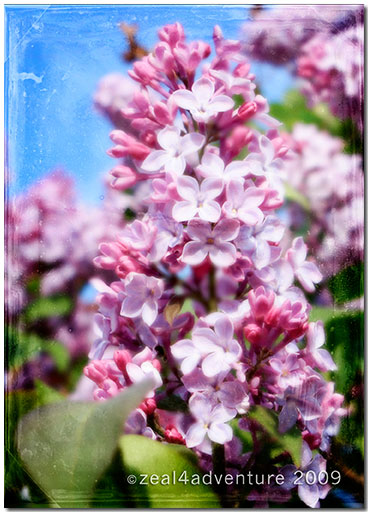 More flowers
 Jasper Firehall
 The neighborhood

 Pinecones
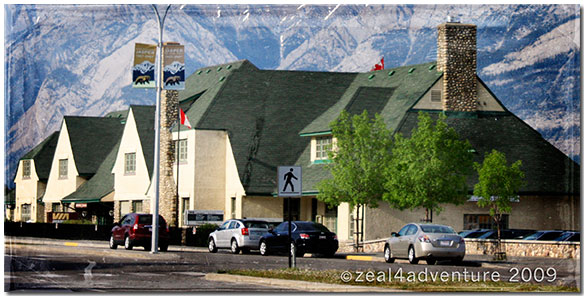 Via Rail Station
Sweet Jasper

Credits: Template: Katy Larson Kiseed Studio; Paper: LivEdesign Sing4Spring PP3 and SP2; Elements: LivE S4S Spring String 2; Alpha Tags: LivE Sing4Spring Alpha Tags
“Must not miss Jasper,” my well-traveled friend advices. “It is a town you will adore.” Anyone who knows me knows that I love quaint, rugged towns and this little town where peaks crown the horizon in every direction is indeed a town I have regarded as one of my top picks. The largest and the most northerly of Canada’s Rocky Mountain National Parks and one of the group of 4 national park and 3 provincial parks which together are designated by UNESCO as the “Canada Rocky Mountain Park World Heritage Site”.
Quieter then the 2 previous towns, Jasper feel more like a friendly small town than a tourist town. It is because nearly one quarter of Jasper’s population is not dependent on tourism. Canadian National, Canada’s largest railroad, employs hundreds of people who call Jasper home.
If you’re into small quaint towns (filled with abundant wildlife) as I am, this rugged, not-so-little piece of wilderness will become your favorite spot as well once experienced. In my next few post, you’ll see why. So consider this an intro to one of my favorite places.
Journey to Ancient Ice

Connecting the two towns of Lake Louise and Jasper is the extremely scenic Icefield Parkway. To travel it is to experience a world where snow and ice dominates the land. Stretching 230 km between the two towns, the parkway offers easy access to one of the most spectacular mountain landscapes.

The largest of the chain of icefield stretching more than 25 km across the Continental Divide, Columbia Icefield straddles the boundaries of Alberta and British Columbia, as well as Banff and Jasper National Parks.
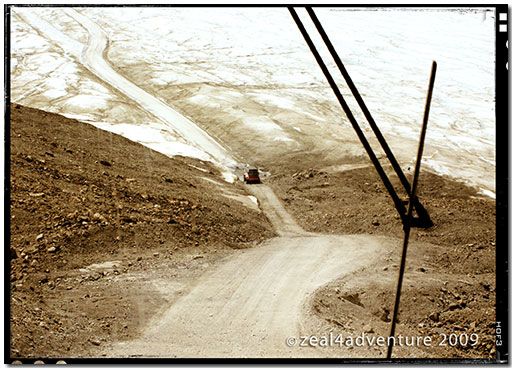
The massive Brewster Ice Explorer is a modern marvel specially designed to clamber up the glacier, which took us out to the slopes of the Columbia Icefield, the Athabasca Glaciers for an up-close glimpse of icy crevasses and ice-fed streams.

A driver-guide led the 90- minute journey sharing information about glaciers and icefields. We get to step out midway onto the glacier and stand on ice of yore.

Columbia Icefield is a surviving remains of the thick ice mass that once covered most of Western Canada’s mountains lying on an elevated plain. It is North Amercia’s largest sub-polar ice park.

Parker Ridge Trail

Located in Northern Banff and closer to Jasper. On the way to Columbia Icefield from Lake Louise is Parker Ridge Trail, a popular day hike and one of the best among several popular trail.
The trail leads to a ridge overlooking Saskatchewan Glacier and the Columbia Icefield and can be done in an hour. A hike I would have loved to do if I had my way. Here’s what the sign reads:

More snaps from the road:


To see more scenic snapshots, click here.
Bridal Veil Falls


Not too far away, on the same pull out as that of Crowfoot Mountain and Bow Lake is a sign pointing to Bridal Veil Falls.

A popular name for waterfalls from Australia to Zimbabwe, I found out. But this one is just a hop away from where we were and all you need is a telephoto lens to take this shot.

There is a trail south of the sign leading to different views of the falls. To learn more, click here.
 my adventure odyssey