Beijing Acrobats

Credits:  LivE S4S Stitched Page Overlay, TW Lesson 2 paper, Laurie’s Ornament, KPertiet Storyboard Negatives.

China’s acrobatics are world-renowned and deservedly popular among Beijing’s visitors.  Young students that demonstrate extreme flexibility, dexterity and balance that boggle the mind perform today’s acrobatic shows.  If you have enough time, might as well witness a show.  Expect to “ooh” and “ahh” during the entire show as the young performers show off stunts such as: plate spinning, unicycling, juggling, Chinese yo-yo, etc.

Snippets from the show:

Where to watch:

Chao Yang Theater

Wansheng Theater

Tiandi Theater


A Taste of Ancient China

Credits:

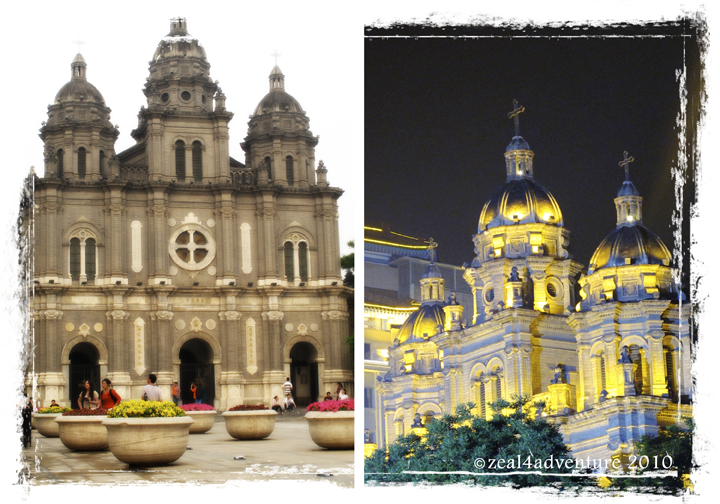
Although the Tian An Men (Men meaning gate) Gate was built in 1417 during the Ming Dynasty to compliment the Forbidden City, what first came to mind as I was walking through the humungous complex was the 1989 protest known to the world as the Tiananmen Square Massacre.  This was where the heroic flight of thousands of young men and women played a crucial role in the events that ultimately led to the collapse of communism.

The largest city space in the world at 40,000 square meters the square was packed with people wandering about.  It held the monument of the National Heroes, the Great Hall of the People, the National Museum of China and the Mausoleum of Mao Zedong.  It also is the gate connecting to the Forbidden City, which sits on its north.

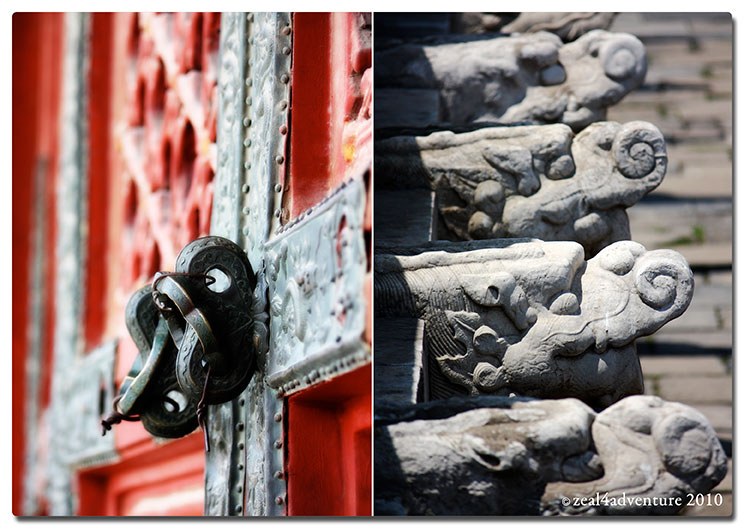
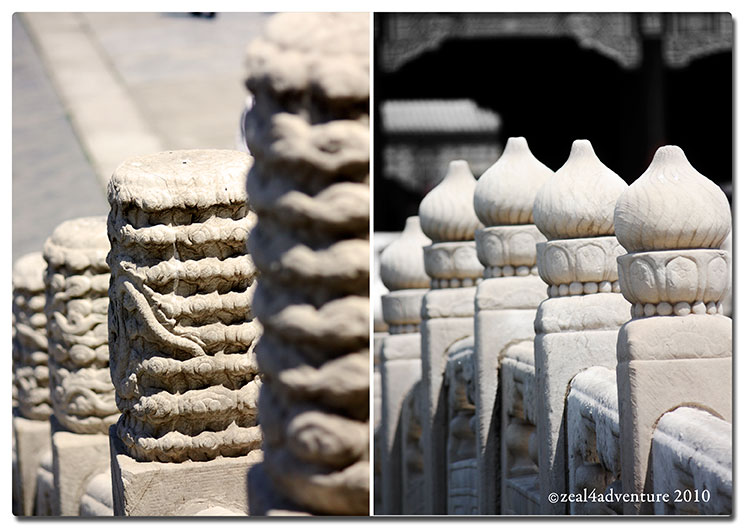
The large white marble column seen all around the square was constructed in 1420 as part of the Forbidden City ‘s grand design, which took 14 years to complete.

This Chinese inspired palace is located in the middle of Beijing and now houses the Palace Museum.  For almost 500 years (from the Ming Dynasty to the end of the Qing Dynasty), it served as the home of emperors and their households.  It likewise was the economic and political center of the Chinese government.  The construction began under the Ming Emperor Yongle in 1406 and is the largest and the most well preserved imperial residence in China today.

Walking through the city gives an idea of the grandiose lifestyle of the former emperors.  During these times, common Chinese were not allowed to enter the city at all, a big contrast to today’s millions of people entering daily.

The entrance of the Palace is through Tiananmen gate and once you reach the Wumen (Meridien Gate),

you enter the heart of the complex where you fall in line or wait for your guide to purchase your ticket.

It was chaotic and it continues to be so until you leave the complex.   The rooms are now off-limits and one can only take a peak from the outside, unlike a decade ago when one could actually enter and have a feel of the old splendor.  The price of commercialization, I guess.

Despite the chaos, a visit to the Forbidden City is a must especially if it is your first time.

Because of the size, allow at least 3 hours to walk the complex, wear comfy walking shoes and best to get those audio guides for a thorough walk through.

Forbidden City
North of Tiananmen Square
Dong Cheng District
Opens from 8:30am – 4pm daily
Price:  ¥ 40-60 / ticket

Beijing at Night

Credits:  Kitschy Digital (You are awesome kit) Chevron and Yellow Houndstooth papers, Knotty girl’s pp1 paper;  Caro 752 Marquee 1 & 2 brushes, KPertiet Grungy clusters and LivE Sing for Spring Page overlay;  LivE TW01 Tag;  K Pertiet Academic Alphas.

A “Snack Street” and a “Bar Street”, both alive till the wee hours of the morning, both swarming with street food – some made me squeamish while some whetted my appetite.  Two popular night scenes not to be missed when in Beijing.

Wangfujing Night Food Market

Just off Wangfujing St., located pretty much in the center of Beijing and a 10-minute walk from where we stayed.

After a hotpot dinner at a nearby mall, we walked along Wangfujing St., a portion of it is off limits to cars and other motor vehicles.

The food market was crowded with people, but they say this is quite normal as it is a famous snack street among locals and foreigners alike.  I was not prepared for what’s to come though.

The first few food stalls had as displays bugs and scorpions on a stick, bizarre foods that would probably delight Andrew Zimmern no end but not me.

Even beautiful sea creatures such as seahorses and starfishes.  I was horrified.  Poor creatures.  I now know that there are foods that I cannot eat, what a revelation!!  But not all food stalls are alike,

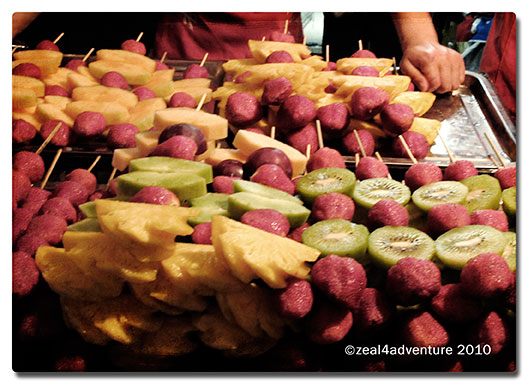
Candied fruits

there were others that had me wish we skipped the hotpot meal and went straight here.

Lamb Shawarma

There were wonderful smells of lamb kebabs, shawarmas, grilled meats, roasted chestnuts and many, many more.

A great place for a cheap sumptuous dinner, sans the bizarre foods of course.

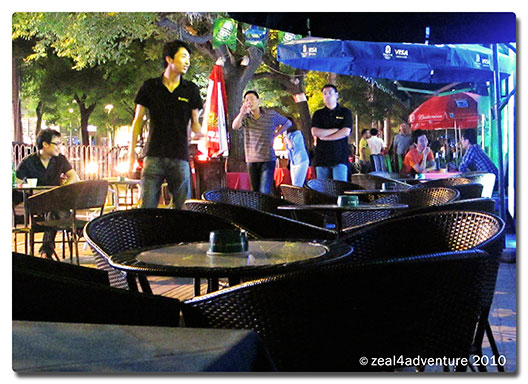
Sanlitun Bar Street

One of the best known bar street in Beijing, Sanlitun is located in Eastern Beijing in the Chaoyung District.

Hidden away in the small alleys of Sanlitun are many small bars and cafes.

This has been one of the most popular entertainment area for foreign expats, recounts my brother who used to work in Beijing in the late ‘90s.  What used to be a small street with bars has turned into stretches of bars and trendy restaurants.  Hardly recognizable, he says, as we weave through the streets in search of his favorite hangout spot 12 years ago.

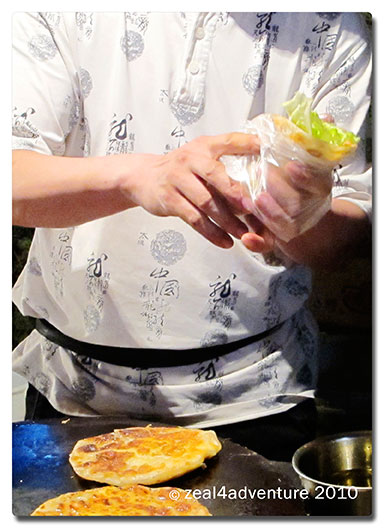
Before taking a cab back to our hotel, we came across this stall selling some sort of a wrap

made up of char siu pork and fried egg with some sort of sweet-savory sauce and lettuce to finish off.

Better then the breakfast offerings at the hotel.

Beijing : The Old Meets New

If the last time you were in Beijing was 15 years ago,

you’d also be surprised at how they have managed to preserve its ancient past even while it transforms into a modern metropolis.

Walking along Wangfujing Avenue, I notice a smattering of bicycles reminiscent of the Beijing I last saw, still pedaling down the streets but is more and more being replaced by cars and buses.

Modern buildings and malls line the streets of Beijing along side stunning ancient eastern architectures. The capital of China with 3,000 years of history is today a dynamic city where the old and new intermingles and is a magnet for local and foreign visitors. It remains the People’s Republic of China’s center of politics, culture and economics.

Great Wall

Great Wall – Juyongguan Pass

A visit to Beijing will never be complete without the imperative call to the Great Wall.  It was the reason for this trip putting aside the good eats, that is.  My nephew wanted to see the Great Wall, after taking it up in school and thus a family vacation was mounted.

Packed with tourists

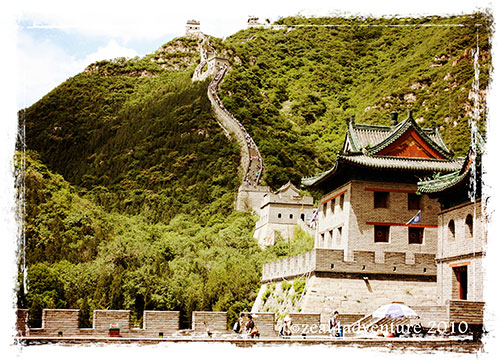
So to Juyongguan Pass (also called Juyong Pass) we went one morning.  It is the nearest section of the Great Wall to Beijing, a little nearer than Badaling, the most popular section of the Great Wall.

Juyong Pass does not however escape the same glut of souvenir shops and a number of other tourist traps that Badaling has.  But if convenience, keeping transportation simple and time management is of importance, both these passes are the best places to get a feel of the walls’ more than 2,000 years history.  In fact, as early as the 13th century, the area of Juyong Pass was known for its beauty and was listed as one of the eight “great sights of Yanjing”.

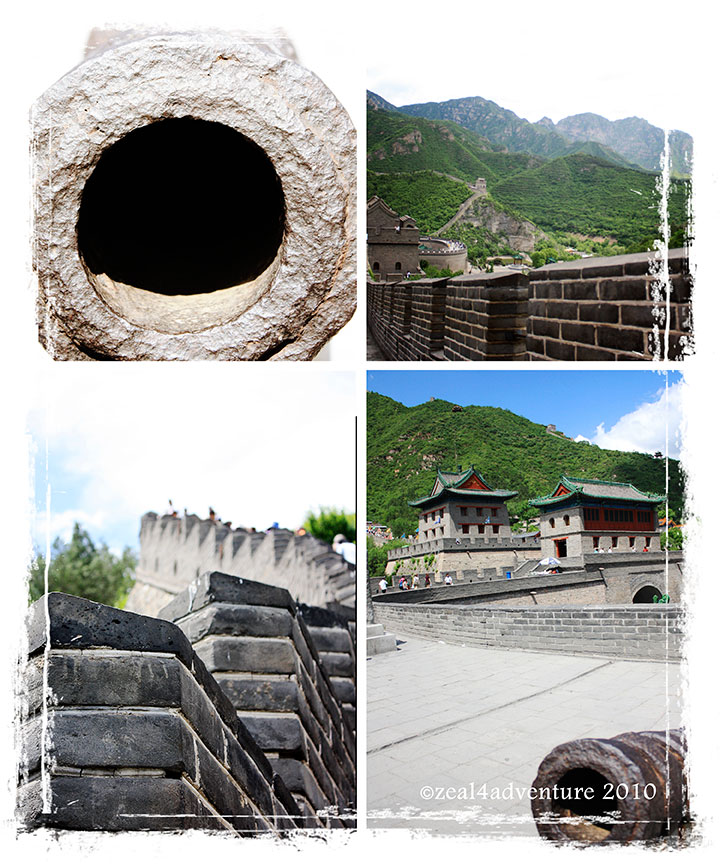
Aside from its easy access, its steps starts off from the same level as the parking lot so there is no need to climb or take a cable car to reach the wall.

It however rises steeply on both sides of the gate

The view from mid-way to the 1st watchtower

Our goal that never was.

– a reason why we never even reached the first watchtower.

Once a strategic military garrison, this 20 kilometer-long valley,

stretching along the ridge of incredibly steep mountains was considered important in the defense of Beijing in the ancient China.  These mountains that flanks the valley can definitely be credited for the beauty of the pass.

If you are looking to see authentic “Ming Dynasty” walls though, this is not the place to be as a short expanse of the wall has been recently restored.  Simitai might be a better option since it is virtually unreconstructed and is listed as a UNESCO’s World Heritage Site.

More of Beijing in my next posts.   🙂

Scenic Sunday

Ubud for Kids?

Ubud only have a few places suitable for young kids.  This however being our annual family vacation, the kids were with us.  We indulged them and went to a few kid friendly places.  On their last day, we indulged them even more and had them stay in to play and swim to their hearts desire.  I’m sure they enjoyed that the most.   😯

So if you have kids and HAVE TO bring them to Ubud with you, here are some of the places that they might enjoy.

The Sacred Monkey Forest

monkeys-1

This place is full of long tail Macaques.  Within Balinese Hinduism, monkeys can be the embodiment of positive and negative forces, which is why the Balinese both loathe and revere these monkeys.  Monkeys that occupy sacred Balinese Hindu temple sites (such as this place) tend to be revered and protected by the Balinese because monkeys are believed to be capable of guarding temple sites against evil spirits.  They, however become a negative force once they start raiding rice fields or snatch items from souvenir shops.

monkeys-2

Some of the trees here are likewise considered holy and are vital in various Balinese practices.

This is good information but the young ones will surely find fascination in the monkeys.  Period.

Elephant Ride

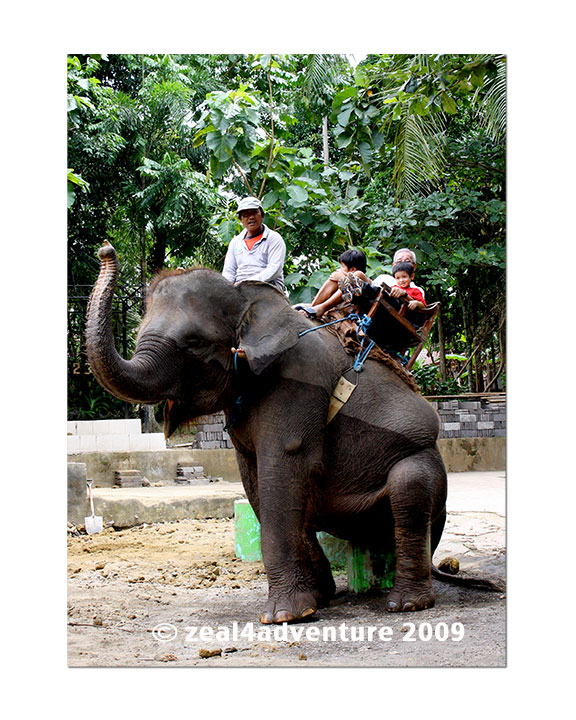
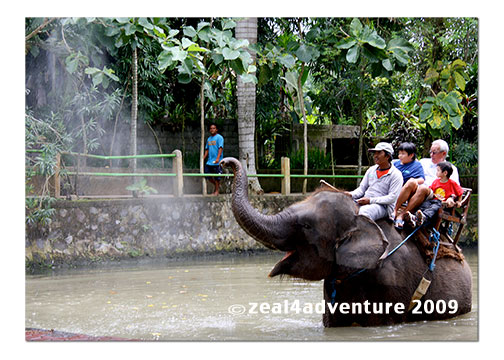
elephant-1Experience sitting atop an elephant in a teak wood chair.  These trained elephants are native to Sumatra.  Apparently, there are 2 different places to see these jumbos and that is the Elephant Safari Park at Taro and Bali of Elephant Camp, where we ended up.  I didn’t realize that there were two places and when our driver/tour guide took us to the latter I just assumed it was the former.   The 30-minute ride at the camp had the kids wired and the grandfather sore.  Unfortunately, there was no elephant show much less the painting elephants as these are found on the one in Taro.

elephant-2

Ubud… Second time around

I’ve been to Bali 3 times in the past 2 decades.  Twice for work and once tagging along an incentive trip of an ex.  Each time was spent on a beach resort, Nusa Dua to be exact.  My first and only time in Ubud prior to this trip was in 1991.  A day trip only.  Almost 2 decades later, here I am experiencing Ubud like it was my first time.

Ubud is Bali’s cultural enclave, where one can find artists’ studios & galleries, rice fields, ornate temples and ancient historical sites.  While it once was an oasis for backpackers, artists and bohos, Ubud is now a popular destination for literati, glitterati, art collectors and connoisseurs.  Elegant 5 star hotels and sprawling mansions now stand in the outskirts of Ubud.

ubud-dance

So without further hoo-ha, here’s a list of places that deserves a thumbs up (according to me)!

The Crispy Duck of Bebeck Bengil:

dirty-duck1

Lines were long even at 1pm.  Obviously a popular eating joint for both locals and tourists alike.  Service was slow and quite inefficient.  But the (long) wait was worth it.   The duck was very tasty.  Crispy yet juicy – fried to perfection, if you ask me.  It didn’t look very appetizing but it definitely had me at first bite.

Dinner at Lamak Restaurant and Bar:
lamak

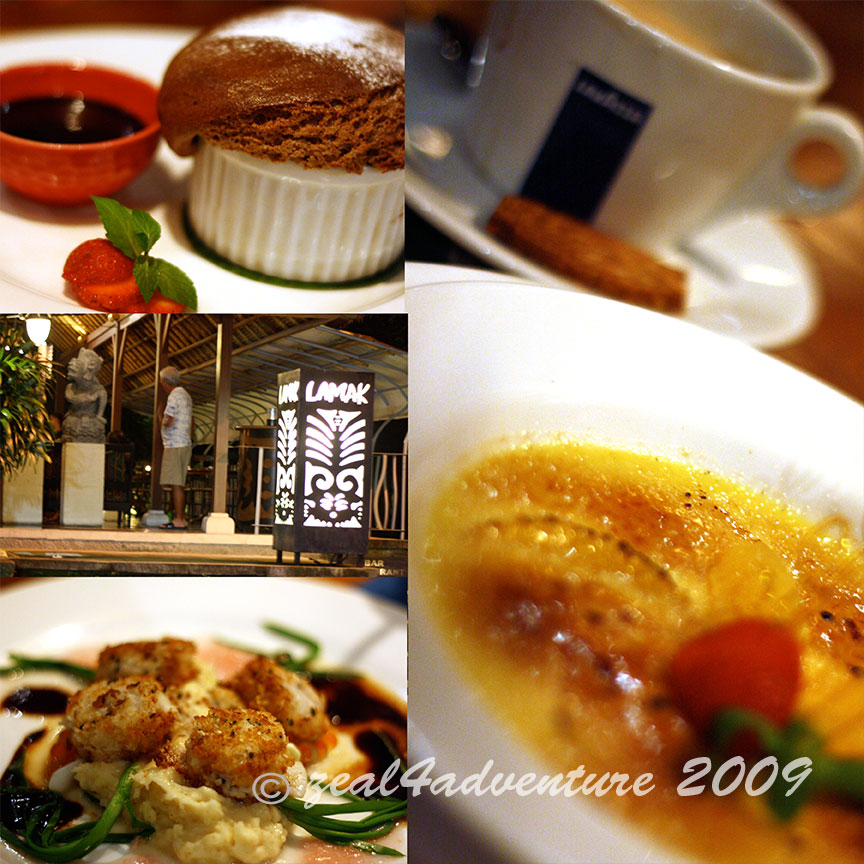
Hands down the best meal of our entire stay.  Located along Monkey Forest Road, they serve excellent fusion dishes like Tea Infused Duck Broth with dumpling and Sesame crusted Scallop w/ Kung Pao Sauce.  And desserts like Orange & Ginger Bruleé, Chocolate Soufflé and Chili ice cream.  Nuff said!  My dad actually wanted to return for lunch or dinner the next day.   😀

Pura Puseh Temple, Batuan Village:

pura-puseh

Considered to be one of the finest and oldest temples in Bali. The temple dates back to the 11th century and has many fine carvings. This Balinese village of Batuan possesses one of the richest cultural legacies on the island.  Renowned for some of the finest music, dances and sculptures in all of Bali, it has performances twice a month of the Gambuh, a rare ancient dance drama.  Regular performances are held on the 1st and 15th of every month.  Nope, we didn’t catch it; it was the wrong time of the month.

Ubud Palace / Puri Saren Agung

ubud-palace

Set in the center of Ubud, across the Ubud Central Market.  This is the palace of the Royal family that ruled from the late 1800’s until World War II and is essentially the father of other Ubud Palaces or Puri, as the locals call it.

When we arrived, a portion of the palace was closed (for unknown reasons) but the little that I saw of the grounds impressed me.  The garden was beautifully kept, the old stone gates and the statue guards in that familiar checkered cloth skirts were main points of interest.  Definitely worth a revisit.

The front courtyard is open to the public during the day and a traditional dance performance, the Legong Dance is held here every night.  Interesting to note, some of the pavilions have been turned into hotel rooms for those who want a glimpse of the Royal life.

Shopping!!!

shopping-in-ubud

Along Monkey Forest Road and Jalan Raya.  Fantastic and extremely varied.  You can find all kinds from ancient antiques to whimsical trinkets.  Shops upon shops filled with sarongs, woodcarvings, paintings, souvenirs, jewelries, incense potteries…  It’s a shopping haven even if I had to put my rusty bargaining powers to use.  For many, bargaining is an art and is what makes shopping fun… not for me as patience is not my virtue. Wahaha!   😛

Maya Ubud – A Haven of Tranquility

mayaubud-1

Our home for 4 days.  Let’s just say I can afford it because I wasn’t paying for it.  If you like the finer things in life and prefer traveling luxuriously as my family does, Maya Ubud is for you.

maya-ubud-2

Reviews says that it is a cut above the rest and rightly so.  Located high between 2 river valleys, set in sprawling lawns and gardens, Maya Ubud is indeed a haven of tranquility.  All villas face the river, and the sound of the river brings such serenity.
maya-villa

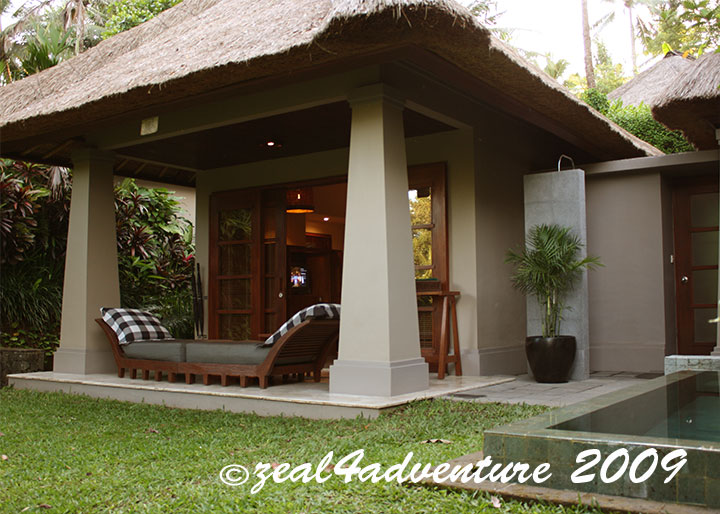
I adore my villa and the daybed outside my room.  I spent a lot of time reading on that comfy daybed.  It is pure bliss to be able to just relax and read my book.  The greatest indulgence however was a relaxing bathing experience in the privacy of my bathroom.  For US$15, I had a personal assistant prepare my bath.  When I arrived from dinner, there it was, all ready for me.  I just had to slide in and enjoy my book some more before I slumbered off.  Now that’s what I call capping the day.  And the best part is that they provided an extra set with their compliments and for 2 straight nights I bathe in tranquility.  Such is life!   😉

maya-bath

One thing I didn’t get to do was try the award winning spa.  It was kinda duh of me but I just couldn’t bring myself to pay for something that I can get in Manila for a quarter of the price.  Could anything be that worth it?  Regretfully, I’ll never know!  😦