El Nido: Island Hop Day

“The best island destination of Southeast Asia” was how National Geographic Traveler Magazine sized up El Nido in its November-December 2007 issue.  And has since been dubbing it as one of the best travel destinations.  Alex Garland’s “The Beach was inspired by El Nido, many say.  The Amazing Race, Bourne Legacy… it’s becoming a Hollywood favorite as well and for good reason.
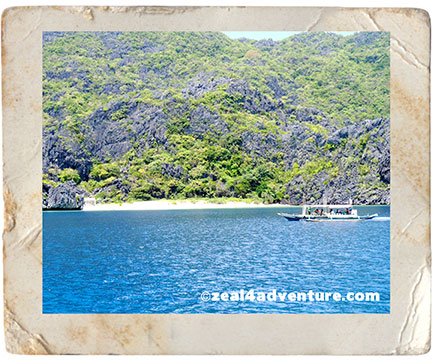
Majestic karst limestone formation, enchanting lagoons, marble cliffs, lush forest, white sandy beaches, clear blue waters, wonderful marine life… all these epitomizes the Philippines’ so called “Last Frontier”.

Shops along the main streets of the town center offer the same A to D island-hopping tours.  To be in El Nido and not do these tours is like going to an ice cream parlor and not have ice cream.
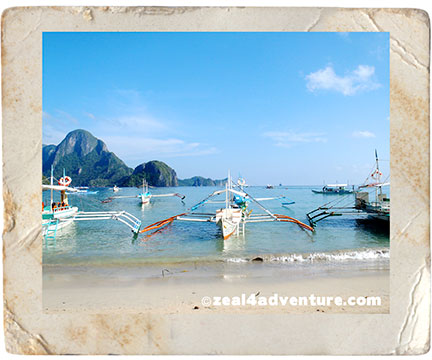
It is after all the gateway to Bacuit bay—
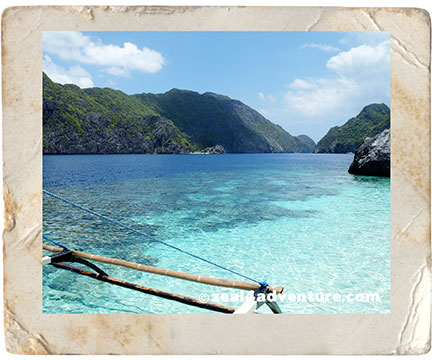
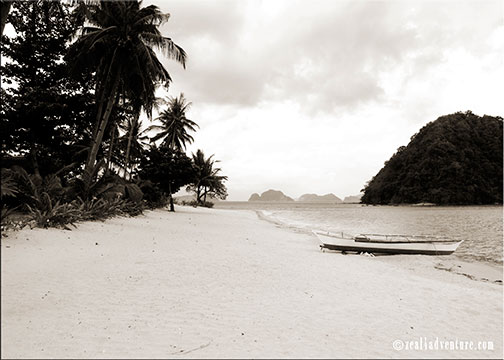
an exquisite nature gem scattered with limestone islands with stretches of white sand beaches and hidden coves.

Mang Rudy promised a good lunch in his tour and so, together with the French friends we met coming to El Nido, we booked a tour with him.
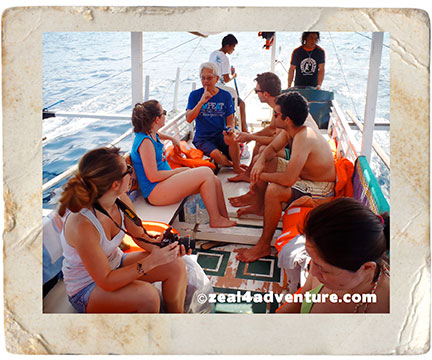
Tour C— because it was my favorite tour the last time and because the our French friends wanted to see “Secret Beach”.
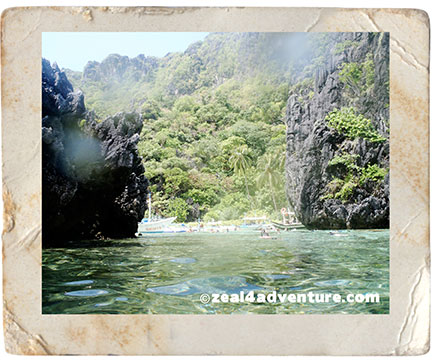
First on the agenda was Hidden Beach on Matinloc Island and the farthest from town.
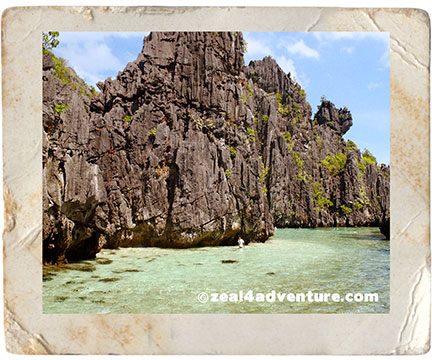
Beautiful beach with lush vegetation hidden behind towering limestone cliffs hence the name.
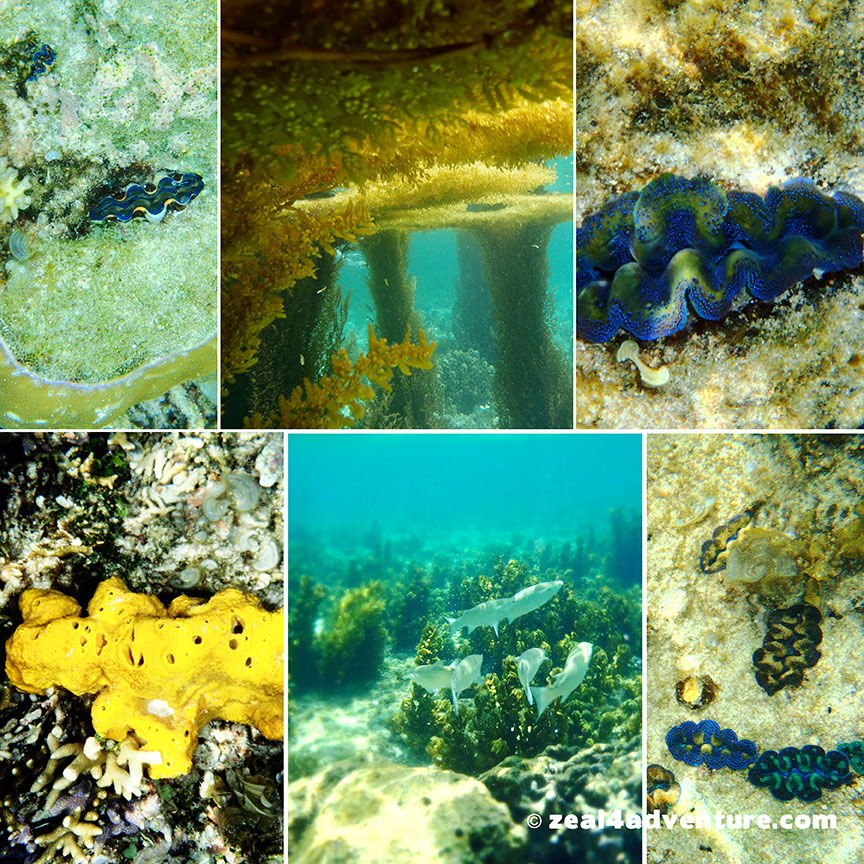
We did some snorkeling but didn’t step foot on the beach.

Matinloc Shrine, our next stop, is on one side of the island.
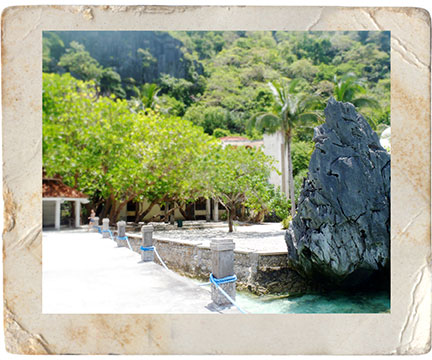
The shrine is a two-storey building towering in one corner and a concrete gazebo at the center of the site.  Abandoned, the shrine is not in good condition but remains part of the tour— most likely because of its remarkable scenery.
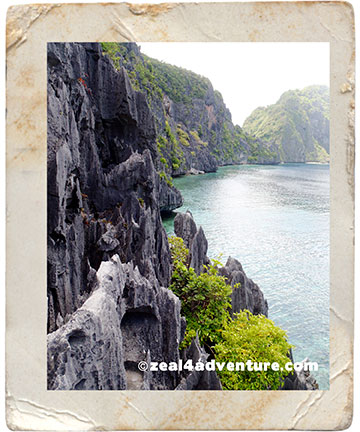
In front of the building stands a limestone cliff with a stunning view of the nearby Tapiutan Island and other beaches of the island.
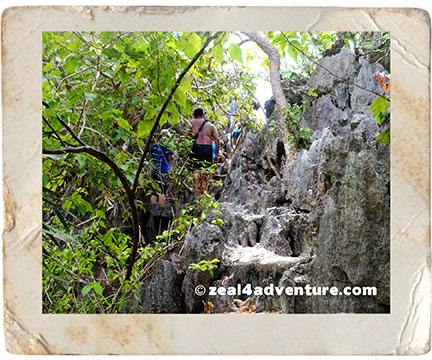
One has to climb the cliff to see the view while relatively easy; the sharp limestone edges can easily cut.  So be careful.
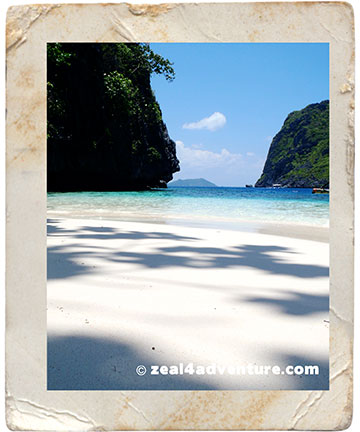
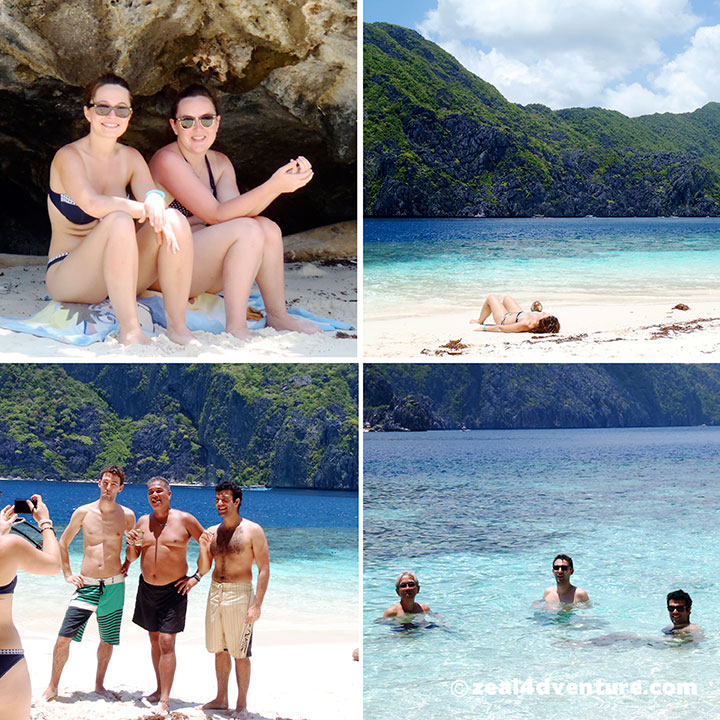
A beautiful tiny cove, Shumizu Island, which we had all to ourselves, was where we stopped for lunch.
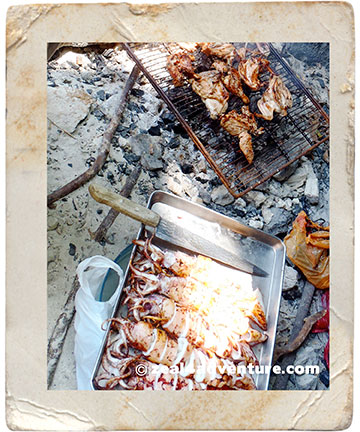
While the food was on the grill, we enjoyed the sun, sea and sand.
Lunch was a wonderful feast of grilled chicken and squid alongside a refreshing cucumber and tomato salad.
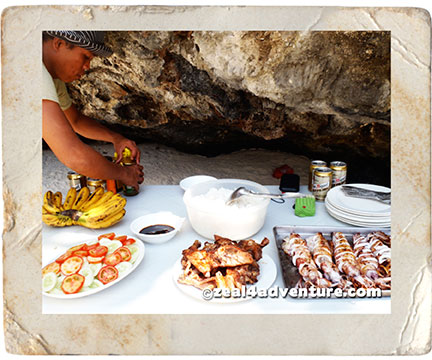
Thank you Mang Rudy, we were not disappointed.

Matinloc Island has a Secret Beach.
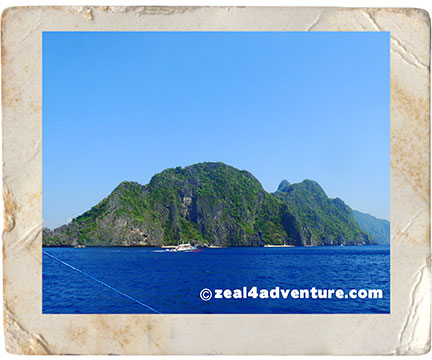
Inside the steep rock wall is an enchanting beach inaccessible by boat.
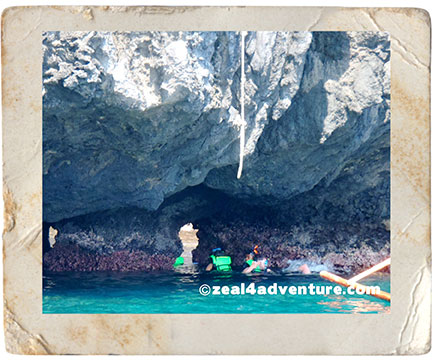
The only way to enter this secret beach is through a small crevice, which during high tide is submerged earning its name.  When submerged, one has to swim through the crevice underwater making the reveal more dramatic, truth to tell.

This particular beach is said to have been the inspiration to Alex Garland’s “The Beach”.  It is easy to understand why.
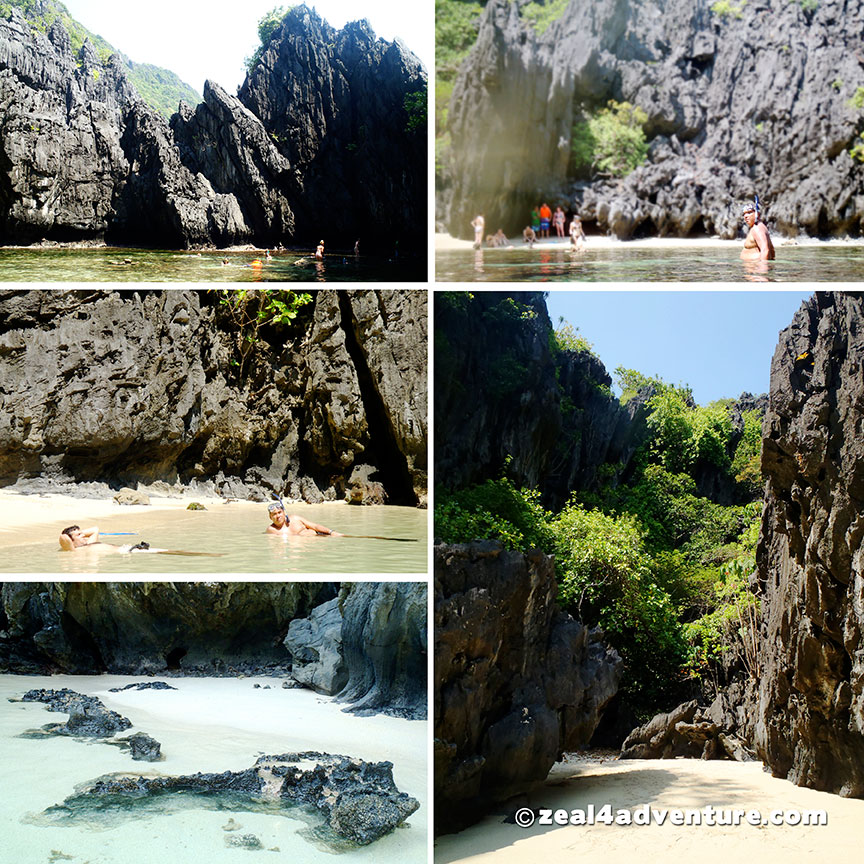
Inside those walls is another world, a secret paradise, if I may call it that.  It is a sight to behold and this, dear friends, is why Tour C became a favorite.
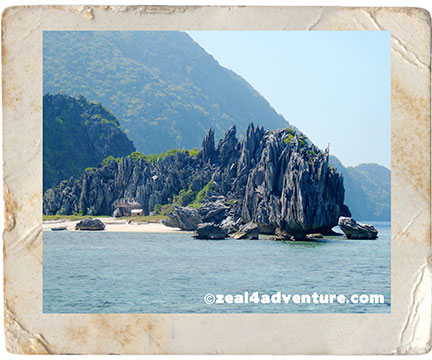
Fronting the Matinloc Shrine is Star Beach.  I particularly love the rock formation in front.
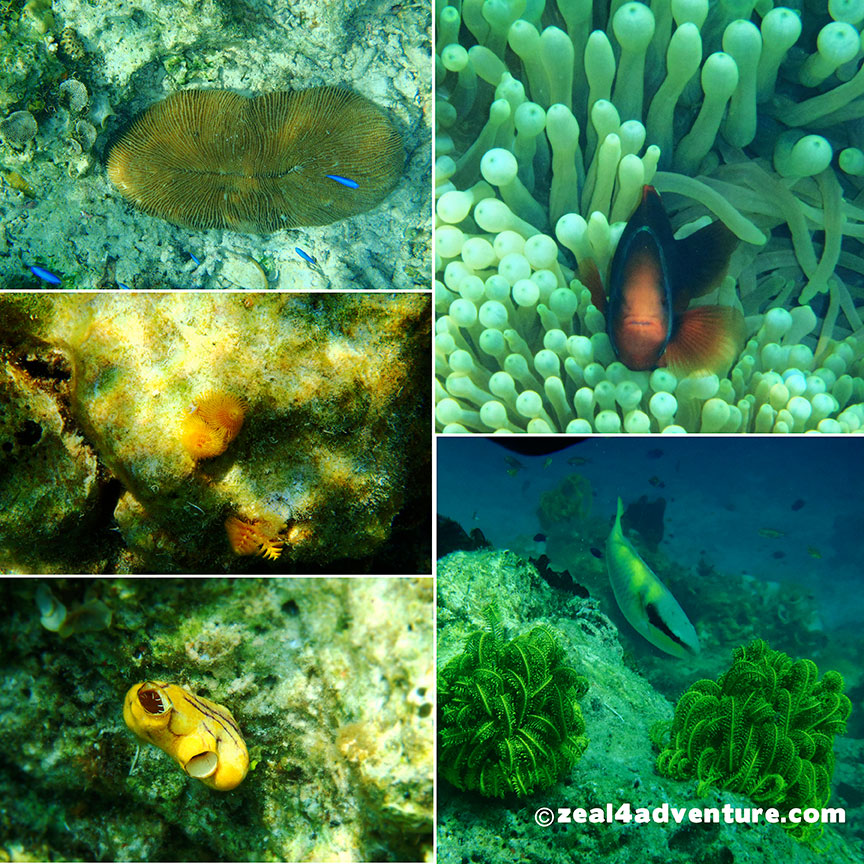
The reef nearby is a great snorkeling spot owing to good coral beds and the abundance of marine life.
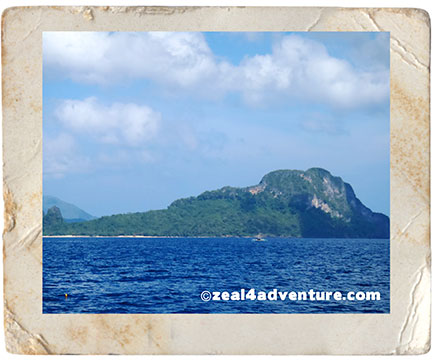
Capping this tour is a stop at Dimalicad Island, better known as Helicopter Island because of the shape it resembles from afar.
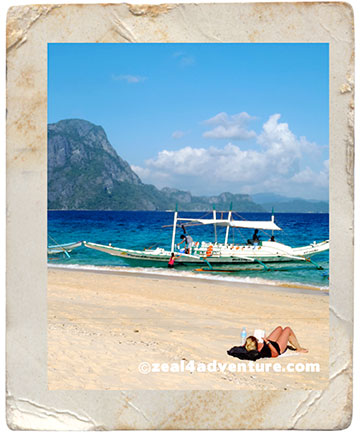
The long stretch of sparkling white sand beach makes it ideal for lounging around with a good book or sunbathing perhaps.
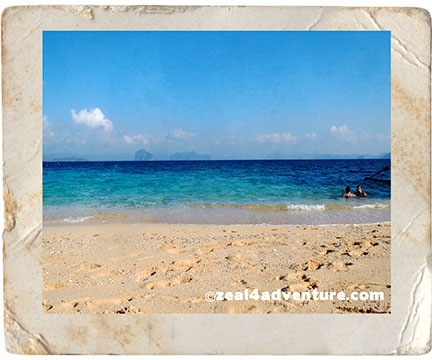
Although the water beckons for a swim, the waves can be strong for some.
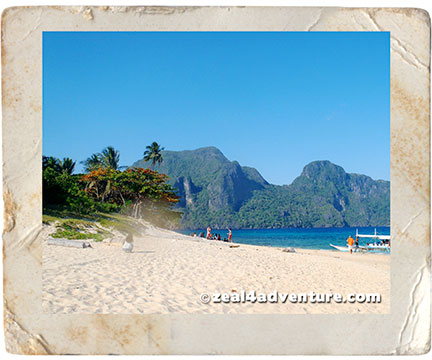
They couldn’t have chosen a more perfect cap for the day.
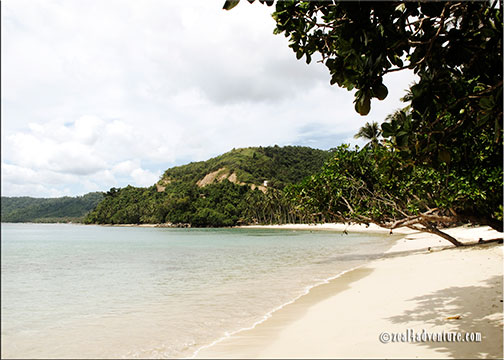
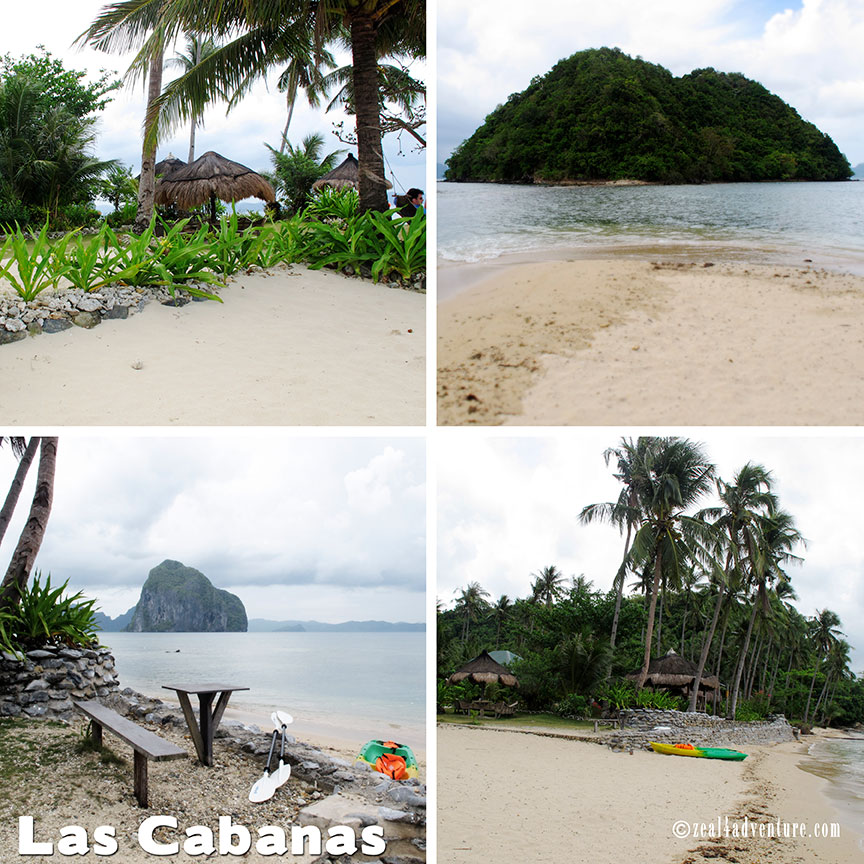
Of Cabanas and Good Books

A free day to lounge around, we got tips from Mang Rudy and the guests next door.  Corong Corong Beach, south of El Nido, came highly recommended.

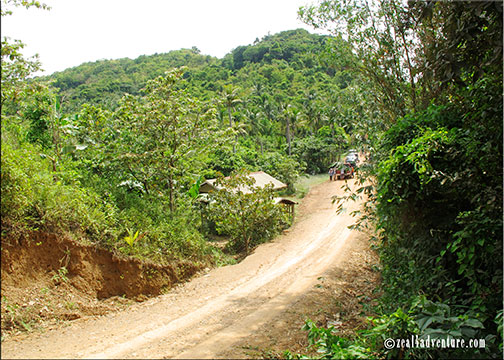
Las Cabanas Beach Resort, we told the tricycle driver and we got dropped off a dirt road.

He said to just walk down till we end up on the beach.  Las Cabanas will be on the left side.  He will pick us up in the afternoon.

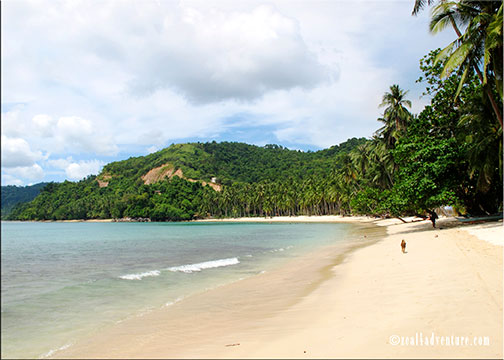
Just 3 kilometers south of El Nido town center is a gorgeous stretch of white sand beach, not quite Boracay-fine but fine enough for me.

Still part of the Bacuit Archipelago, the panoramic view of the distant islands and the peaceful environment makes for a relaxing get-away from the hustle and bustle of town.  It is definitely more private, a lot quieter, unadulterated still.

We followed the driver’s instructions, we walked pass a resort which looked charming enough for us to want to stay.

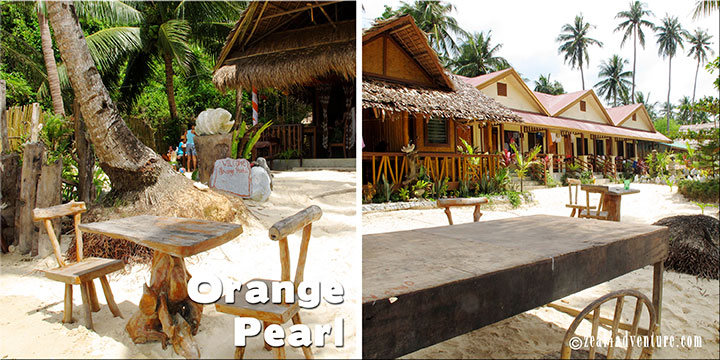
Orange Pearl has a few beachfront cottages and a restaurant that served simple Filipino food.  I was happily considering pancit.  We, however, decided to walk the rest of the strip and alas, we arrived at Las Cabanas.

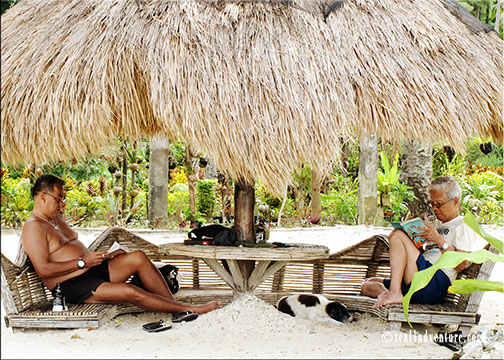
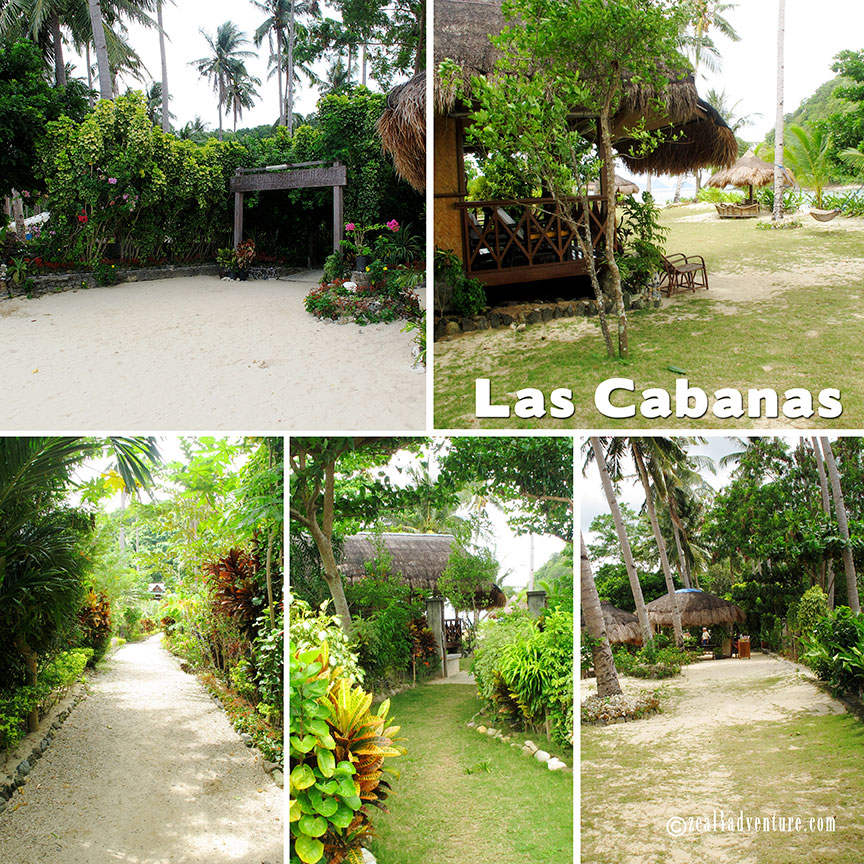
So much more cozier with beachfront cabanas calling our names.  There were hammocks too.  What a find… perfect place to chill with a good book.

I snooped inside and was impressed with the lushly landscaped grounds.  I catch sight of what seemed like well-appointed cottages.  A nice, quiet place to escape the crowds, if that is what’s preferred.  Lunch was quite good – served family style.

Guests leaned towards families – tranquil waters and a secluded beach plays a big part for sure.

Facing west and unobstructed, Corong Corong is known for its glorious sunsets the same way the town isn’t.

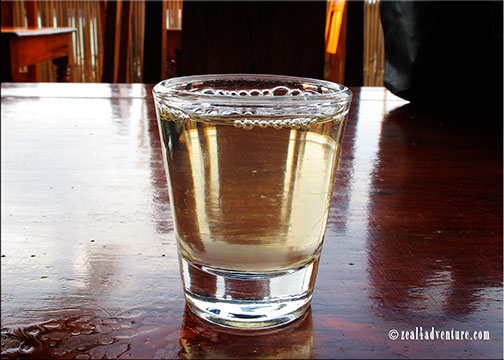
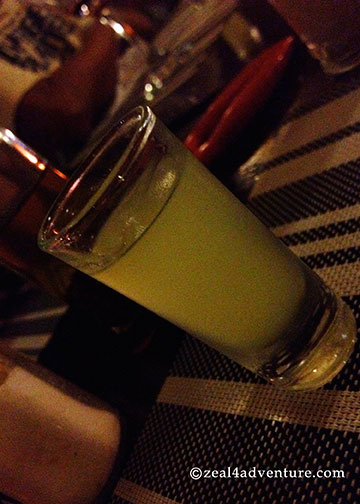
We however decided to miss the sunset and head back to town early, take a nice shower, enjoy a shot or two of the ginger-flavored rum at La Salangane before devouring a delightful “brick-oven” pizza.  A good reason to miss the sunset, you think?

Rugged Mystique

Credits: Papers from SDynes Christmas Treasures Mini Kit; Frames from Orchbroom Mask and SDynes Christmas Elements; Floral Elements from Sahlin Studio’s Story Telling kit (sc flowers).

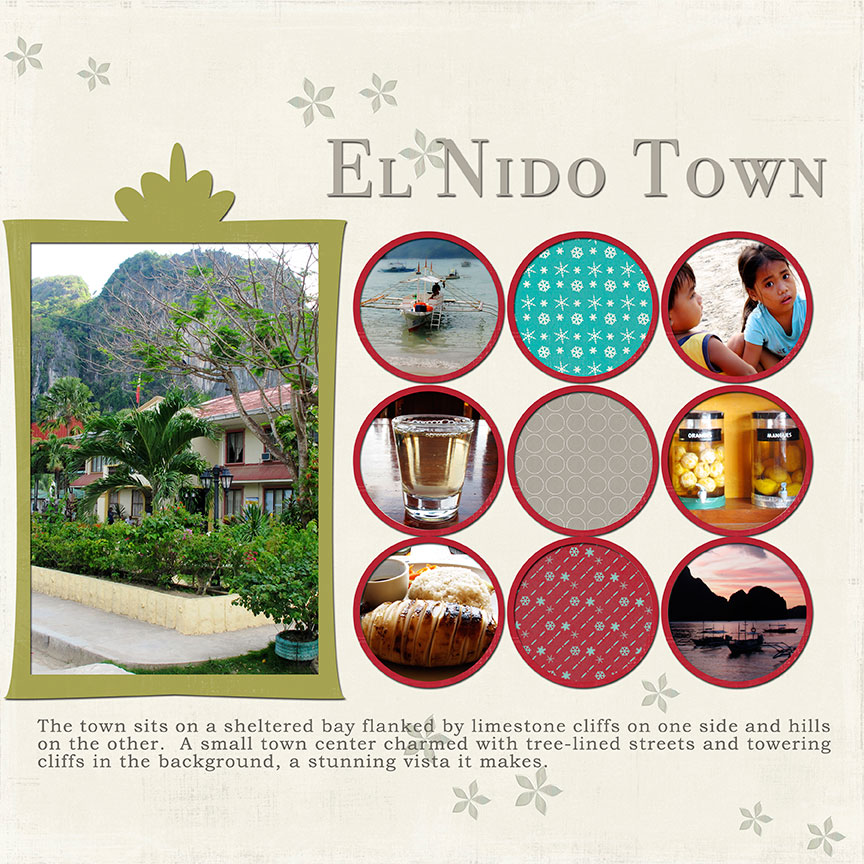
Bewitched.  I can’t seem to put my finger on it but there’s something about the town of El Nido that has left me enchanted from day one.

The town sits on a sheltered bay flanked by limestone cliffs on one side

and hills on the other.

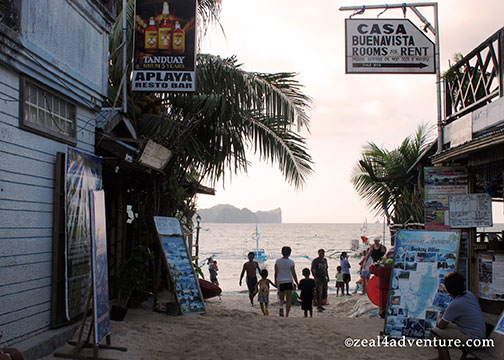
A small town center charmed with tree-lined streets and towering cliffs in the background, a stunning vista it makes.

It still is very much a backpacker’s town really and it is this laid-back backpacking atmosphere that lured me back to many years after.

This charming fishing village in the northernmost tip of the Palawan Island often is referred to as the Last Frontier due to its rugged mystique.

How time flies… it took me 8 years to come back to one of my favorite towns.  I still remember many details of the town like it was yesterday.

El Nido has turned into a touristic town and I see that more exciting places to eat and stay have sprouted everywhere.

Madali ang pera dito kung masipag ka”, says Mang Rudy.

The opportunities are endless with tourism at the forefront here at El Nido and money can indeed be easy if one works hard.

The one place I would have loved to go back to, we heard no longer serve meals on a regular basis.  Walking to town, we unwittingly found the house so we entered the half-opened gate and were told that they don’t accept dinner bookings anymore.  We took it as that.  On hindsight, I am not sure if they meant that they were already full for the holidays or that they weren’t serving because it was a holiday.  Having seen many closed shops and restaurants around Palawan during Easter break, this will not come as a  surprise.  Elm St Café is a cozy dining place set in a beautiful garden amidst a limestone backdrop so beautiful when lit at night.  The owners opened their home along Rizal Ave. and they served meals to those that booked in advance – usually a surprise, depending on what is found in the market that day.  They were the best of the best then, the ambiance and the element of surprise added to the experience and memories.

Not to fret though as there are a whole new lot to choose from, we barely scratched the surface, I think.  And here are some that caught our fancy.

La Salangane – more than the French meals, what had us coming back were the homemade flavored rums.

Ginger, apple, pineapple, pears, oranges, mangoes, even pepper –

wonderful flavors enjoyed in a relaxed atmosphere overlooking the Cadlao Mountain by the beach.

Made more special over sunset.  This is THE place to get your espresso fix as well.  Many of the places in E Nido, including our inn, do not even serve brewed coffee.

The Alternative Restaurant – mentioned by some French tourists we met on our way to El Nido, we decided to give it a shot.  The place was not easy to find as it does not look like much from the outside and we kept walking pass it.

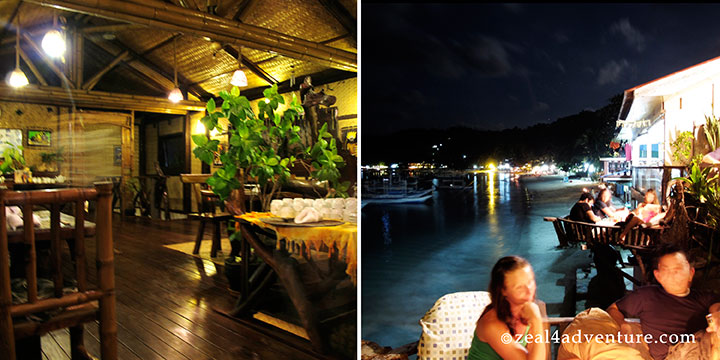
On the 2nd floor though where the restaurant is, the ambience turned to cozy.  At one side overlooking the sea, a few sunken oval seats resembling a “bird’s nest” overhangs the beach – a cool place to hang out and watch the sunset, me thinks but A wasn’t as confident that the structure would hold us so we got ourselves a table instead.

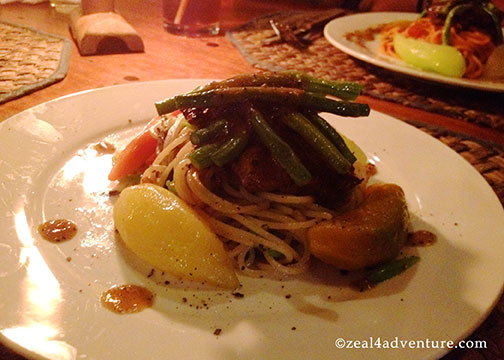
Despite an extensive vegetarian choice, I had a pork dish with pasta – and it was pretty good.  Our French friends though were not as impressed.

Altrové Trattoria – saving the best for last.  This Pizzeria was the best of the lot in my books.

Made of fresh dough and cooked crisp in a brick-oven is perhaps the best pizza in town.  The place, unlike The Alternative, is hard to miss.  Beautiful façade of a place, the brick oven proudly stands at the ground floor.

A nicely decorated second floor is where the dining area is.

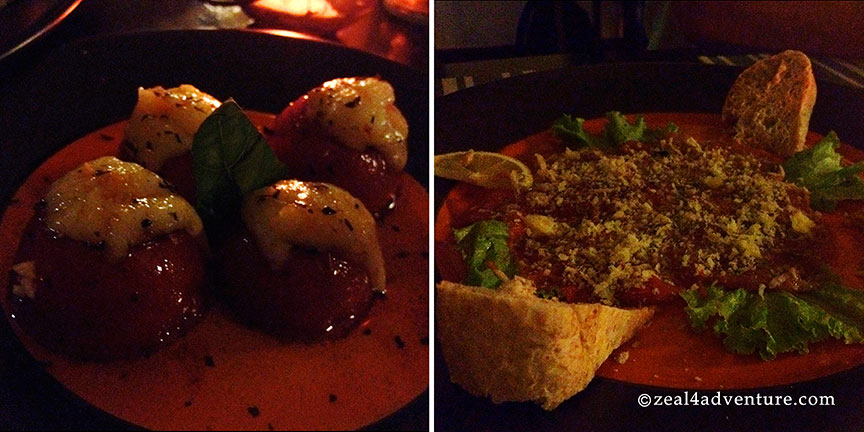
We enjoyed our antipasti of Beef Carpaccio and Baked Tomatoes on Mozzarella.

The seafood pasta dish was divine and the pizza, wonderfully crusty.  And to cap the evening… Limóncello, how can I not love this place?

To serve Limóncello in a town like El Nido, where electricity only runs from 2pm-6am, was impressive.  And this, dear friends, has easily landed on the top of my El Nido list, dining-wise.

Useful Info:

La Salangane
Serena Street
Barangay Buena Suerte
Contact:  (63) 916-648-6994
Email:  info@lasalangane.com
 
The Alternative
Serena Street
Barangay Buena Suerte
Contact:  (63) 917-896-3408
 
Altrove Trattoria
Hama Street
Barangay Masagana
Contact:  (63) 927-741-8016 
 

Random Travel Snaps: Spotted Eagle Ray

Photo courtesy of R.Rellosa

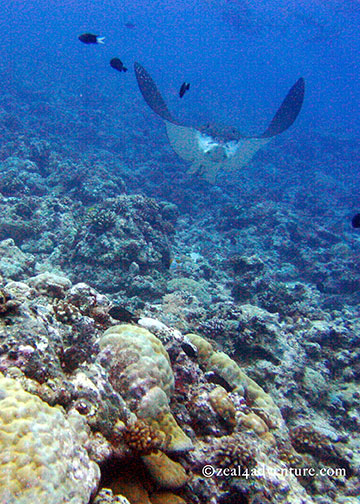
Somewhere near Blue Corner off the waters of Palau, a creature gracefully glided its way towards us.  It was my first encounter with rays and it was intoxicating.  Stupefied, I watched its flat disk-shape body with its soaring wings fly towards us.  It was identified as a Spotted Eagle Ray because it has white spots on its deep blue body.  Their long rounded snout, almost like a pig’s snout, distinguishes it from other rays.  The one encountered was quite big but it is said that a Spotted Eagle Ray can grow to nearly nine feet (3M) from wingtip to wingtip.

Rays are some the most fascinating creatures to soar through the world’s ocean and they are found worldwide in tropical waters, most commonly in shallow inshore waters, around reefs.  To come across them in Palau is quite common, thanks to the island formation and currents.  Made up of over 100 islands with low-lying oval islands ringed by barrier reefs, it is world renown for its marine bio-diversity.  Outside of the pelagic (such as sharks and rays), the water is teeming with barracuda, jacks and tuna.  Over 600 coral species smother the reefs overflowing with small fish.  Definitely a must for every diver.

As a new diver in 2007, my trip to Palau was a series of firsts – it was my first time to dive outside of the Philippines, to drift in strong currents, to use a reef hook, to see big fishes like sharks and rays…  And these firsts gave me the confidence underwater.  But truth be known, that Spotted Eagle Ray made my Palau dive experience impossible to forget.

A Leisurely Stroll Through Luang Prabang

Credits: Papers by Sahlin Studio’s Sweet Story Telling papers, Creativity by Crystal’s Room Collection Solids; Elements by Sahlin Studio Sweet Story Telling Kit.

It was a beautiful ordinary day.  No agenda, we just played it by ear, went with the flow.  The plan was to leisurely walk the streets and see where it takes us.

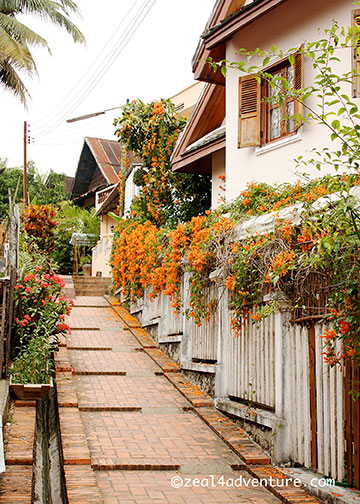
The serene atmosphere of this enchanting city begs for nothing more.  Having strolled down these streets before, it was interesting to see new ventures turning up while many stayed the same.

Luang Prabang lies in the heart of the mountainous region of North Laos.  Also known as the jewel of Indochina, the ancient royal city sits between the junction of the Mekong and the Nam Kahn Rivers.

And our nice little boutique hotel, Villa Deux Rivieres is situated somewhere near the junction in Kingkitsareth Rd.

Monks with their signature umbrellas in Sakkarine St. — a quieter part of town.

Great location as it really is just a short walk away from many places of interest and the main street, Sakkarine,

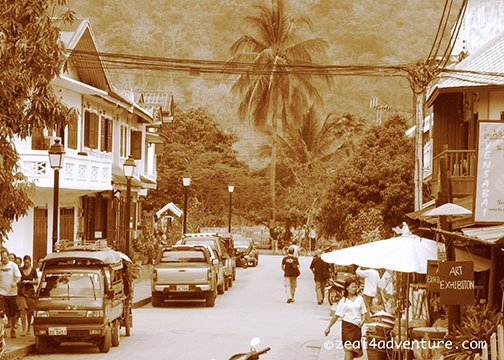
The busier street of Sisavangvong has more tuk-tuks and motobikes lining the streets.

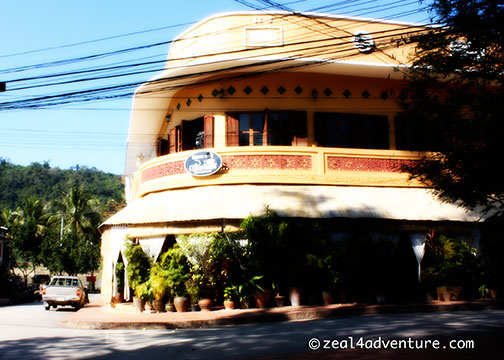
which turns into Sisavangvong St. if you walk further.  We spent a lot of time in Sakkarine St. browsing, sometimes buying from the many little shops or relaxing in several of the cafes lining the stretch.

Café Ban Vat Sene across the charming Wat Sene and Le Banneton with its wonderfully crusted breads are our favorites hang-outs.  We sat outdoors and enjoyed the cool air and the easy going vibe of the town.

Those breads lured us to Le Banneton

Caruso Lao never fails to lure me in each time we walk pass it.  Beautiful stuff on display, a bit pricey but well worth the workmanship, me think.

And look what I have displayed at home.  There could have been more, if freight wasn’t so ridiculously high.

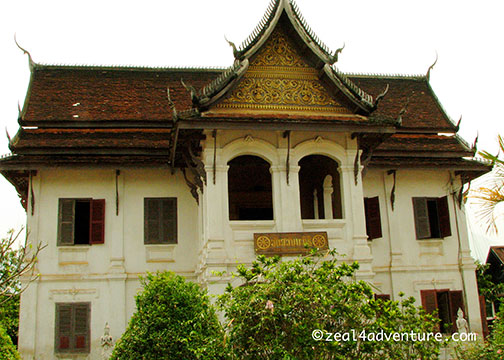
Comprising this enchanting little city are ancient structures, a Royal Palace, a National Museum,

Wat Sene along Sakkarine Rd.

and a concentration of golden temples they call Wats, all thirty-four of which have been listed for preservation.

Luang Prabang, a UNESCO World Heritage Site since 1995, is undoubtedly rich in cultural heritage and has both historical and natural sites to boast.

Traditional wooden dwellings and old colonial style houses fused into a distinct cultural tradition with beautiful landscapes that surrounds.  Mount Phousi perched in the middle of town showcases stunning views of the surrounding temples and hills.

It is a city where time seemed to have stood still.  The old town (their historical district) in particular has an old world charm,

reminiscent of the 1940’s where bicycles dominate and colonial style interspersed with traditional houses line the streets with some vintage cars even.

Small enough to explore by foot, we started our stroll at our hotel in Kingkitsarath to the bank where Khan and Mekong meet. The street, as in many in Luang Prabang, becomes Khem Khong or Mekong Rd at some point.

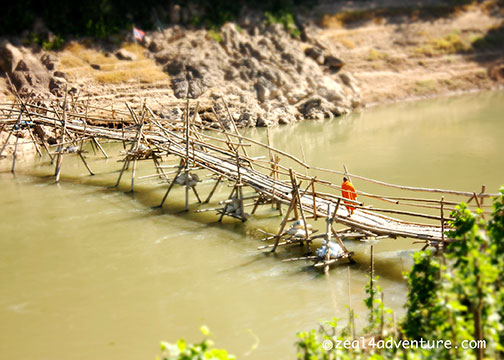
At the confluence, a path led to the river below where a wooden bridge stands.  Across is a handicraft and weaving village that one can explore but we didn’t venture out there anymore.

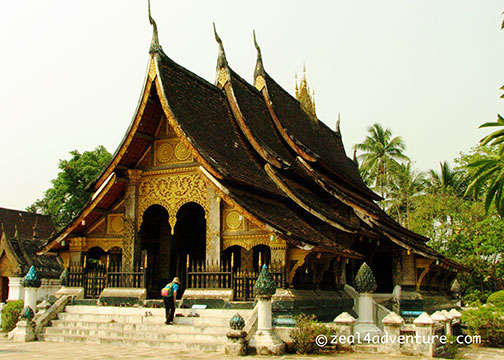
Instead, we continued on Khem Khong to get to Wat Xieng Thong – perhaps the most magnificent but definitely the most important and impressive of Lao temples.  There is a cluster of  ancient buildings dating back to the mid 16th century.

At the back of Wat Xieng Thong is a tree of life mosaic in colored glass.  Anyone with a keen interest in Lao history should not miss the religious artworks and artifacts housed here.

When it was time for lunch, we went for L’Elephant, an institution in its own right in Luang Prabang.  Menu was mostly French.

For starters we had a refreshing Carrot and Orange Salad and a superb Escargot baked in Garlic and Parsley Butter – cooked the way we like it.  For main, I had the Mekong Perch in Coriander Sauce and A had Stuffed Roasted Boneless Quail.  I say fine dining at its best in Luang Prabang.

The laid back, open-air atmosphere with high ceiling fans half expects you to see Rick Blaine come out and entertain.

In between lunch and a traditional lao massage, we explored more of Khem Kong, definitely a very quiet street where many upscale hotels are located.

Khem Kong facing the Mekong

 One of many roadside restaurants with a view of the Mekong or the Nam Khan

We then visited the Haw Kham, which is now known as the National Museum.

Once the Royal Palace, the building is a fusion of Traditional Lao and French design.  It houses an impressive collection of royal memorabilia and religious artifacts.

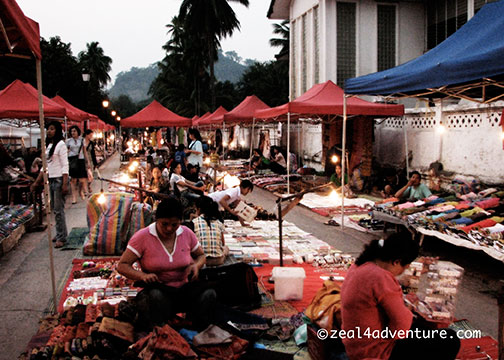
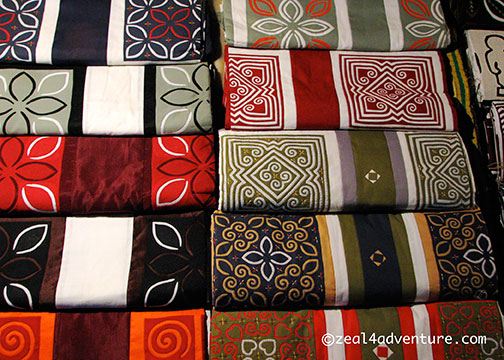
Every night, Hmong people come dowm from their villages in the mountains to sell their hand-made products,

typical Lao arts and crafts that include appliquéd blankets, silver jewelries, embroidered bags and a lot more.

A short walk-through here is more than adequate if a bargain hunter you are not.  They  have interesting and tasteful designs at a bargain, the quality is another thing though. But I guess you get what you pay for.   🙂

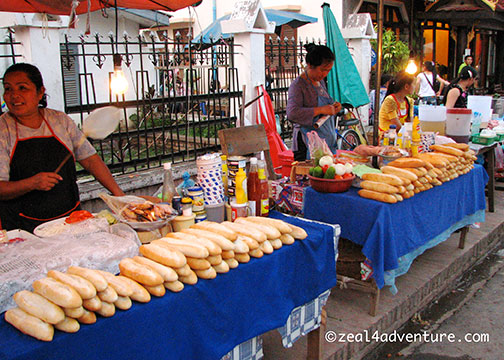
Many of the stalls here sell Lao street foods but we had our eyes set on Mango Tree in a quieter part of Sakkarine St.

Suffice it to say that dinner was fabulous.  Superb Lao dishes plated beautifully and served in a casual garden setting.

An extraordinary meal to cap an ordinary day, I must say.

So tell me, how can you not fall in love with Mekong’s jewel, its beautiful people,

its heritage and its shabby chic French fused Lao architecture that is so uniquely Luang Prabang?

Useful Info:

Villa Deux Rivieres
Kingkitsarath Rd., Ban Khily
Luang Prabang, Laos
+856 207737 8575
 
Cafe Ban Vat Sene
Sakkarine Rd.,
Luang Prabang, Laos
+856 71 252 482
 
Le Banneton
46 Sakkarine Rd., (opposite Wat Sop)
Luang Prabang, Laos
+856 21 217 321
 
 
L’Elephant Restaurant
Ban Vat Nong
Luang Prabang, Laos
+856 71 252 482
 
 
Mango Tree
Sakkarine Rd.,
Luang Prabang, Laos
+856 71 253 750

Wat Xieng Thong
Khem Khong Rd.,
Luang Prabang, Laos
Admission: 20,000 kip
 
National Museum
Sisavangvong, Luang Prabang
+856 71 212 122
Admission: 10,000 kip


Soaring High in Vang Vieng

With most of Vang Vieng still asleep, we sauntered down before the break of dawn to the hotel lobby half asleep ourselves.  The ride came at 6 in the morning as promised and drove us to an empty lot where another vehicle with the basket and balloon arrived almost the same time.

They flipped the basket sideways, inflated the balloon with a giant fan and simultaneously flames it to give out that required hot air.

“You’re taking the VIP ride”, said a Chinese man in a coat to us.  Essentially, he meant that the basket can fit 4 but with no one else booked, the basket was ours for the next 40 minutes.  With their GPS and radios checked, we were asked to climb in.

By now Vang Vieng was waking up.

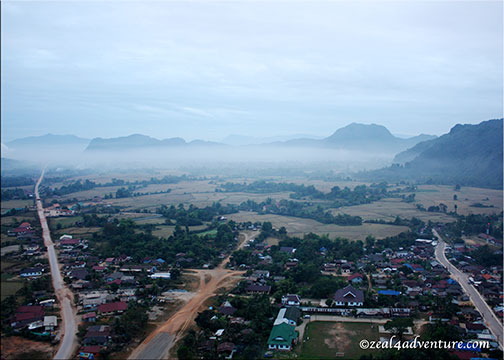
The balloon slowly lifted us up allowing us a bird’s eye view of this picturesque town.

With the air still misty, the mountain peaks looked mystical, like a painting almost.

The rice fields stretches out of the town and into the foothills.

The Namsong River beautifully snakes through Vang Vieng, manifesting its charm even more.

From the top, we see that the empty lot is actually the old airstrip and close to it is the road leading to Luang Prabang.

The beauty of Vang Vieng so captivated me; I forget that I was afraid of heights.  Tranquility fused with a rush of adrenalin was an experience unlike any I’ve had.

Hot Air Ballooning over Vang Vieng seemed to have blown away the cloud looming the town lately.

On the bus to Luang Prabang later that morning, I take one last look and say adieu to a town I have, in less than a day, become enchanted with.

Useful Info:

The Ballooning Company
Ban Vang Vieng, Laos PDR
+856-20-9691-8111
email: info@laoballooning.com
website: http://www.laoballooning.com

A Day in Vientiane

Credits: Page from Kayla’s Tin Album by Shabby Miss Jenn.

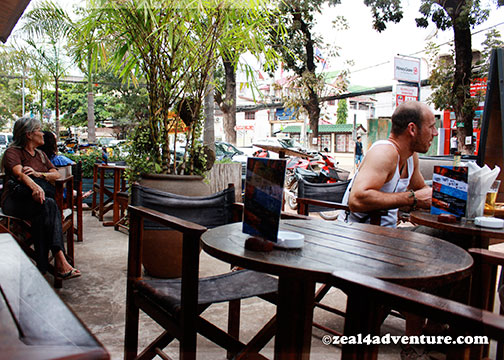
The outdoor seating at Dao Fa Bistro called out to us as we walked pass it.  We were tired from wandering the streets of Vientiane, visiting temples, doing some window-shopping and some real shopping along the way and resting our weary soles seemed like a good idea.

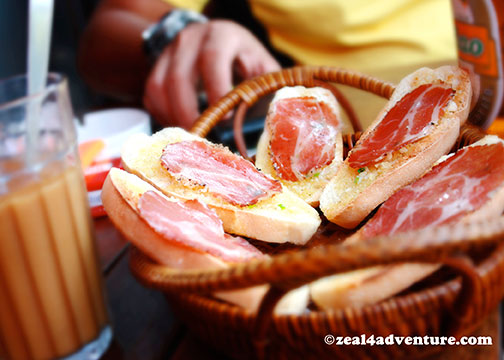
Right beside our table was a couple chatting over a plate of prosciutto on sliced garlic bread.  We decided to order the same.

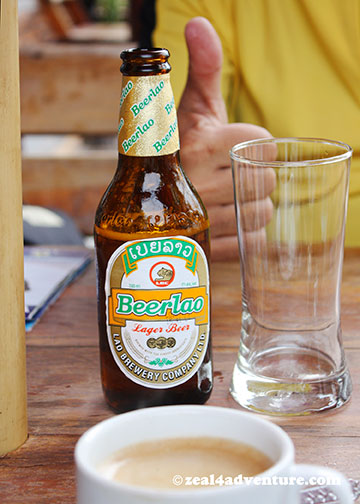
While we watched the people pass by, we devoured our basket of this heavenly tasting cured ham on garlic bread over iced coffee and cold Beer Lao.  How French can you get?  Laos was under French rule from 1893-1953, the influence evident in the many French inspired bistros that line the streets.

Our day started early at the LCCT in Malaysia.  An early morning flight to Vientiane had us arriving in Laos’ capital at around 9AM.  A taxi prearranged with our hotel was waiting for us outside the Wattay International Airport.  “Welcome to Vientiane” the driver greeted us.  A friendly guy wanting to know more – where are we from, how long we’re staying, where else we’re going, so on and so forth.  What a nice start to our Laos adventure, me think!

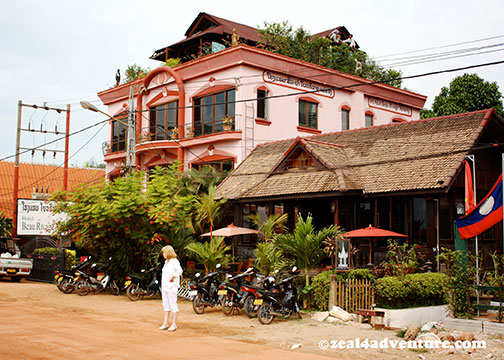
After 15-20 minutes probably (I was so deep in conversation with the taxi driver, I lost track of time), we arrived at what looked like a pink colonial 3-storey building on an unpaved road across the Mekong River.  We thanked the driver and paid him Kip 64,000, equivalent to US$ 8 for the pick up.

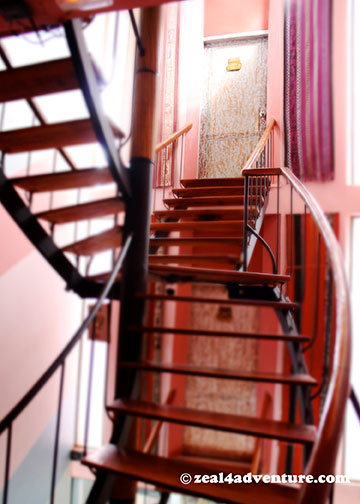
The cool modern design of the interior was a contrast to the colonial style exterior.  The color maintained the same scheme of pink and light blue of the exterior.  We were told to wait as they fix our room and we can wait at The Spirit House, the restaurant next door.

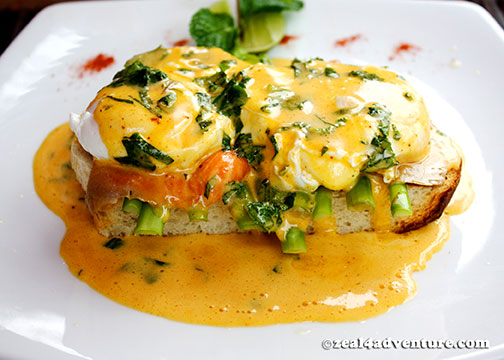
It was 10AM so we opted to share an Egg’s Benedict, just enough to satisfy our hunger but leaving space for lunch.   This was the first of many good meals throughout this trip.  But I was expecting that and would have been disappointed if our meal were anything less than good.  In 2008, when I first visited Laos, I was amazed to find the food here superb – Laotian, French or a fusion of both.  Not leaving out the charm of Laos, the food was one major reason why I went back and writing to you about it.

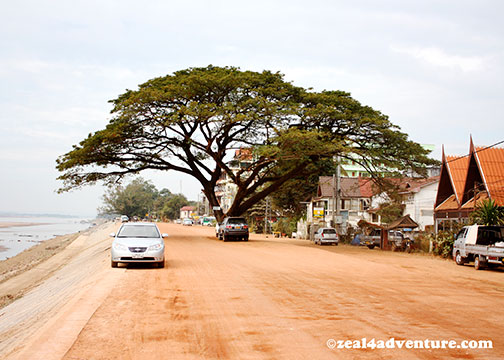
Hotel Beau Rivage Mekong is a boutique hotel sitting on a quieter stretch (road still unpaved) of Fa Ngum Road, a short distance from the center of town where the main “riverside scene” is.

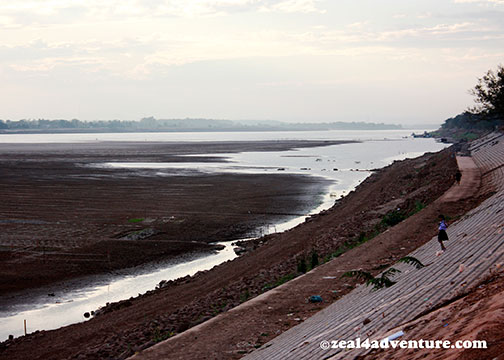
The Mekong River albeit practically dry in January serves as its main charm – great sunsets over cocktails is the main lure of their restaurant, The Spirit House.  A superior room would have the river view

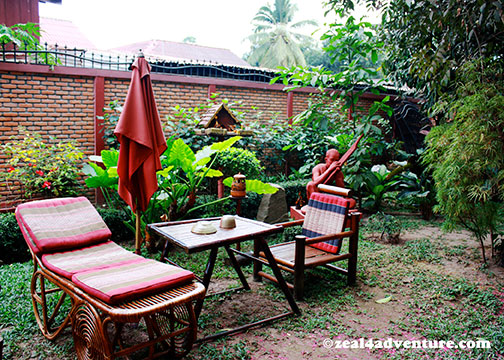
while a standard room at US$ 53, had the garden view.

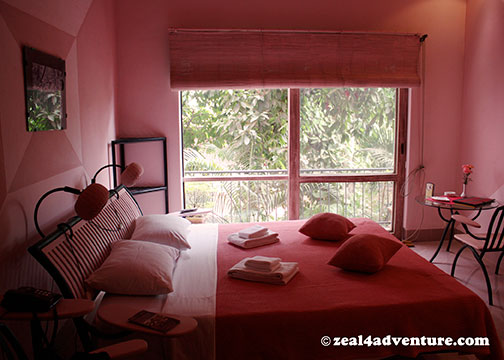
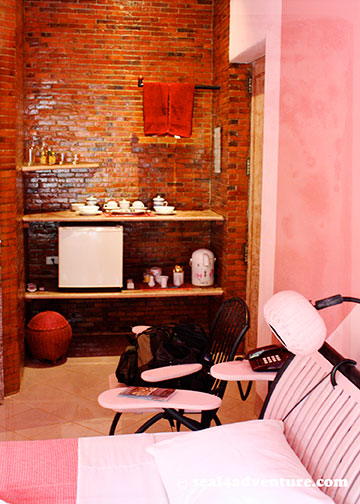
Our room was predictably pink – clean and spacious with a nice corner bar.

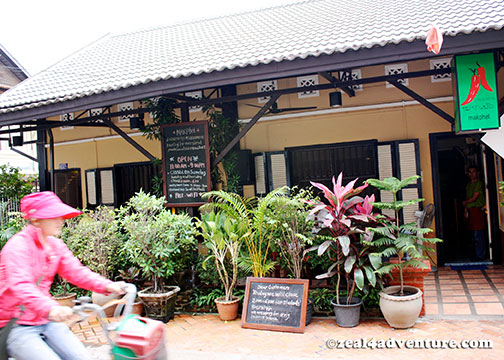
Leisurely walking to the main town, we would wander into streets; exploring shops that would catch our fancy when we happened to walk pass Makphet, a restaurant on the top of our list.

 We decided that lunch was going to be a little early since we were already there.

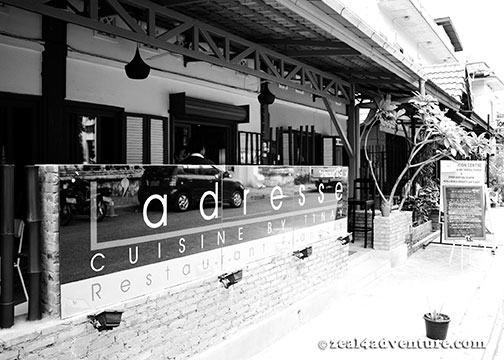
And as luck would have it, L’adresse de Tinay, the other restaurant we were eyeing was right beside so we made dinner reservations before we continued our exploring.

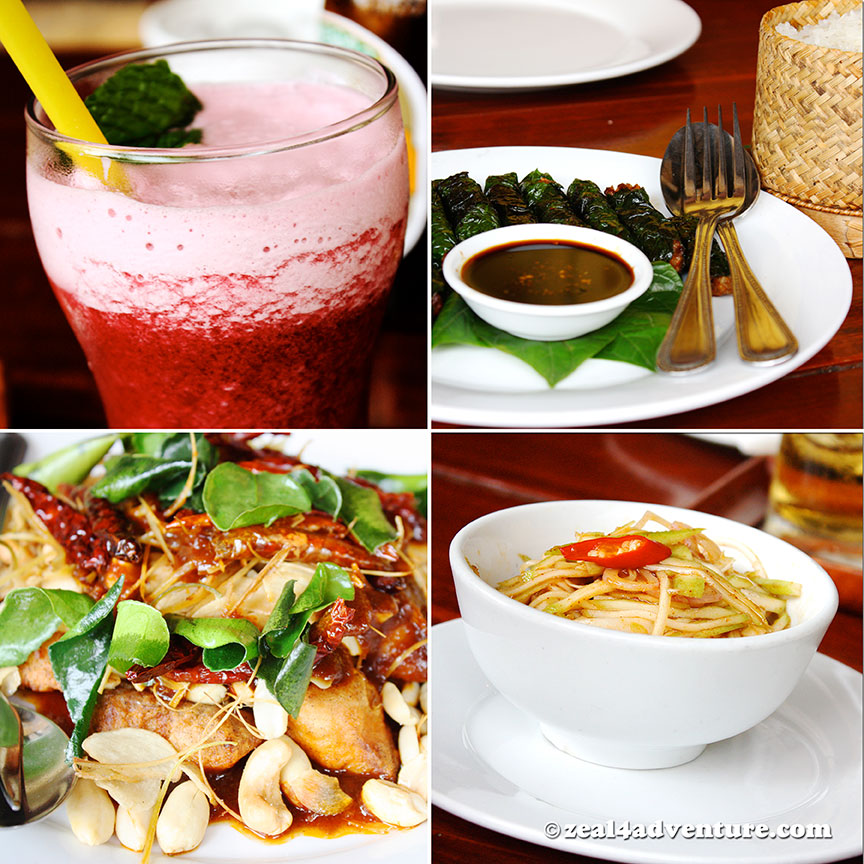
Clockwise: Grilled Beef Filet wrapped in Betel leaves with soy chili sauce, Green Mango Salad, Crispy Fried Mekong Fish with Sweet and Sour Tamarind Sauce, Red Hibiscus & Lime Breeze.

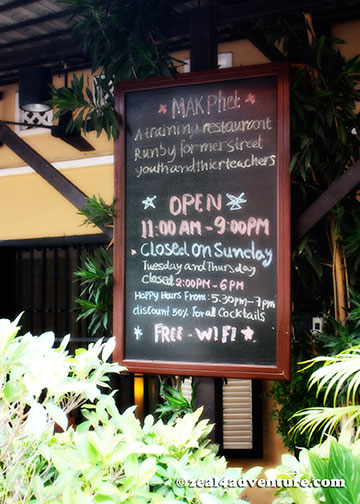
 Ranked by the 2009-2010 Miele Guide as one of the best restaurant in Asia, Makphet is a nice cozy restaurant serving modern Lao cuisine.  Not only do they serve wonderful food here, they are a “training restaurant” as well.

A training restaurant consists of culinary instructors from organizations such as Friends International to train homeless children and youths in the kitchen and in the front of house.  The group now run and support similar projects in Cambodia, Thailand, Indonesia, Honduras, Mexico, Egypt and Myanmar.  Needless to say, the dishes we chose were excellent and service was good.  They taught them well.  Be sure to get there earlier as the place can get packed.

* More on Makphet here.

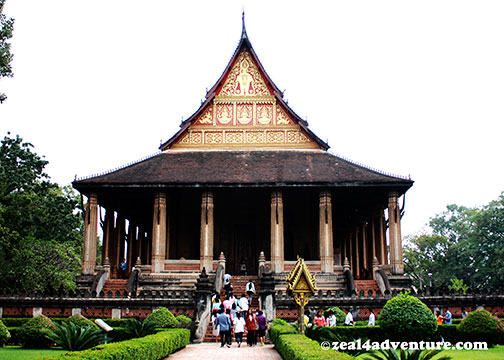
Stuffed yet happy to be ticking off one item off our long list so early in the trip.  We walked to Haw Phra Kaew, once a royal temple of the Laotian monarchy that now houses a decent museum of Laotian art.  Built in 1565 by King Sethathirath as his private sanctuary.  This charming temple used to house the famous Emerald Buddha, which is today housed in Bangkok.

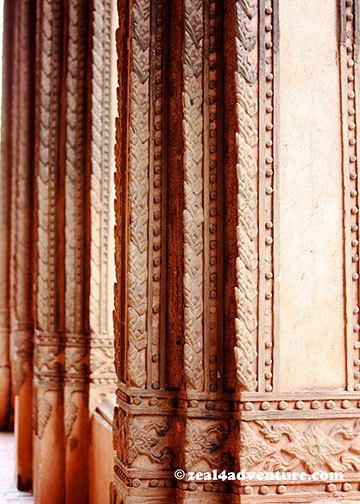
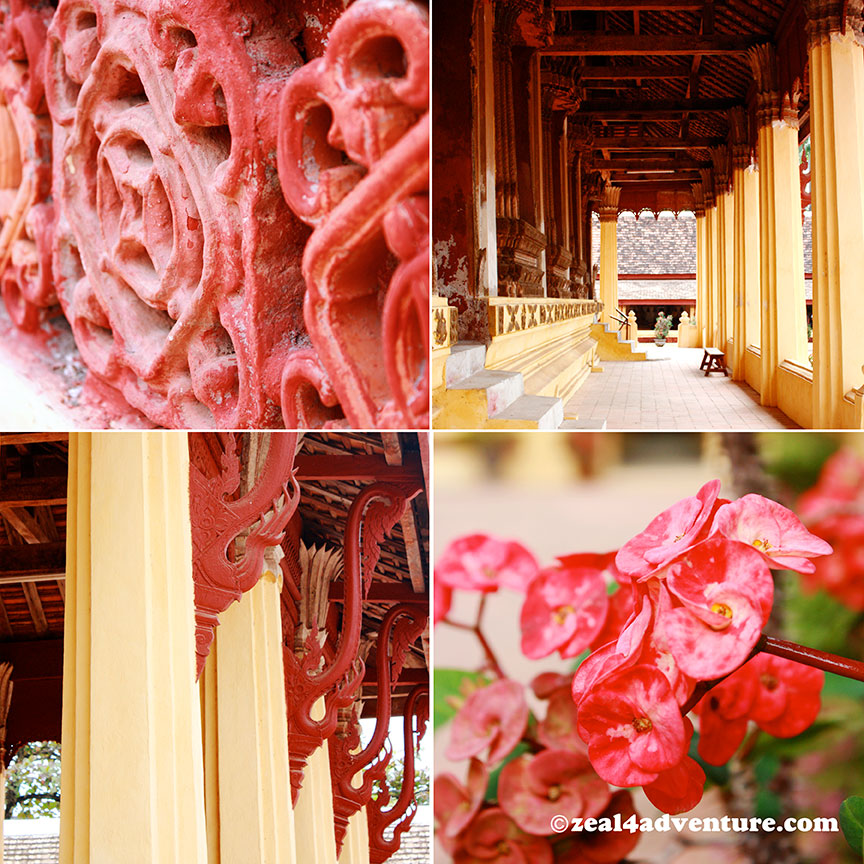
Intricately designed columns surround the temple

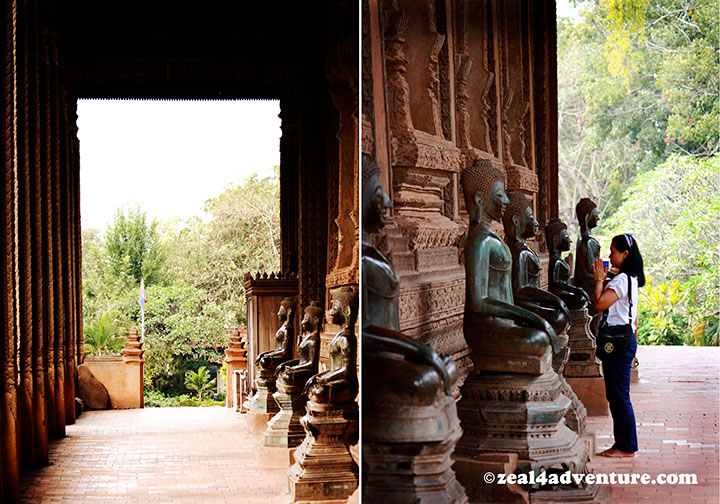
and buddhas grace the hallways where many still worship.

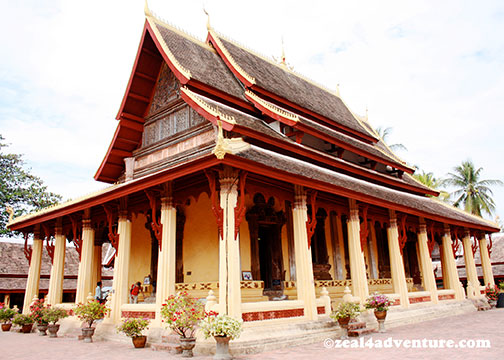
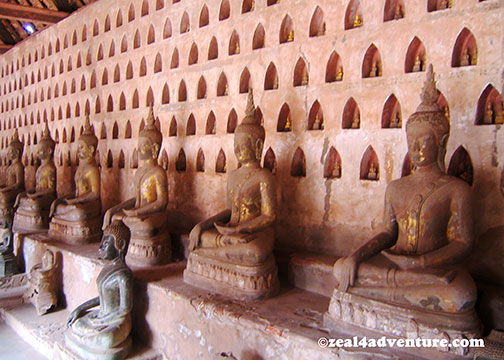
Practically across Haw Phra Kaew on Setthathirath Rd. is Wat Si Saket – a favorite and no doubt one of the most beautiful in Vientiane.  Both are important Buddhist sites but the latter is known to be the oldest temple still standing.

Modernization:  This was what greeted us at the entrance.

Built Siamese (Thai) style rather than Lao style, which could have saved the temple from destruction when the Siamese army destroyed and burned most of Vientiane in 1828.  The French restored the temple in 1924 and again in 1930.  The sim or the ordination halls stands in the middle of a square cloister.

Thousand of small niches were built at the outer walls of the cloister with small Buddha images on each niche.  On shelves in front of the wall are three rows of Buddhas in various shape and size.

Along the edge of the cloister were potted plants abundantly blooming bringing life to the faded yellow walls and pillars, exuding a tranquil charm all its own.

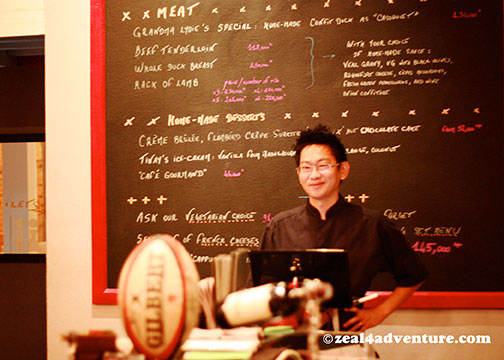
Dinner at L’adresse de Tinay was the perfect cap to our tiring yet beautiful day in Vientiane.  Tomorrow, we journey on to a Vang Vieng.  L’adressee is so to speak the newest kid in town serving outstanding French cuisine.  When we arrived, we were shown to the table we personally picked that afternoon.  A young man in black came out to greet us and get our orders.  Deliberating on what to order, the young man started giving his two cents worth and recommendations, owning up to the dishes when it hit me…  “Are you the chef?” I asked and he smiled and humbly introduced himself as Chef Tinay.

Trained in France, he went back home and opened this gem of a place with the help of his French wife, Delphine.

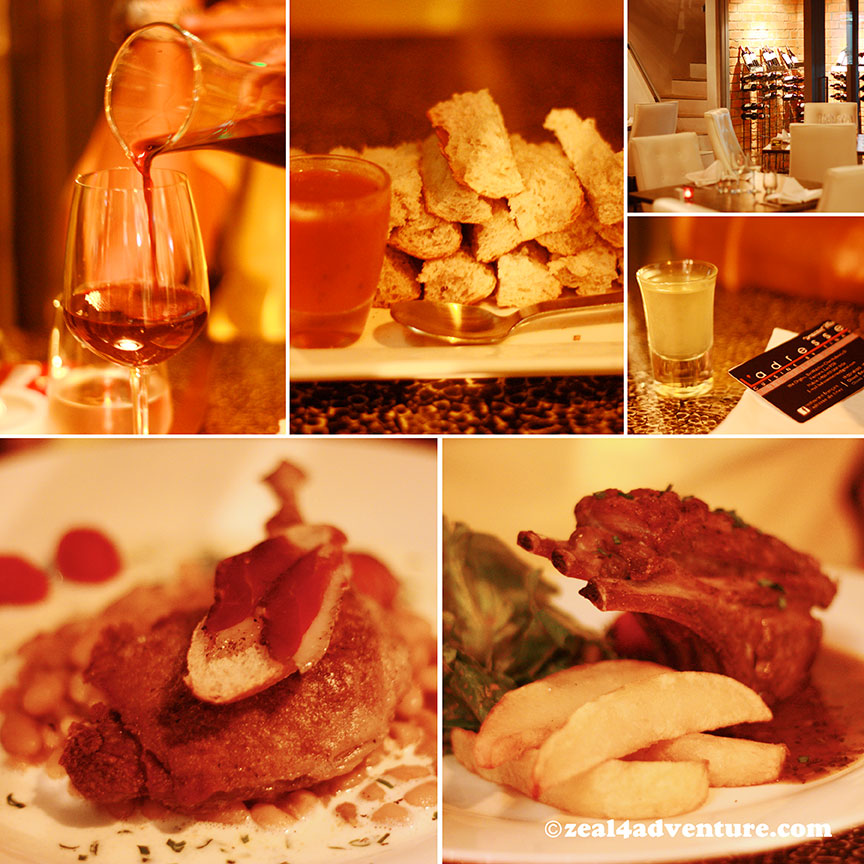
Main dishes: Duck Confit served as a cassoulet with Toulouse Sausage in sweet garlic cream (bottom left); Perfectly cooked Rack of Lamb (bottom right)

Everything we had from start to finish was excellent, ending with Delphine’s Limoncello, which she herself served.  Excellent French meal for US$ 40 per person… can you actually believe that?

* More on L’Adresse de Tinay here.

And with that we went to bed pleased at how well the day went.

Useful Info:

Hotel Beau Rivage Mekong
Fa Ngum Road, 
Ban Seetarn Neua,
Vientiane, Laos
+85621-243-350
Email: contact@hbrm.com
 
Makphet
Behind Wat Ong Teu parallel to Sethathirat Road,
Vientiane, Laos
+85621-260-587
Email: Makphet@friends-international.org
 
L’adresse de Tinay
Behind Wat Ong Teu parallel to Sethathirat Road,
Vientiane, Laos
+85620- 913-434
Email: ladressedetinay@gmail.com

Road Trip Eats: Cagayan Valley

“If you reject the food, ignore the customs, fear the religion and avoid the people, you might better stay home,” James Michener

Cagayan Valley is composed of five (5) provinces namely: Batanes, Cagayan, Isabela, Nueva Vizcaya and Quirino.  It lies in a larger valley in northeastern Luzon, between the Cordilleras and the Sierra Mountain Ranges.

Abuan River in Ilagan, Isabela

I’ve traveled this road countless times and for good reasons.  Besides serving as a jump off point to activities such as whitewater rafting and kayaking, Cagayan Valley’s allure includes beautiful mountain ranges that never failed to blow me away, unspoiled caves (except for Callao, of course) that begs to be explored, breathtaking sceneries along pristine rivers, historical churches, and good friends forged through the years.  Another important reason why I keep coming back is the food and here’s why.

The rugged mountain ranges greet you once you hit Nueva Vizcaya, also called the gateway to Cagayan Valley.  I’ve always looked forward to this part of the drive precisely because of the stunning mountains ranges of the Sierra Madre, the Caraballo and the Cordilleras that surrounds this province.  Truth be told, given that there are a lot to explore, I’ve never really set foot here except to pick up some gorgeous citrus fruits along the highway at Busilac, Bayombong– whatever is the sweetest and in season.

Satsuma from Nueva Vizcaya

The province has become known for its citrus fruits and oranges, which is available all year round.  Open even at the wee hours of the evening for the night travelers, the row of fruits stand at Busilac sells different varieties of oranges, which includes Perante, Valencia, Clementine, Satsuma, Pongkan, Washington Navel.  Other citrus fruits like Pomelo are also available when in season.  A bit on the tart side and not as sweet as the Davao variety, this yellowish variety is refreshingly juicy and best with salads and made as juice.

As you journey on, stop at Ilagan, Isabela (about 120 km from Nueva Vizcaya) for some really good suman (rice cake) called Inatata.

Wrapped in banana leaves as most sumans are but distinctly bundled in 10s.  But what makes this adorable mini suman a cut above the rest lies not in the packaging but in the product itself.

Made of glutinous rice, sugar, butter and coconut milk, somewhat like Biko but smoother and creamier in texture.  I must warn you, these little babies are so good, it’s hard to stop.  A bundle goes so quickly and before you know it, you’re so stuffed.

Once you reach the town proper of Ilagan, you’ll find a nipa hut (or is it a bamboo?) stall somewhere around the rotunda that sells Inatata for P25 a bundle.  Get a few bundles and a few more for good measure, then go across to a Jollibee to get yourself some coffee to go with the it.  You’ll thank me for it.

Make sure to save some for the road or for dessert after a plate of Pancit Cabagan at Cabagan, Isabela.  They say Feli-Cita’s serves the best in Cabagan.  This pancit has become the benchmark of all pancits for me.  Nothing so far is better than Pancit Cabagan, a medley of stir-fried fresh noodles, julienned cabbage and carrots, boiled quail eggs, and a generous heap of lechon de carajay.  Eaten with fresh onions, local soy sauce and calamansi… heaven.  What makes this so heavenly are the fresh al dente noodles – an apparent secret that may be hard to replicate.

I always have mine not in Cabagan but in Natan’s.  A small outdoor restaurant just outside the Tuguegarao Airport.  This simple pleasure I can have without having to do a road trip actually.  I often look forward to trips to the airport (whether arriving or departing) for I can have my fix of Pancit Cabagan at Natan’s.  Pancit Cabagan and Coke… need I say more?

Speaking of Tuguegarao – my base when I’m in the region and the gateway to Peñablanca where the Pinacanauan River flows.

It is one of my favorite rivers where just hanging out along the riverbanks for a barbecue lunch and some kayaking is enough to make me happy. Kayaking aside, it is also home to the circadian flights of fruit bats – a must-see spectacle when in the area.

Longganisa served at Casa Carag

When in Tuguegarao, I make it a point to bring home packs of Tuguegarao Longganisa for my stash and to give as gifts.  I’ve never met anyone who’ve tried this garlicky sausage and not love it.

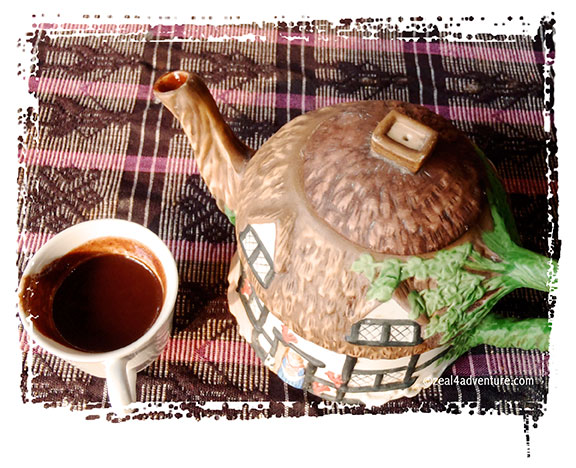
Native Chocolate at Casa Carag

Another must have when I’m in Tuguegarao is their Tsokolate.  Four tableas (tablets) to a cup makes a perfect native chocolate drink – just thick enough with the right amount of sweetness.  Tsokolate, longganisa, eggs and garlic fried rice = a power breakfast courtesy of Tuguegarao.

About 65km further north on your way to Sta. Ana perhaps, is the town of Lal-lo.  Although it is recognized in history as once being the seat of the Diocese until it was transferred to Vigan in Ilocos Sur a long time ago, I know it as a town that makes the best milk candy I have ever tasted.

Better than the more popular Alcala milk candy, I swear.  Both made of carabao’s milk but somehow, the one from Lal-lo is softer and creamier with seemingly more milk.  Both are not too sweet but the Lal-lo specialty wins hands down.  The thing is, you won’t find it at the Tuguegarao airport where the Alcala milk candy abound.

So if you find yourself in Lal-lo by any chance, look for this sign along the road.  I promise it is worth the stop.

Once you reach Sta. Ana, head straight to the market for some fat, sweet crabs, lobster and the freshest fish.

Known as a game fishing mecca, the rich fishing grounds yield lobsters, octopus, yellow fin tuna, blue marlin and many more.  Freshwater fish, crabs and shrimps likewise abound in inland fishing grounds.

Best is to buy them at the market and have it cooked in a restaurant nearby for a fee.  We had ours cooked by JnJ Seafood restaurant along the Highway.

Ok, enough…

I’ll leave you with this for now but let this be a Part 1 as I document more good eats from this region.  A region still underrated and unnoticed in the tourism realm.   Its people, its natural wonders and its food keeps me coming back for more.

Unexpected Bonus

Mag-dive ka na, nandito ka na rin, you should dive, you’re already here”.  To be in Moalboal and not dive is indeed ridiculous. But because I was the only diver in the group, I didn’t plan to… until the divemaster convinced me, that is.

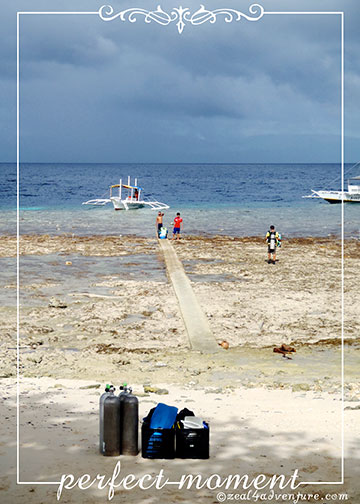
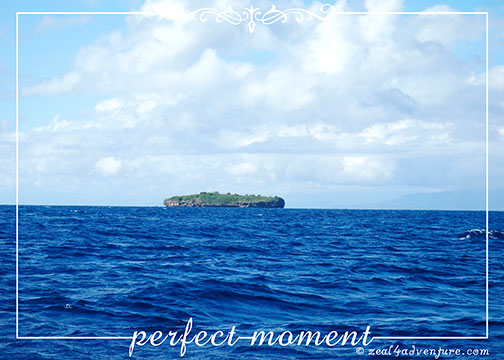
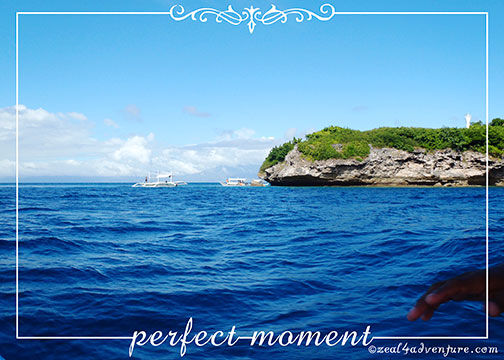
So we got up early the next day, sore from yesterday’s canyoning, and headed to this tiny island called Pescador.  Among the many impressive dive spots in Moalboal, Pescador is described to be their “jewel”.  My friends indulged and shared the cost of the banca (outrigger boat) with me.  They went snorkeling while I explored the world under… ok, that doesn’t sound right but you know what I mean.   😉

Located in the Tañon Straits, a narrow stretch of sea between the southern end of Cebu and Negros Oriental.  Considered “the most unique in the world” as it has the richest marine biodiversity in the coral triangle in the Philippines.

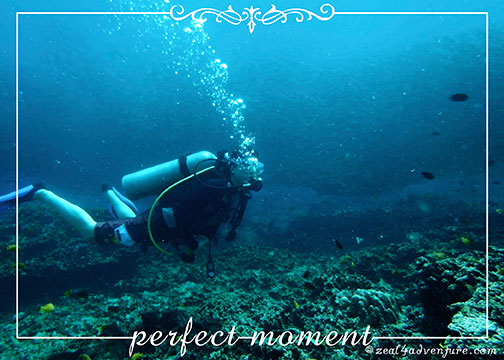
The island is essentially a wall dive made interesting with the overhangs, small caverns and holes in the reef wall.  It was an easy dive with just the right currents.  I was enjoying the drift, fascinated with all the marine life along the small caverns when divemaster taps me on the shoulder.

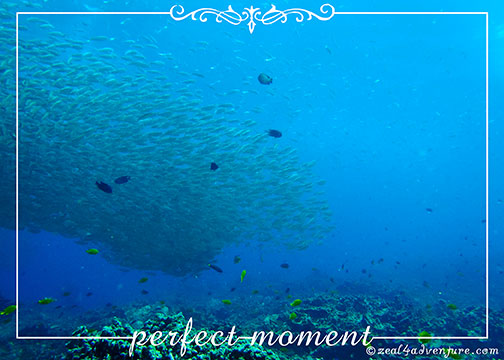
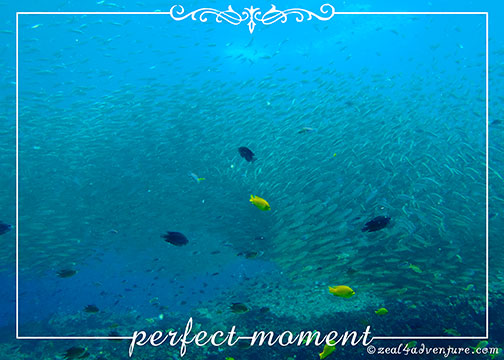
He pointed to my left and there, a short distance away, was a giant wall of fish, a silvery cloud of endless sardines against the blue backdrop of the deep, moving in one accord.  I was awestruck.  Never thought I’d ever get to see such a spectacle in our shores.

The first time I became aware of a sardine run was when a friend, years back,  showed me an awesome video filmed in South Africa.  Every year between the months of May and July, this famous shoal of sardines travel from their home in Agulhas banks and head north.  Predators follow this migration making it the main attraction for divers, rivaling the great migration in the African savannah.  This made it to my bucket list.

The tiny island off Moalboal has been host, for a few years now, to millions of sardines running the tropical waters but unlike the migration in South Africa; the sardines in our shores seemed to have made it its home (at least for now).  This wonderful phenomenon is seen all year round.  Predators seen in these side are mostly Threshers, White Tips and Whale Sharks.  Unfortunately, there were no predators in sight in this dive.  We were flying out the next day and couldn’t go below 40 ft.  Although not as spectacular as the South African video, it was an awesome experience nevertheless.

Observing from the surface, the snorkelers had their share of awesomeness from a different perspective.  They had to abort mid-stream though as the water got choppy, making it difficult to continue.  “Super bitin, too short” they said.

On our way back to the resort, the choppy waters were too big for our small boat, breaking an outrigger.

We were dropped off somewhere along White Beach.  Carrying our gears (except the tanks), walked the rest of the way back to the resort.  Awesome day.

The Kawasan High

Credits:  Papers by Queen of Quirks, Elements by Scrap Matters’ Life Simple Surprises Kit

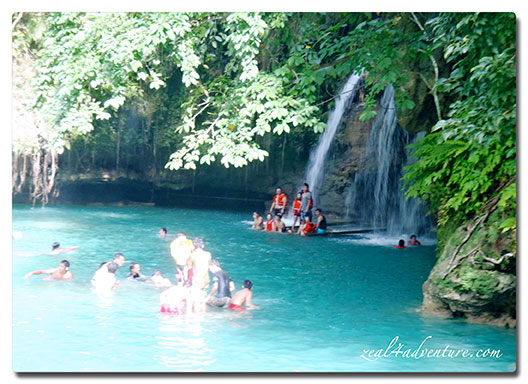
Remarkable diving defines Moalboal and many combine it with a side trip to Kawasan Falls in nearby Badian town.

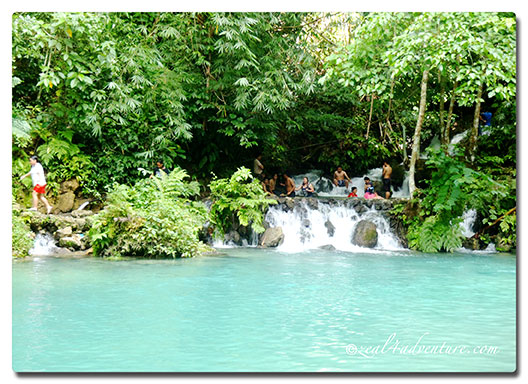
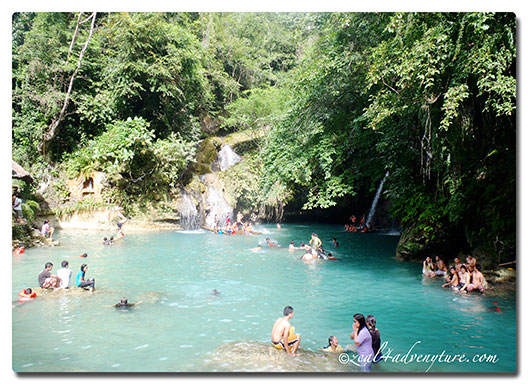
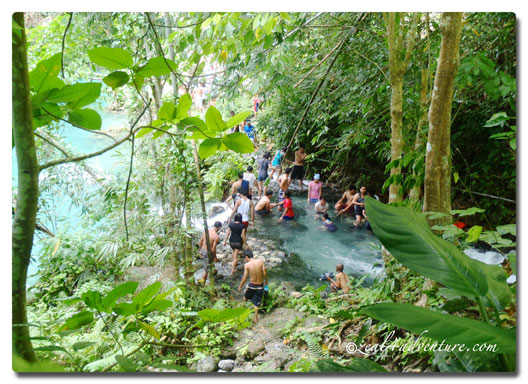
Just an hour away from Cebu’s diving destination, Badian is known for its 3-tiered waterfalls called Kawasan Falls.

A short trek will take you to the first falls where one can enjoy it with nary a need to swim if that is the preference (bamboo rafts are available to take people to the falls).

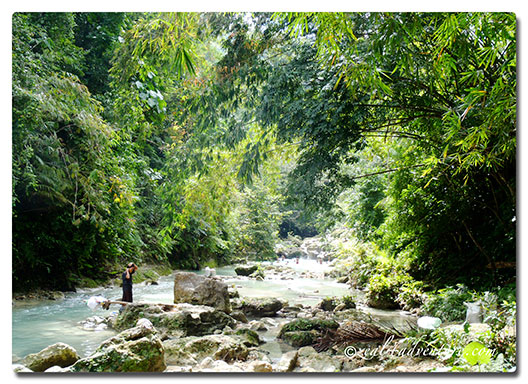
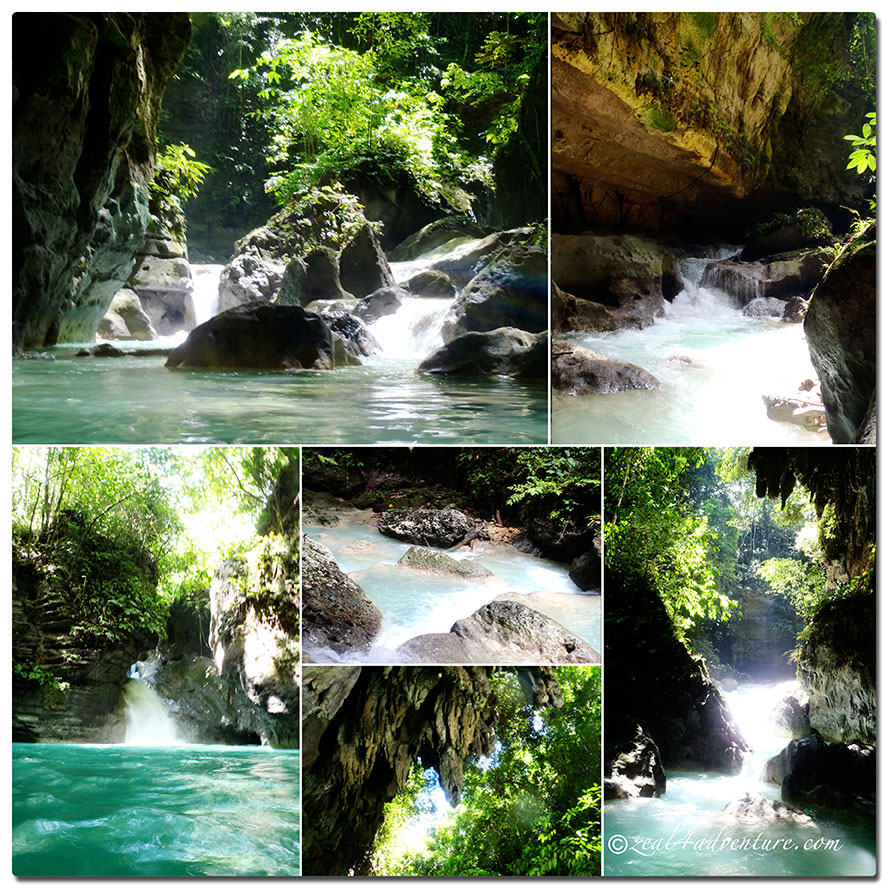
The beauty of the waterfalls cascading into turquoise pools and the lush tropical vegetation surrounding it already provides a natural high.

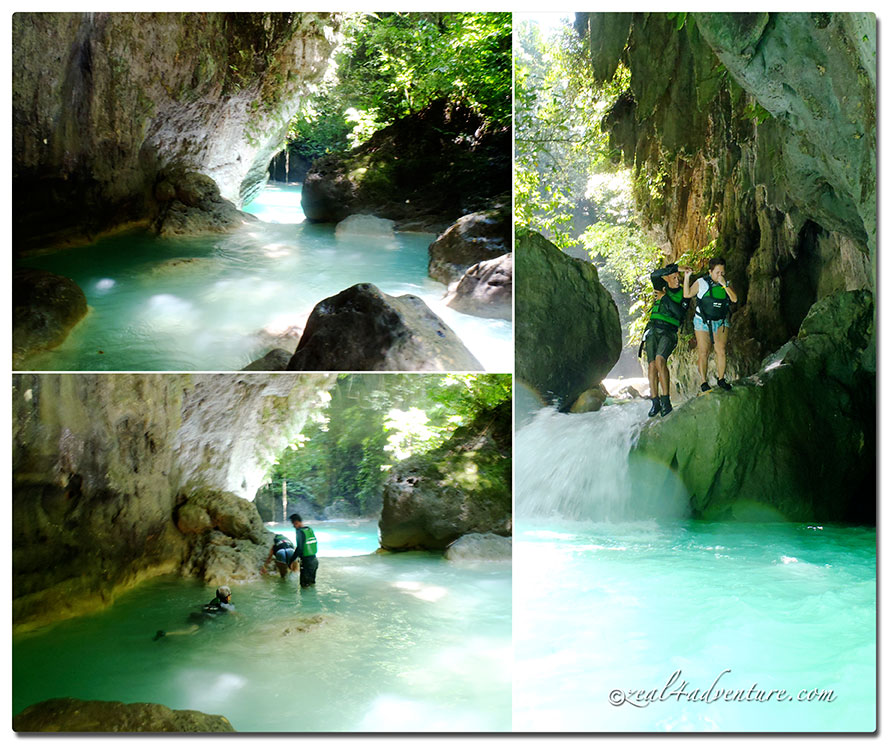
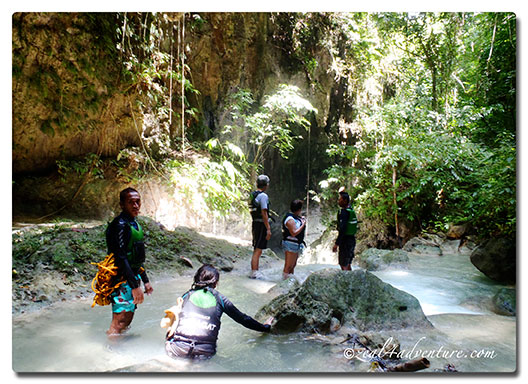
What more if, for 4 hours, you get to swim, trek, and jump into several of the turquoise pools along the way to Kawasan Falls?

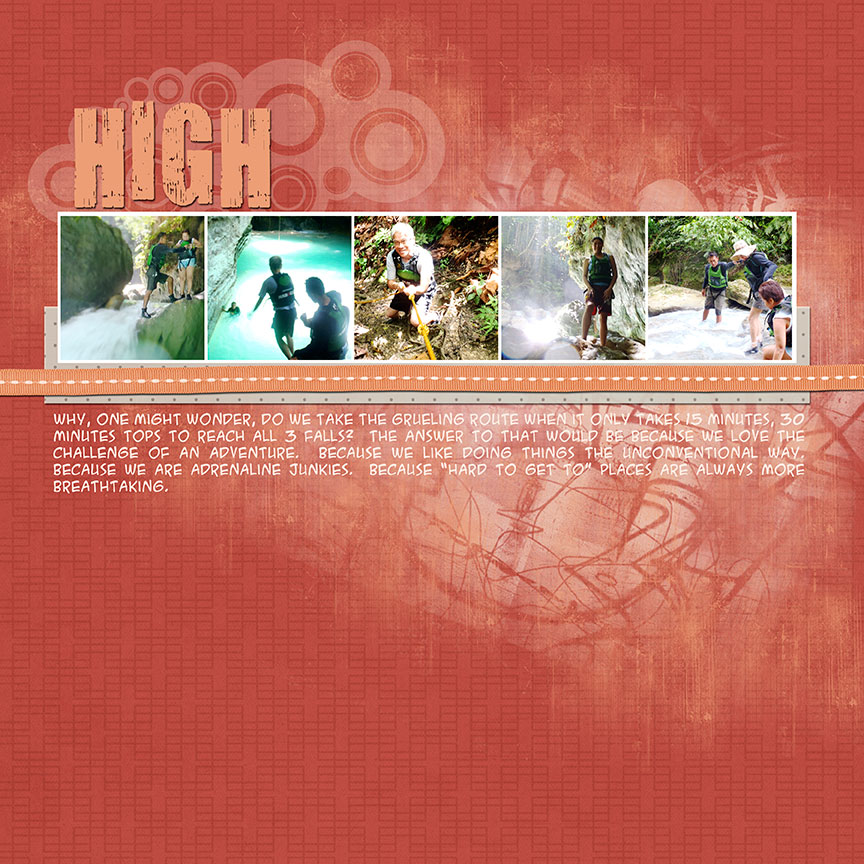
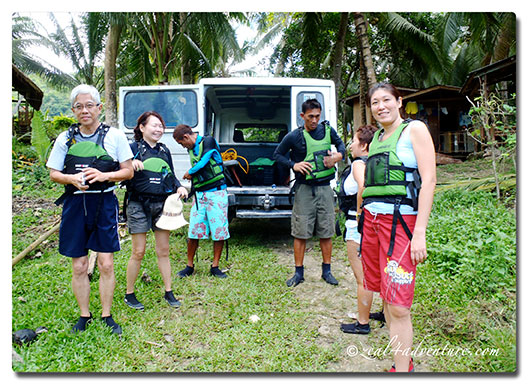
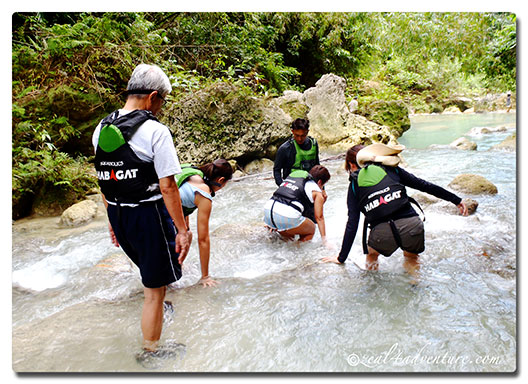
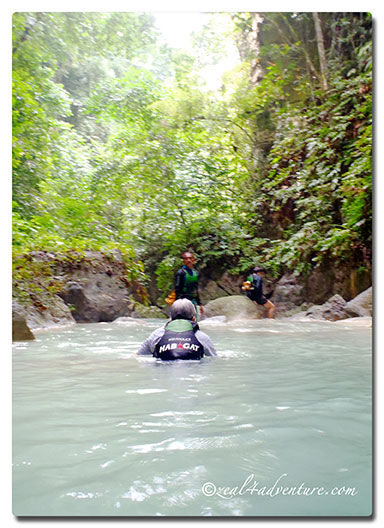
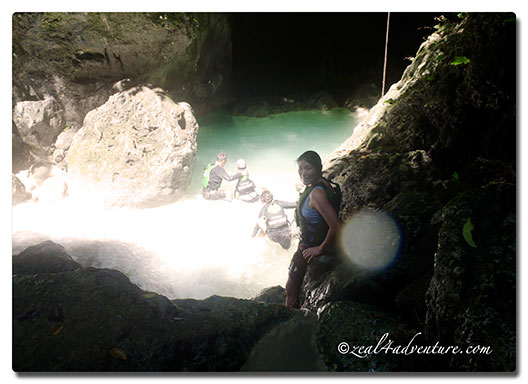
We entered the falls from upstream, near the border of Badian, at the Matutinao Valley geared with a pair of booties, a life jacket and an adventurous spirit.  Canyoning at the Kawasan is not your ordinary Kawasan Falls excursion.

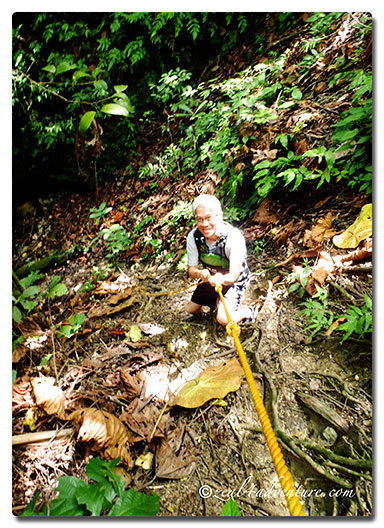
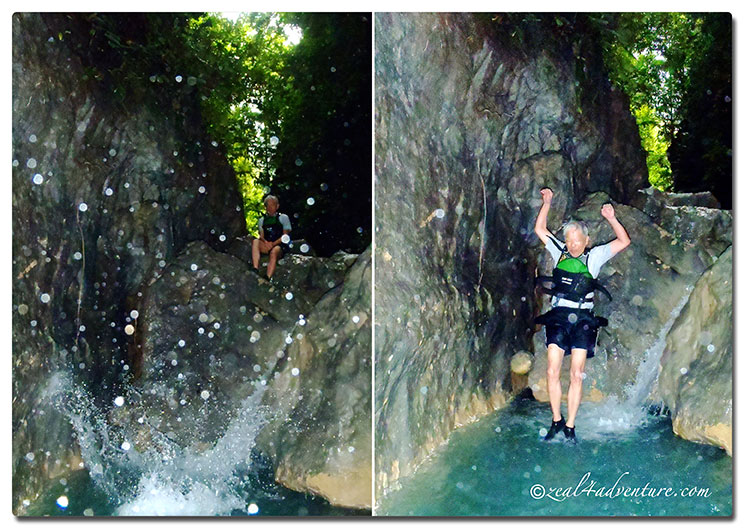
It requires swimming, river trekking, jumping off waterfalls and a bit of rappelling.  Canyoneering, as they call it, is a sport of exploring a canyon by engaging in rappelling, rafting and waterfall jumping.

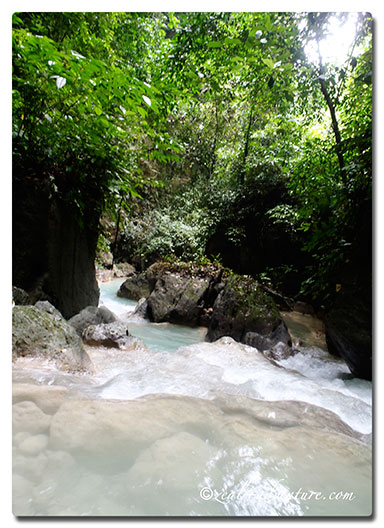
The adrenalin started pumping at the Matutinao River, just a short distance from our jump-off.

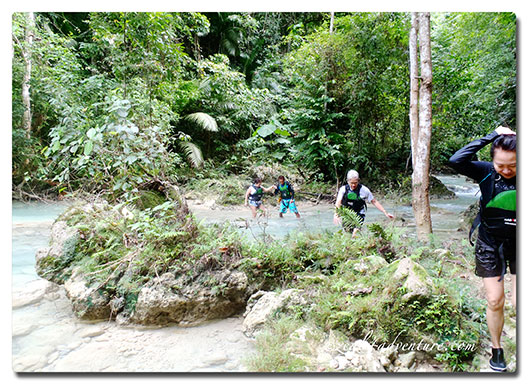
We scrambled over rocks as we get use to the art of river trekking.

We sort of rappelled down a mountain slope to reach another canyon.

We swam when the water was deep.

We jumped from big boulders 4 times, sometimes over waterfalls, other times into a small basin with little room for error.

It was terrifying at times, but for the most part, it afforded us an ultimate high, non-stop adrenalin rush.  It was a high like no other.

The Aquaholic team made us feel safe all through out, guiding us through the magnificent sceneries of gorgeous blue lagoons and spectacular canyons and rock formation.

The remoteness and lack of habitation have left this valley a sanctuary.  In the course of our 4-hour escapade, we bumped into a few locals at the start and another canyoning group that explores the river the harder way from below, which they call river climbing.  Otherwise, we had the river and the beautiful riverscape all to ourselves to take pleasure in.

We reached the top of the 3rd cascade of Kawasan Falls at around 2pm.  Contrary to the tranquil environment we came from, we were greeted with loads of people enjoying their Sunday.

Caught off guard and surprised to see people out of nowhere walking down from atop the falls, they watched us with wonder as we walked pass them, exhausted but exhilarated.  Their facial expressions seemed to ask, “Where the heck did they come from?”

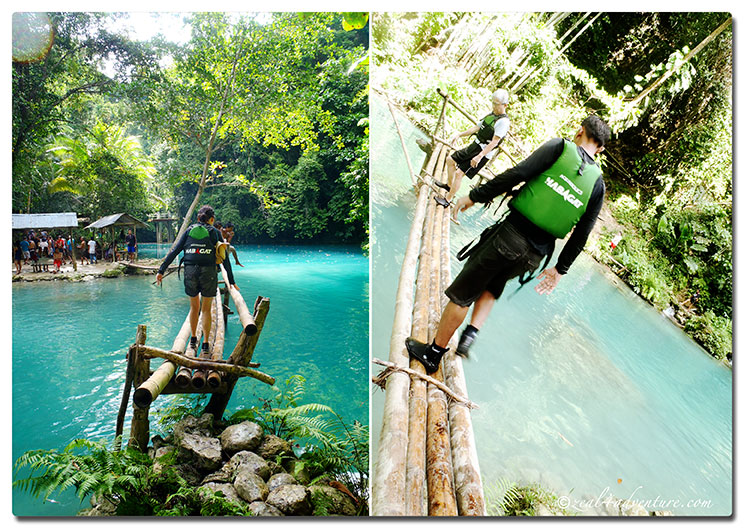
Going back to the van we walked this bamboo bridge which ironically was more frightening.

Why, one might wonder, do we take the grueling route when it only takes 15 minutes, 30 minutes tops to reach all 3 falls?

The answer to that would be because we love the challenge of an adventure.  Because we like doing things the unconventional way.  Because we are adrenaline junkies.  Because off-the-beaten paths are always more breathtaking…
Useful Info:

Philippine Aquaholic Diver’s Inc.
Club Serena Resort
Moalboal, Cebu City
Contact No: +63 (32) 516-1847; +63 (32) 474-0050; +63 (917) 717-3333
Email: dive@aquaholics.com.ph