Beijing Acrobats

Credits:  LivE S4S Stitched Page Overlay, TW Lesson 2 paper, Laurie’s Ornament, KPertiet Storyboard Negatives.

China’s acrobatics are world-renowned and deservedly popular among Beijing’s visitors.  Young students that demonstrate extreme flexibility, dexterity and balance that boggle the mind perform today’s acrobatic shows.  If you have enough time, might as well witness a show.  Expect to “ooh” and “ahh” during the entire show as the young performers show off stunts such as: plate spinning, unicycling, juggling, Chinese yo-yo, etc.

Snippets from the show:

Where to watch:

Chao Yang Theater

Wansheng Theater

Tiandi Theater


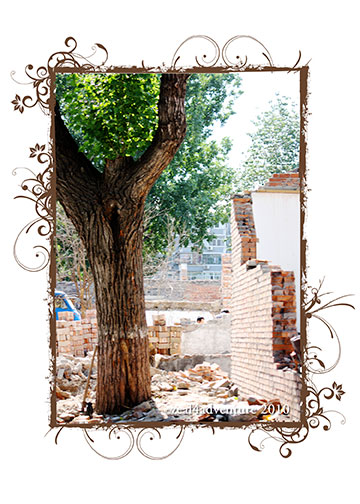
A Glimpse of Beijing’s Ancient Neighborhoods

A hutong is an architecture and structure unique to Beijing and visiting one of this (either by walking or a rickshaw) is one of Beijing’s attractions especially to people wanting to know more about its history.  Going around a hutong will let one experience the remnants of Beijing’s ancient culture.

In old China, there were clear definitions of what streets and lanes are.  A 36-meter-wide road was called a big street while an 18-meter-wide road was called a small street.  And a 9-meter-wide lane was called a hutong.

According to history records, these hutongs came to existence during the Yuan Dynasty when the Mongols – led by Genghis Khan, occupied Beijing.  The city had to be rebuilt after it was demolished during the take over, thereby creating hutongs.  The word “hutong” is Mongolian in origin, which means, “water well”.  People tend to gather where there is water so with the digging of new wells; new communities are not far behind.  Hutongs are alleys formed by lines of “Siheyuans” (traditional courtyard residences).

Hutongs were established surrounding the Imperial palaces throughout the Yuan, Ming and Qing Dynasties.

Since the mid- 20th century however, new roads and buildings have replaced many of the hutongs.  Some hutongs though still survive today, thanks to their local government’s protection policy.  Most in existence today date from the Ming (1368-1644) and Qing (1644-1911) dynasties.

Walking through the hutongs, it is common to see groups of elderly citizens playing cards, mahjong or Chinese chess together.

Also important to hutong life is the traditional foods sold in carts or small stalls.  These ancient neighborhoods today provide a glimpse of the life in old Beijing.  To live in a hutong would mean no baths and toilets in their homes.  Public baths and toilets are provided and imagine having to trudge your way to the toilet in the middle of the night at below zero degree.

And yet there are still many living in these ancient neighborhoods, perhaps it is the way of life these folks are accustomed to, real life as it has been for generations.


A Taste of Ancient China

Credits:

Although the Tian An Men (Men meaning gate) Gate was built in 1417 during the Ming Dynasty to compliment the Forbidden City, what first came to mind as I was walking through the humungous complex was the 1989 protest known to the world as the Tiananmen Square Massacre.  This was where the heroic flight of thousands of young men and women played a crucial role in the events that ultimately led to the collapse of communism.

The largest city space in the world at 40,000 square meters the square was packed with people wandering about.  It held the monument of the National Heroes, the Great Hall of the People, the National Museum of China and the Mausoleum of Mao Zedong.  It also is the gate connecting to the Forbidden City, which sits on its north.

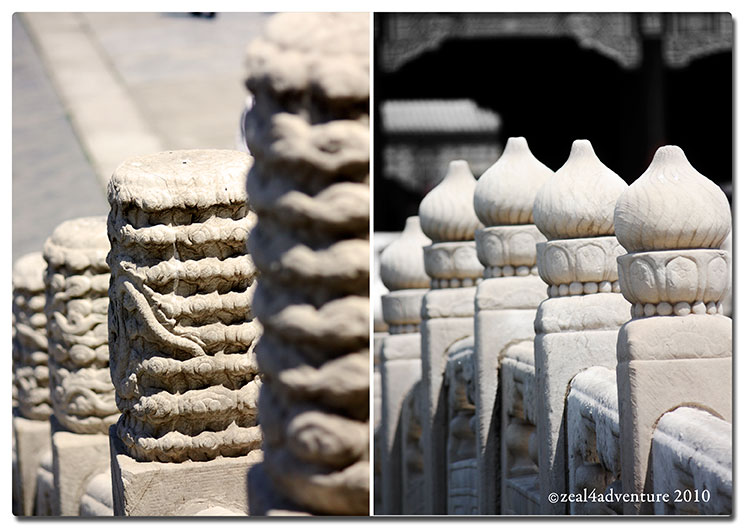
The large white marble column seen all around the square was constructed in 1420 as part of the Forbidden City ‘s grand design, which took 14 years to complete.

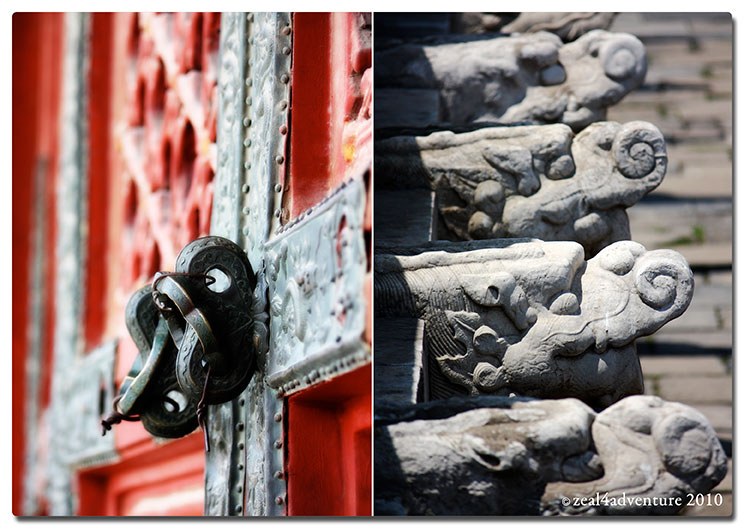
This Chinese inspired palace is located in the middle of Beijing and now houses the Palace Museum.  For almost 500 years (from the Ming Dynasty to the end of the Qing Dynasty), it served as the home of emperors and their households.  It likewise was the economic and political center of the Chinese government.  The construction began under the Ming Emperor Yongle in 1406 and is the largest and the most well preserved imperial residence in China today.

Walking through the city gives an idea of the grandiose lifestyle of the former emperors.  During these times, common Chinese were not allowed to enter the city at all, a big contrast to today’s millions of people entering daily.

The entrance of the Palace is through Tiananmen gate and once you reach the Wumen (Meridien Gate),

you enter the heart of the complex where you fall in line or wait for your guide to purchase your ticket.

It was chaotic and it continues to be so until you leave the complex.   The rooms are now off-limits and one can only take a peak from the outside, unlike a decade ago when one could actually enter and have a feel of the old splendor.  The price of commercialization, I guess.

Despite the chaos, a visit to the Forbidden City is a must especially if it is your first time.

Because of the size, allow at least 3 hours to walk the complex, wear comfy walking shoes and best to get those audio guides for a thorough walk through.

Forbidden City
North of Tiananmen Square
Dong Cheng District
Opens from 8:30am – 4pm daily
Price:  ¥ 40-60 / ticket

The Art of Bargaining

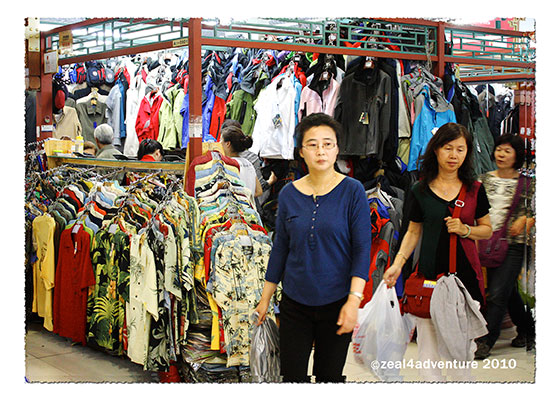
All these name brands that you of course know are fake but sometimes wonder if they really are.  They look and feel like the real thing.  You make eye contact and hold that shirt and ask, “how much?” then she types a price on a calculator that can’t possibly be right but validates what you already know.  So you pretend disbelief, and show a “you must be kidding” face. She goes, “how much you want?”  Then you offer a price 70% lower than what she asked for.  And then she gives you the same look you just gave her and adds, “you joking!”  You look her straight in the eye, “no”, you say.  Then she brings down the price a bit while you do not budge.  The game goes on for a bit longer; by this time her price is about 30% lower than her original quote.  You walk away and she grabs your arm and asks you once more, “how much you want?” in a more irritated manner, you try to break free and walk away, she follows and continues to ask, “how much you want? enough joking.” you tell her your price, which by now is 20% higher than your first offer, sometimes she will offer to a price a tad higher than yours and you finally compromise and concede.   Everyone’s happy; the vendor will even praise your bargaining skills.   Sometimes though they will walk away grudgingly and call you crazy.  Don’t fret, there are at least 500 stalls (the whole building is reported to have 1,500 stalls) with more or less the same merchandise and if you really like it, you can repeat the same exercise with another vendor.   After a few hours of this, you feel exhausted but happy.  You feel like a cup of coffee or a bottle of beer to reward you for a job well done.

Many coffee shops and restaurant chains on the first floor

My mama always say, “They will never sell you anything at a loss, so don’t feel bad.”  You see she has been going back to the silk market and similar markets in Shanghai and Guangzhou for more than a decade.  She IS the expert when it comes to bargaining with the Chinese.  I take to heart her practical advice and oftentimes end up with a good bargain – that is if my impatience doesn’t get the better of me.  Here are some advices from the expert herself.

  1. Don’t want the item too much.  They are fakes after all.
  2. You will most likely find the same item in the stalls next door.
  3. Always start at least 70% below the asking price.
  4. Do not concede unless it is at least half the asking price.
  5. If you happen to break rule no. 1, then at least concede only if the price is 40% lower than their asking price.
  6. Bargain hard.
  7. Pretend to know what you’re doing, don’t be wishy-washy.
  8. Be prepared for some abuse, some will grab you and drag you back to their store, even if you’re already 3 stores down.

The Silk Market is a 5-story building that offers more than just silk.  There are garments, jackets, jeans, leather goods, shoes, bags, watches, handicrafts, jewelries, toys, you name it.  It opened its doors in 2005 replacing the original outdoor Xiu Shui Market.

Try it… it can be fun.  It’s a game not everyone can play well though but practice makes perfect.   😉

Useful Info:

The Silk Street Market
Chaoyang District, No 8 Xiu Shiu East Road
To get there: take the subway line 1 – Yong Anli Station

Beijing at Night

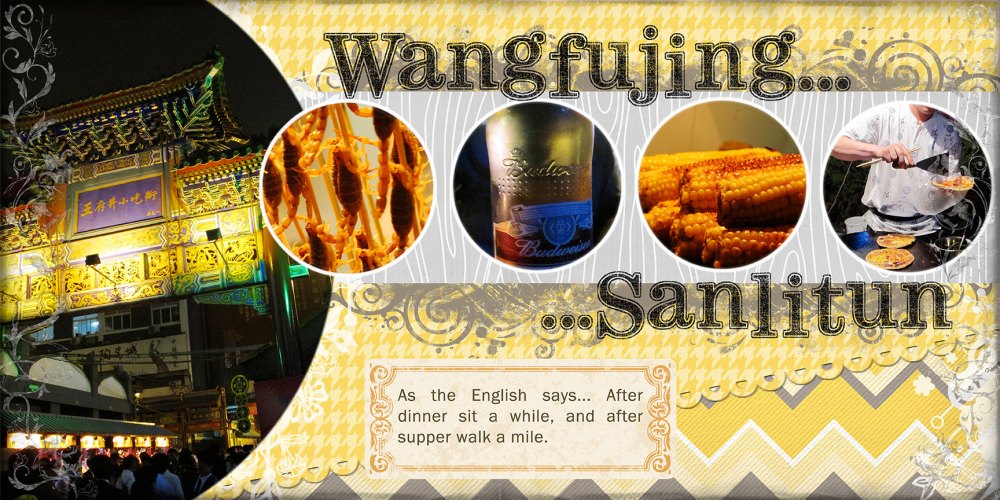
Credits:  Kitschy Digital (You are awesome kit) Chevron and Yellow Houndstooth papers, Knotty girl’s pp1 paper;  Caro 752 Marquee 1 & 2 brushes, KPertiet Grungy clusters and LivE Sing for Spring Page overlay;  LivE TW01 Tag;  K Pertiet Academic Alphas.

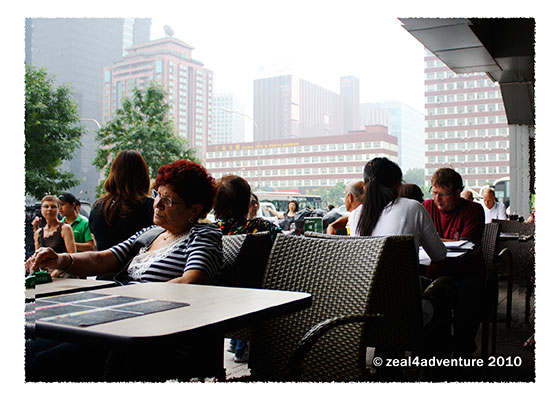
A “Snack Street” and a “Bar Street”, both alive till the wee hours of the morning, both swarming with street food – some made me squeamish while some whetted my appetite.  Two popular night scenes not to be missed when in Beijing.

Wangfujing Night Food Market

Just off Wangfujing St., located pretty much in the center of Beijing and a 10-minute walk from where we stayed.
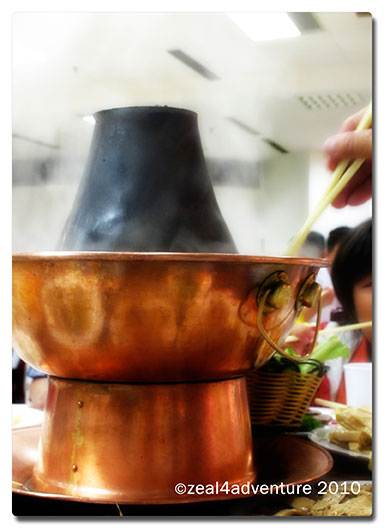
After a hotpot dinner at a nearby mall, we walked along Wangfujing St., a portion of it is off limits to cars and other motor vehicles.
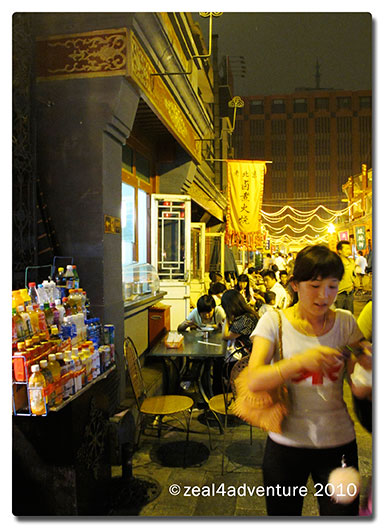
The food market was crowded with people, but they say this is quite normal as it is a famous snack street among locals and foreigners alike.  I was not prepared for what’s to come though.

The first few food stalls had as displays bugs and scorpions on a stick, bizarre foods that would probably delight Andrew Zimmern no end but not me.

Even beautiful sea creatures such as seahorses and starfishes.  I was horrified.  Poor creatures.  I now know that there are foods that I cannot eat, what a revelation!!  But not all food stalls are alike,
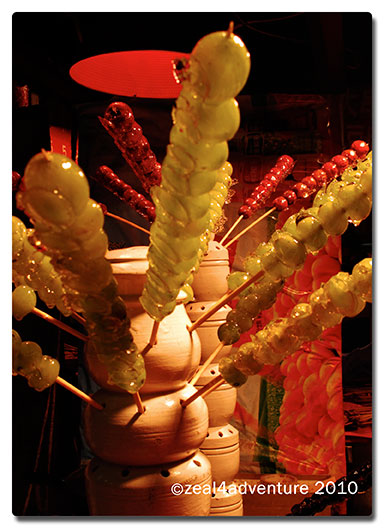
Candied fruits

there were others that had me wish we skipped the hotpot meal and went straight here.

Lamb Shawarma

There were wonderful smells of lamb kebabs, shawarmas, grilled meats, roasted chestnuts and many, many more.
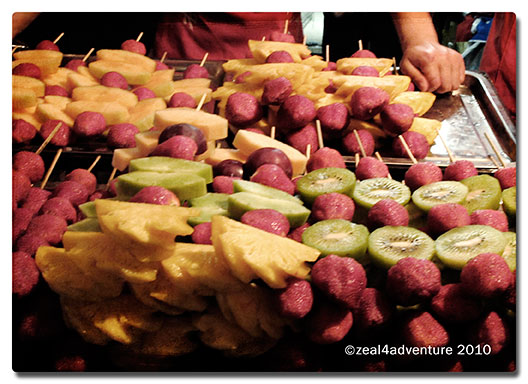
A great place for a cheap sumptuous dinner, sans the bizarre foods of course.

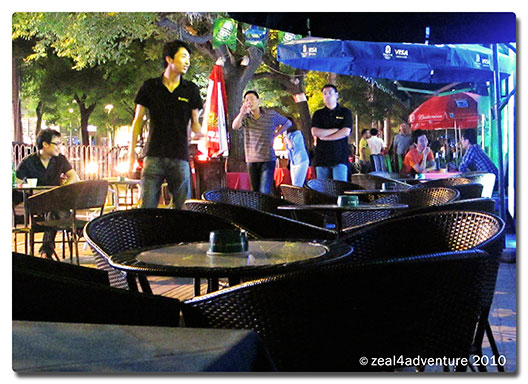
Sanlitun Bar Street

One of the best known bar street in Beijing, Sanlitun is located in Eastern Beijing in the Chaoyung District.

Hidden away in the small alleys of Sanlitun are many small bars and cafes.
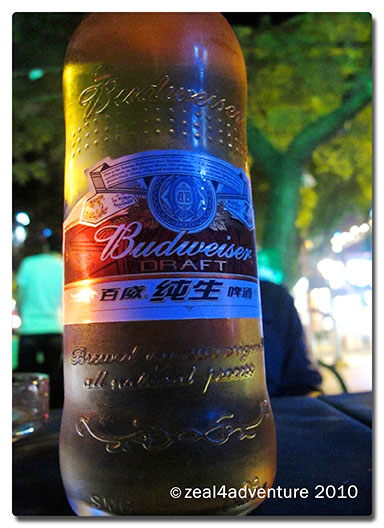
This has been one of the most popular entertainment area for foreign expats, recounts my brother who used to work in Beijing in the late ‘90s.  What used to be a small street with bars has turned into stretches of bars and trendy restaurants.  Hardly recognizable, he says, as we weave through the streets in search of his favorite hangout spot 12 years ago.

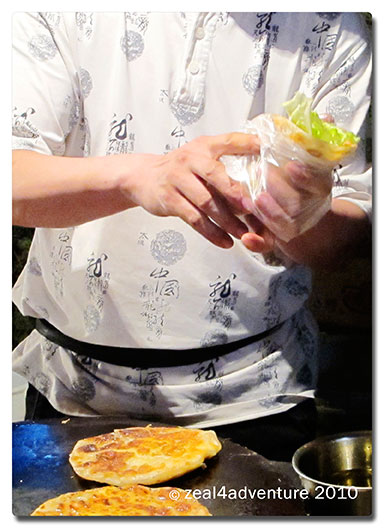
Before taking a cab back to our hotel, we came across this stall selling some sort of a wrap

made up of char siu pork and fried egg with some sort of sweet-savory sauce and lettuce to finish off.

Better then the breakfast offerings at the hotel.

Beijing : The Old Meets New

If the last time you were in Beijing was 15 years ago,

you’d also be surprised at how they have managed to preserve its ancient past even while it transforms into a modern metropolis.

Walking along Wangfujing Avenue, I notice a smattering of bicycles reminiscent of the Beijing I last saw, still pedaling down the streets but is more and more being replaced by cars and buses.

Modern buildings and malls line the streets of Beijing along side stunning ancient eastern architectures. The capital of China with 3,000 years of history is today a dynamic city where the old and new intermingles and is a magnet for local and foreign visitors. It remains the People’s Republic of China’s center of politics, culture and economics.
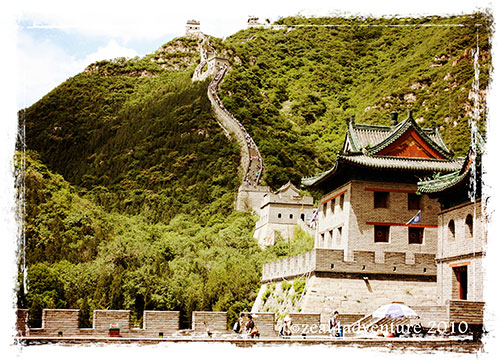
Great Wall

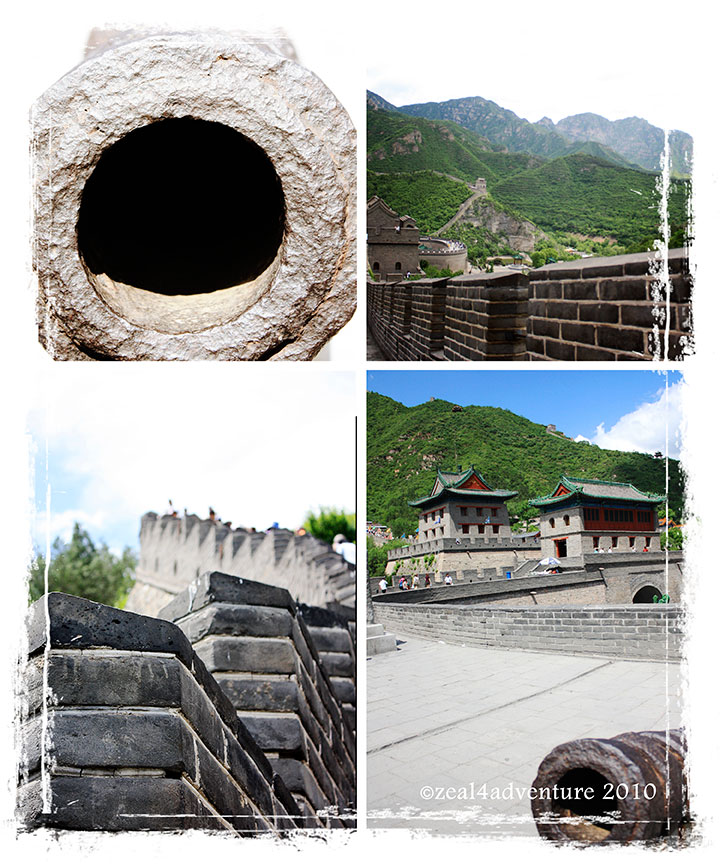
Great Wall – Juyongguan Pass

A visit to Beijing will never be complete without the imperative call to the Great Wall.  It was the reason for this trip putting aside the good eats, that is.  My nephew wanted to see the Great Wall, after taking it up in school and thus a family vacation was mounted.

Packed with tourists

So to Juyongguan Pass (also called Juyong Pass) we went one morning.  It is the nearest section of the Great Wall to Beijing, a little nearer than Badaling, the most popular section of the Great Wall.

Juyong Pass does not however escape the same glut of souvenir shops and a number of other tourist traps that Badaling has.  But if convenience, keeping transportation simple and time management is of importance, both these passes are the best places to get a feel of the walls’ more than 2,000 years history.  In fact, as early as the 13th century, the area of Juyong Pass was known for its beauty and was listed as one of the eight “great sights of Yanjing”.

Aside from its easy access, its steps starts off from the same level as the parking lot so there is no need to climb or take a cable car to reach the wall.

It however rises steeply on both sides of the gate

The view from mid-way to the 1st watchtower

Our goal that never was.

– a reason why we never even reached the first watchtower.

Once a strategic military garrison, this 20 kilometer-long valley,

stretching along the ridge of incredibly steep mountains was considered important in the defense of Beijing in the ancient China.  These mountains that flanks the valley can definitely be credited for the beauty of the pass.

If you are looking to see authentic “Ming Dynasty” walls though, this is not the place to be as a short expanse of the wall has been recently restored.  Simitai might be a better option since it is virtually unreconstructed and is listed as a UNESCO’s World Heritage Site.

More of Beijing in my next posts.   🙂

Scenic Sunday

A Must See

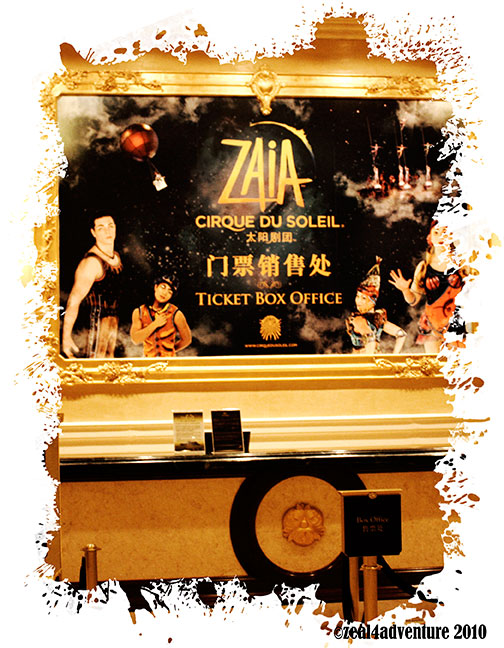
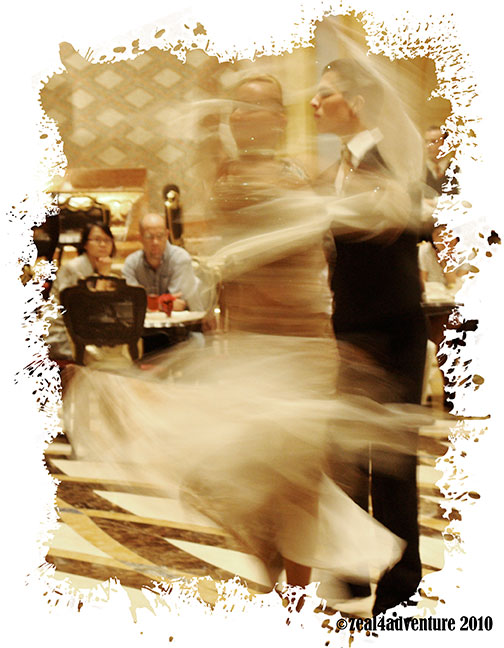
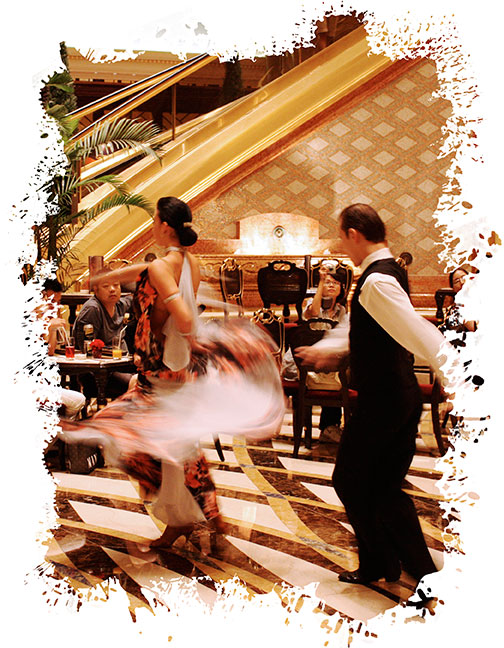
Cirque du Soleil.  Oh yes, O Manel was part of the lure but this 90-minute mega production was one major reason why I found my way back to Macau.  The award winning creation that began with a group of street performers in Quebec is known the world over for its innovative shows.  Zaia – the one staged at The Venetian Resort in Macau – is wall-to-wall with breathtaking aerial acrobatics, entrancing special effects and fluid dance and movements, that captivated me from the moment the stage lit up.

So to The Venetian we went just for this.  And while we were there, we might as well explore the much talked about Resort-Hotel that supposedly played a crucial role in transforming this once rural part of Macau – even sleepier than old Macau towns – into one of the biggest tourist destination in Asia.  It is home to Asia’s largest casino with 1,000 slot machines and over 600 gaming tables bustling 24/7.

Never a dull moment, The Venetian is filled to the brim with activities at every turn.

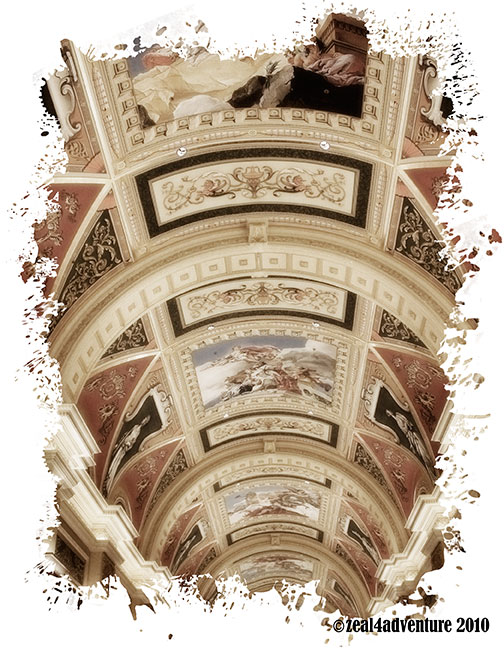
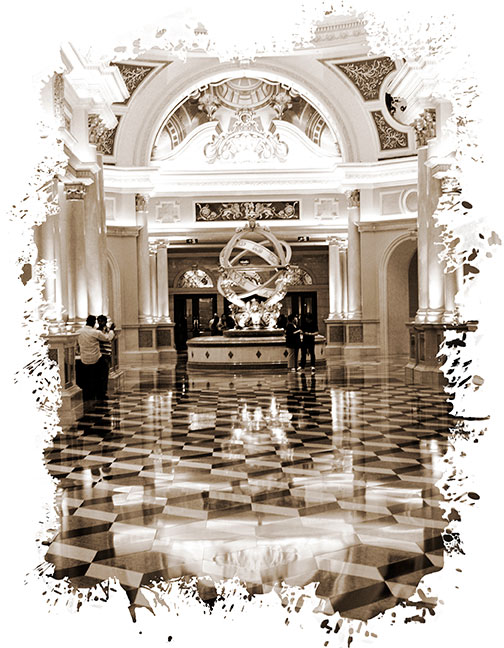
As one enters, one gets transported to lavishness, owing to its décor.  The resort boasts of 19 remarkable restaurants but because we were pressed for time, we settled for the food court, which in itself had quite an interesting selection.

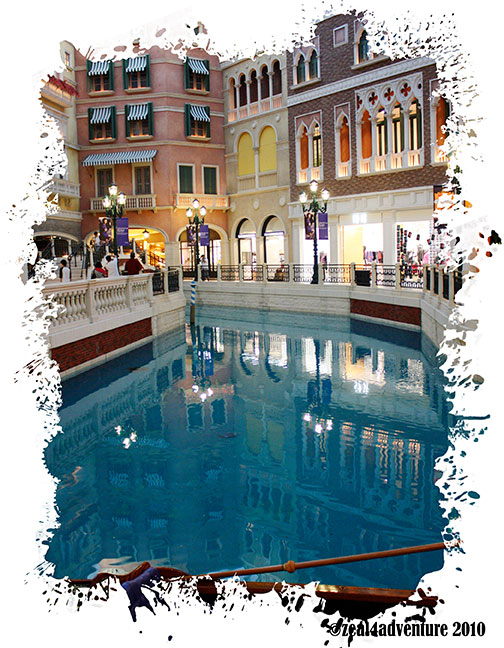
We also found ourselves wandering around, browsing through boutiques and brand name outlets along the Grand Canal Shoppes.

The Venetian sits on Cotai strip, a 5.2 km section of reclaimed land that now links the 2 former islands of Coloane and Taipa in the Pearl River Delta just across from Peninsular Macau.

Getting There:

Complimentary Venetian shuttle buses depart throughout the day from the Macau Ferry Terminal, Border Get and Lotus Ferry Terminal to the Venetian Macau Hotel – Resort.   Sands Casino also provides shuttle buses between the 2 hotels.  For a more up to date schedule, click here.

Other useful information:

Book Cirque du Soleil online here.

Scenic Sunday

Making Good Use of Downtime

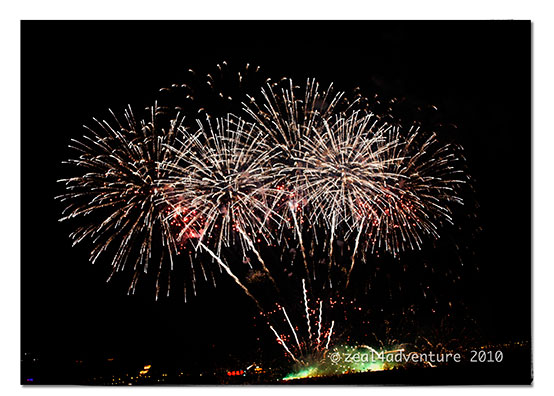
We were at the sea area in front of the Macau Tower early to catch the Annual Macau Fireworks Display contest.

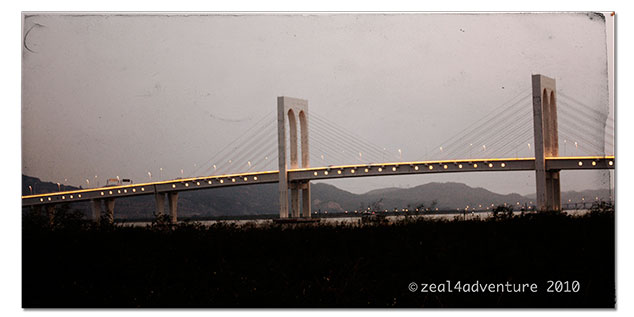
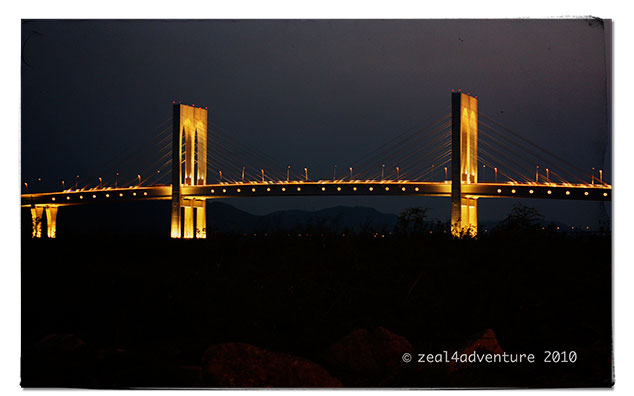
Early birds have its drawback… a long wait.  Its reward however outweighs it inconvenience.  Securing good front row seats afforded great captures of the fireworks and these series of shots of the Sai Van Bridge as the sun sets.

Once considered remote from Peninsular Macau, when they were accessible only by small ferries, the islands of Taipa and Coloane have developed as integrated suburbs since being linked to the mainland by 3 bridges.

One of them is Sai Van Bridge, opened in January of 2005.  It is the first cable-stayed bridge in Macau.  The double deck bridge has 6 lanes in the upper deck and 4 at the lower deck.

More of the fireworks in upcoming posts.  For more scenes from around the world click image below.

Scenic Sunday

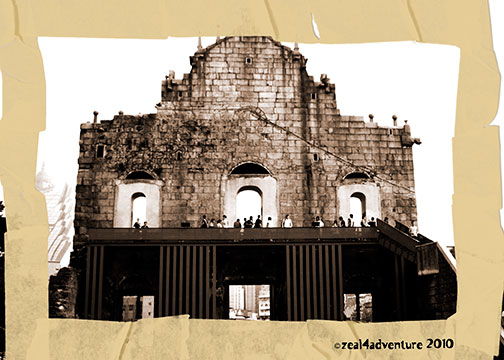
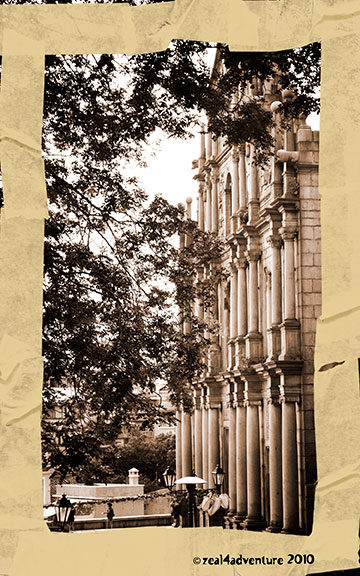
The Ruins of St. Paul’s (Ruínas de São Paulo)

The sixty-eight granite steps from the square will lead you to a façade of what was once the greatest cathedral in Macau.  Built from 1582-1602 by the Jesuits, the remains of St. Paul’s Cathedral was the largest Catholic Church in Asia at the time.

It is a fine example of Macau’s unique characteristic as a city of Europeans, Chinese and other Asian exchange.  Ruined by fire twice, ravaging the other buildings and destroying the church ad almost all the complex.  From 1990 – 1995 work was carried out to restore the back of the church, turning it into a museum.

Regarded today as the symbol of Macau, St. Paul’s ruins was considered the core area when the historical center of Macau was inscribed on the World Heritage list in 2005.  It is today one of Macau’s most famous landmark where music performances are held regularly.

If you enjoyed these sepia scenes, click image below for more.