Beijing Good Eats

I love Chinese food.  I think I blogged about it once before but I will say it again… I love Chinese food.  What excited me no end about visiting China was the opportunity to have real authentic Chinese food.  And interesting Chinese food, we definitely had.   Most of our meals were marvelous but I failed to ask our guide what and where they were so I leave you with 2 (of the best I’ve had on this trip) well-known restaurants that had left a lasting impression.

Ya Wang Roast Duck Restaurant
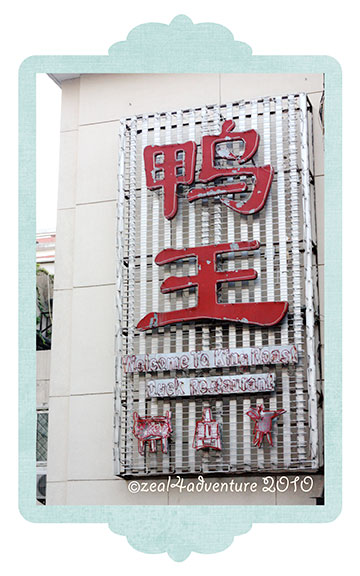
Peking Duck.  Absolutely my family’s favorite since I can remember.  And since we’re in Beijing, how could we not partake of what they consider their national dish?  And so to Ya Wang (Duck King) we went.  Whilst Quanjude and Dadong are favorites among tourists, we opted to go to a less famous but better (in my family’s opinion) tasting roast duck.
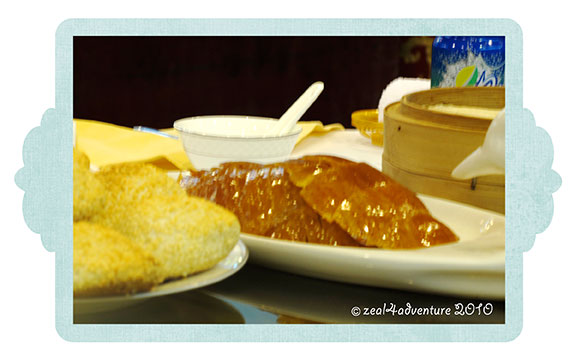
Ya Wang’s version did away with the fat and oiliness but kept the main feature of soft and crispy skin that melts in your mouth.  They say that they make sure that the ducks they serve are not too fat by growing their own ducks.  Also, the skin when carved into thin slivers has some meat on it, unlike the other establishments where they separate the skin from the meat. But it’s to each his own and I like it with some meat.
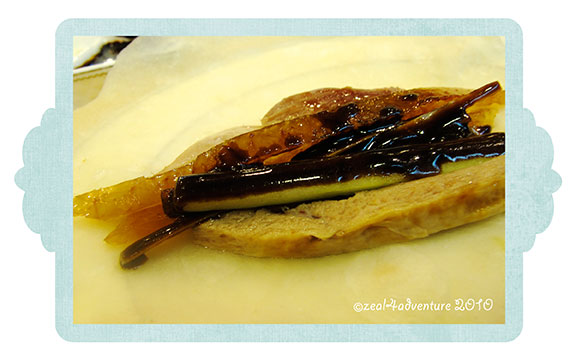
Crispy duck skin, duck meat, cucumber, scallions then topped with hoisin sauce…

Regardless, Peking Duck is a definite must try when in Beijing and Ya Wang is perhaps one of the best places to remember it by.

Xiao Nan Guo
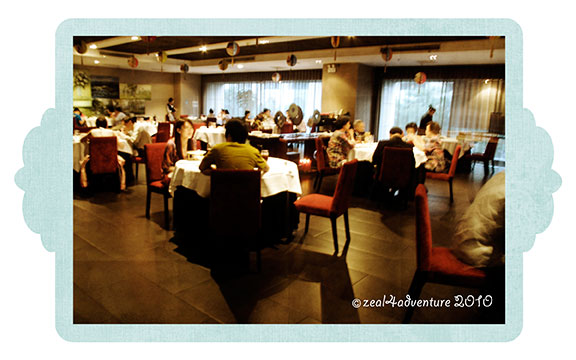
…is a famous chain from Shanghai that found its way to Beijing and Hong Kong.  A renowned restaurant serving Shanghai dishes.  Yes that’s right!  Nothing wrong with that, right?  This wonderful restaurant is modern and elegant featuring a blend of Eastern and Western details.  The food, traditional, served in a way that is more contemporary.  The owner along with her sister started a six-table restaurant in Shanghai 23 years ago beside a restaurant called Da Nan Guo (Big Southern Country) so they named theirs Small Southern Country –Xiao Nan Guo.  Today, this small southern country restaurant is not so small anymore with 7 branches in Shanghai alone, with several in Hong Kong and Beijing.  Some of my favorites:
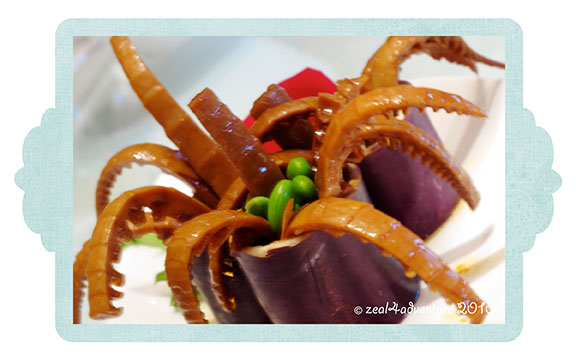
A lotus root appetizer

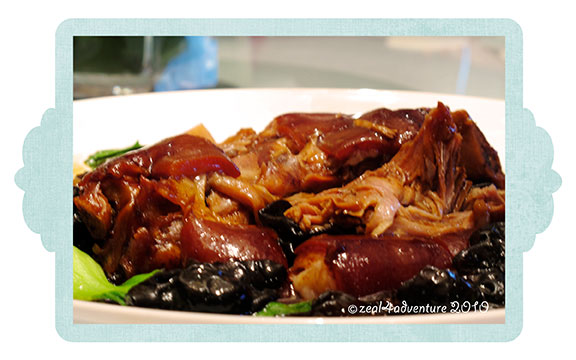
Hong Shao Rou (Red braised pork)

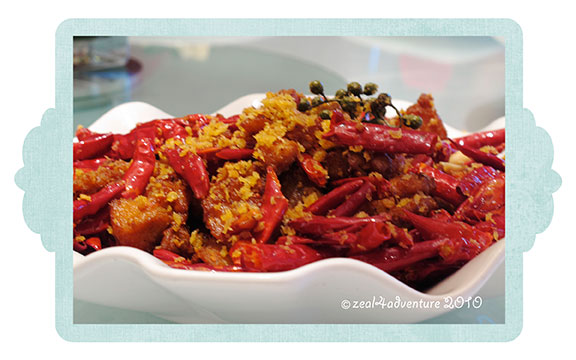
Szechuan styled fried chicken with chilies

Beijing, I found out could be a (Chinese) food lover’s happiness.  And if you feel that you have had too much…
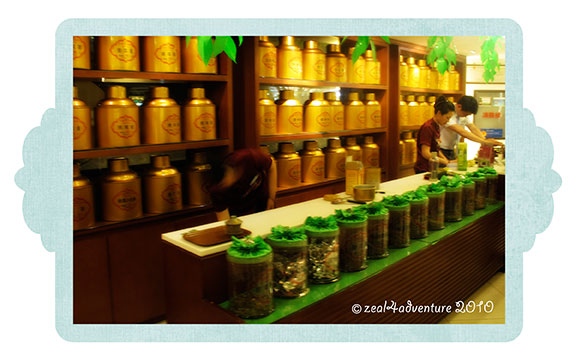
Head over to Ten Fu tea.  They have a wide selection of different kinds of quality tea. Definitely a haven for tea lovers.

Useful Information:

Ya Wang
77 Jiangning Lu,
near Fengyang Lu
Phone: +86 10 6271 1717
Xiao Nan Guo
2/F Jinbao Tower
89 Jinbao Jie, Dongcheng Center
Phone:  +86 10 8622-1717
Ten Fu’s Tea
150 Wangfujing Street,
Dongcheng, Beijing
Phone: +86 10 6527 1888


Xiao Long Bao: Dumpling of all Dumplings

Credits:  Quickpage by Joanne aka 2girlsand poodle from the You Are Awesome Kit.  Alpha by Scrapmatters.com Life Little Surprises kit.

If you haven’t heard of Xiao Long Bao, it’s about time that you do.  You absolutely must try this at least once in your life. This delectable steamed soup dumpling is named after the small bamboo basket it is steamed in.  Inside the dumpling are pockets of minced meat and gelatinized broth made of chicken, pork or cured ham.  When steamed, the gelatin melts inside the dumpling and the soup bursts into deliciousness in your mouth.

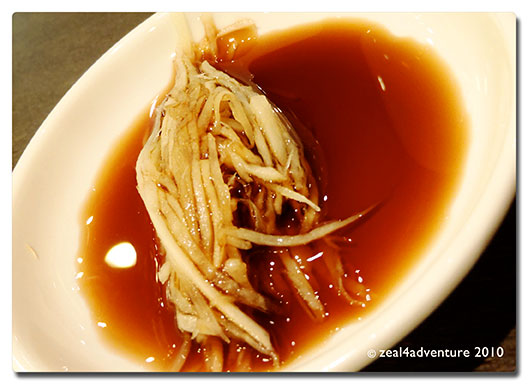
Best with vinegar and ginger slivers

The graceful way I eat this is to bite a small hole into the dumpling and sip out the juice before taking the whole dumpling.  A word of caution… wait a few minutes to cool the dumpling before devouring though – the last thing you want is to ruin the whole experience by burning yourself.

My first encounter with this Shanghainese specialty was in 1991, in Taiwan – the very first branch of Din Tai Fung, I recently learned.   And for a very long time, I could only dream of it.  It took me 10 long years to feast on these babies again, this time in Shanghai.  It took perhaps another 5 years for Xiao Long Bao to make its way to the Philippines.  Eat Well is a favorite and very recently, Crystal Jade opened its doors in Greenhills supposedly offering excellent xiao long baos.  The long line turned me off so I have yet to judge for myself.

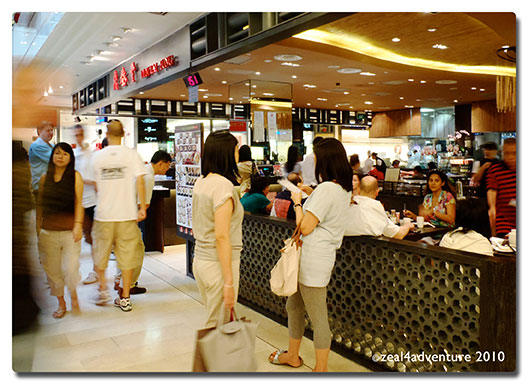
Din Tai Fung. Singapore. Packed!

Recently however, I came full circle when a few months ago in Beijing and more recently in Singapore, I saw myself in Din Tai Fung for a treat of my favorite dumpling (and more).  Din Tai Fung has become known for their delectable dumplings for decades and opened up franchises in many Asian countries but sadly not in the Philippines (yet).  I saw that they’ve expanded their dumplings to more than just their signature Xiao Long Bao.  They now have chicken, fish and even a vegetarian dumpling.

Though I was a bit disappointed with the vegetarian dumplings, their signature dish remains to be my favorite and

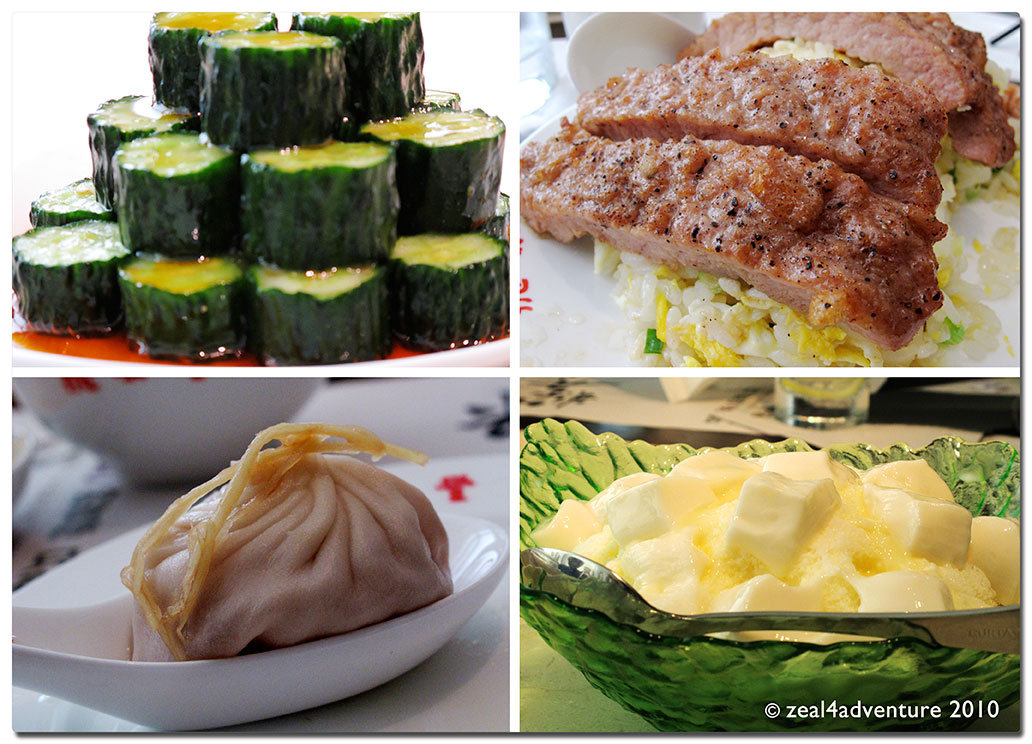
Clockwise:  Cucumber appetizer, Fried Pork Chops on fried rice, Almond Jelly on crushed ice, xiao long bao with vinegar and ginger slivers.

I so totally enjoyed their pork chops and almond jelly dessert.  So really even if XLB made them what they are today, it isn’t just all about dumplings at Din Tai Fung. If you find yourself in a neighborhood with  Din Tai Fung near you, don’t hesitate at all.  Click here to see where they are around the globe.

Where to get XLB in the Philippines:

Eat Well Delicious Kitchen (sounds tacky but they really serve up delicious meals)

At The Fort
Unit C, Ground Floor, Net Quad Building,
30th-31st St., Bonifacio Global City, Taguig
For Reservation and Pickup only: +632 856-9408
At Greenhills
Missouri St. cor. Connecticut St., Greenhills, San Juan, Metro Manila, Philippines
Phone Number: +632 722-8518


Crystal Jade
Unit 117-121 (near Haagen Dazs and Goodwill Bookstore)
V-Mall, Greenhills Shopping Center
Greenhills, San Juan City, Metro Manila

Phone Number: +632 570-6910, 570-6912


Bird’s Nest

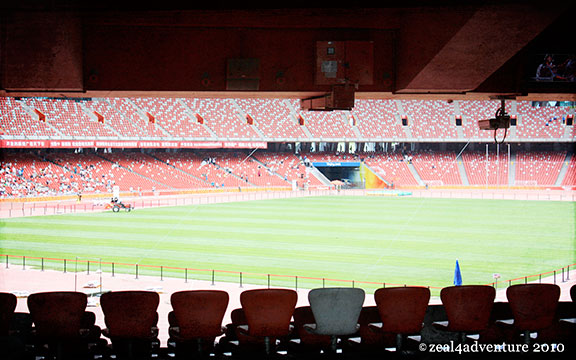
I was glued to the set on August 8, 2008 as I watched in awe of the spectacle that Beijing presented to the thousands of spectators that streamed through the gates of the National Stadium and to millions of others that watched (like me) on television.  Amazed at how they could even begin to prepare for this night — the thousands of dancers, drummers, percussionists, martial art performers, musicians and various artists in full regalia, all performing to the hilt.  Put aside the performers, I was equally awed at the stunning latticework structure that lit beautifully and was made more arresting when the fireworks exploded in its midst.  I knew that one of these days; I will be looking at it up-close and personal.

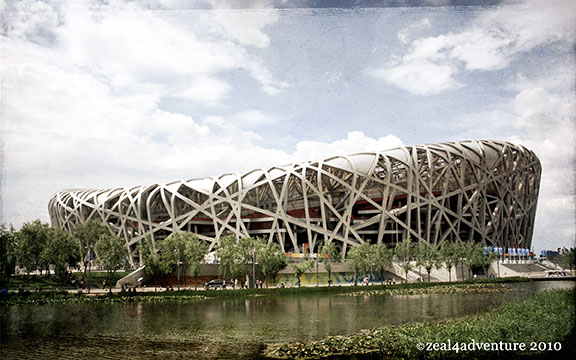
Two years later, we were entering a structure that is a feast to the eyes not only from afar, on TV but up-close as well.  This elliptical latticework has become an architectural landmark and an Olympic legacy.

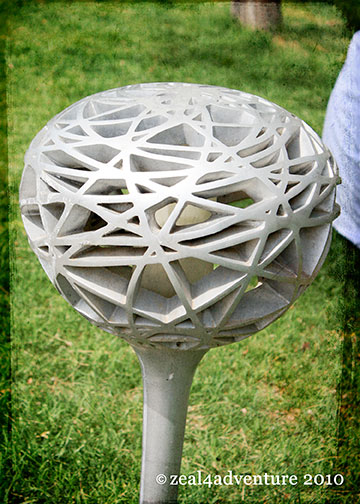
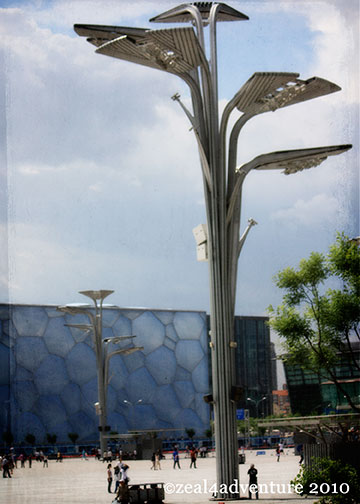
The latticework echoing even to the garden lights.

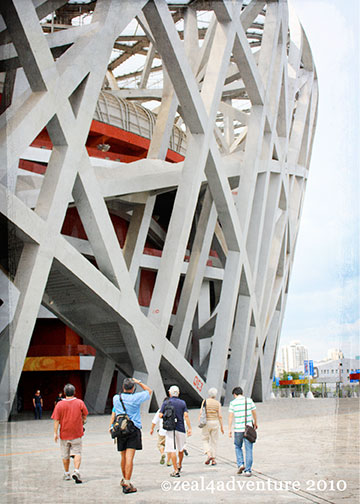
An aesthetic and engineering marvel.  We see as we enter that the grid-like framework serves as both façade and structure merging the walls and roof into one integrated system.

The Bird’s Nest, as it is has been fondly referred to, is the Beijing National Stadium.  Designed by Swiss architects Herzog and De Meuron, this futuristic stadium hosted (as the world knows) the 2008 Summer Olympics.

Today, aside from it being a tourist spot, it continues to host sport events and has become a large scale sports and entertainment facility for the Beijing residents.

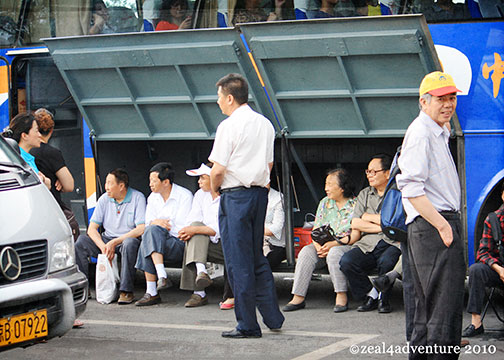
Tired local tourists

There seemed to be a lot of activities going on that day.  Aside from the visitors that flock in on a daily basis, there were athletes and other performers either rehearsing or practicing.

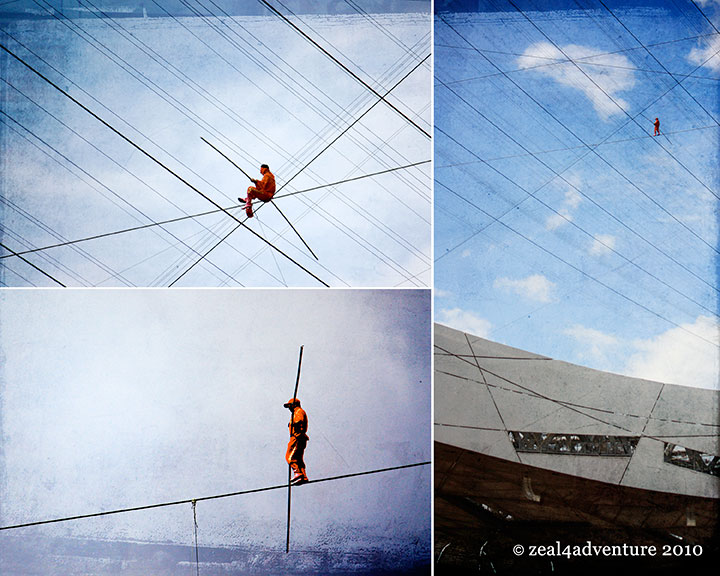
There even was a tightrope walker sans a net for entertainment, I think.  As it turned out, the guy hailed from Xinjiang, the Xinjiang Uygur Autonomous Region (Xin for short) located in Northwest China.

Alongside the Bird’s Nest, an aquatic center was built for the swimming and other water sports competition.  Also known as the Water Cube, the unique and inspired design was based on the way soap bubbles come together.  Before it closed for renovations after the Olympics, it became a ballet theater to host Swan Lake.  Last August, it opened its doors once again to the public, this time transforming into a water park.  At the time of my visit, it was still closed for renovations.


Beijing Acrobats

Credits:  LivE S4S Stitched Page Overlay, TW Lesson 2 paper, Laurie’s Ornament, KPertiet Storyboard Negatives.

China’s acrobatics are world-renowned and deservedly popular among Beijing’s visitors.  Young students that demonstrate extreme flexibility, dexterity and balance that boggle the mind perform today’s acrobatic shows.  If you have enough time, might as well witness a show.  Expect to “ooh” and “ahh” during the entire show as the young performers show off stunts such as: plate spinning, unicycling, juggling, Chinese yo-yo, etc.

Snippets from the show:

Where to watch:

Chao Yang Theater

Wansheng Theater

Tiandi Theater


Kind Words Costs Little But Worth Much

Have you ever spent the night at the airport involuntarily?  I had my Amazing Race moment except that I didn’t have a partner to share this horrible moment with me.  I don’t rant a lot, at least not about my travels because I believe that every experience (pleasant or not) is an experience to tell and learn from.  Even our mishap in Uganda was such a disaster but we chose to take it as it is.   I have eventually learned to laugh about this new mishap but not without a rant.

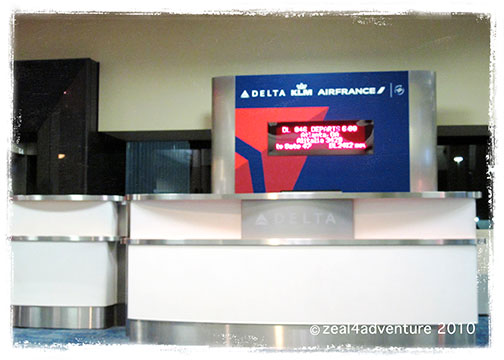
Barely an hour before my flight, my childhood friend M finally picked me up at my best friend’s house in San Carlos.  We were to embark on an extended weekend of fun with some high school buddies in NYC.  I made it through check-in, at least my baggage did.  I, on the other hand, was on stand-by.  It turned out, Delta overbooked the flight by 8 passengers, 6 volunteered to give up their seats, leaving 4 passengers fighting for the 2 available seats.  Since I was practically the last one in, I and another guy was the first one out.  Unbelievable!  I was dumbfounded as I hardly get bumped off.  I really wanted to raise hell but to whom?  My friend whom I hitched a ride with?  (We weren’t on the same flight as she was using her mileage, which was horrifically expensive).  Or perhaps to the Delta ground staff for overbooking?   It really wasn’t their fault… ok, it was partly M‘s fault but she more than made up for it in the end.   🙂  Anyway, Delta offered me a $400 voucher, which I have no use for because, “I don’t come to the US very often”, I told them.  I could give it to friends, they suggested.  I wanted a room but “all their affiliated hotels were booked due to a convention that week”, so they say.

I was really tired so I conceded and accepted the voucher.  I bared and grinned because at the end of the day, it was all my choice.  I took the red-eye flight because I wanted to arrive in the morning so I can make the most of my days in NYC.  I took Delta because it was the cheapest that I could find.  M was able to fly despite the lateness, was it because her ticket was 3x higher than mine?  As I always believe, you get what you pay for… and did I pay!!   😦

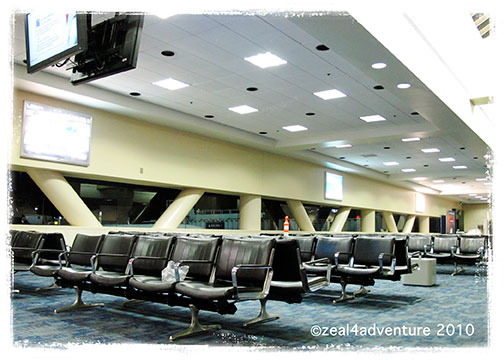
I wandered around the airport until everything started to close.  A nice Delta staff was kind enough to offer me blankets, at least.  It was getting cold as the passengers get on their respective flights.  Soon after, I was alone except for the security staff and the cleaners.  With the uncomfortable bucket seats, the noisy vacuum cleaner and crew talking sometimes even shouting at each other, sleep was a struggle.  It was the longest 5 hours I ever had.  But I wasn’t ranting (yet).

When morning (finally) came, the guy who also got bumped off told me his story after I left the counter.  They couldn’t print his voucher and a supervisor stepped in, it turned out that those who were involuntarily denied a flight had two options — cash or voucher.  Because they couldn’t print his voucher, they gave him CASH!  He told me to give it a try so I waited, and waited, and waited for a supervisor to appear and when he finally did, I asked him about it and he smugly looked at me and had the gall to suggest that I volunteered and didn’t have the right to ask for cash.  Can you believe that old guy?  I was (again) dumbfounded.  I told him that I definitely did not volunteer to give up my seat so I can spend the night at the airport, he looked at me (smugly still) and said that he couldn’t possibly give me what I wanted and I when I asked him why, he replied condescendingly, “because I do not carry that much cash with me”.  I was just too disgusted with this rude old guy and lest I miss my flight again, I felt it was pointless to argue this out.   He told me to try again in Detroit.  A sorry would have been more appropriate, I believe.  That’s customer service for you.

So dear readers, if you were involuntarily denied a seat, for some reason – ASK FOR OPTIONS –some airlines may have cash options.  If the ground staff can’t give you an answer, ask to speak to a supervisor.  Most of the time, the ground staff are not informed of these options too, as I learned.  Or better yet, avoid taking Delta if you can — their staff are downright rude.

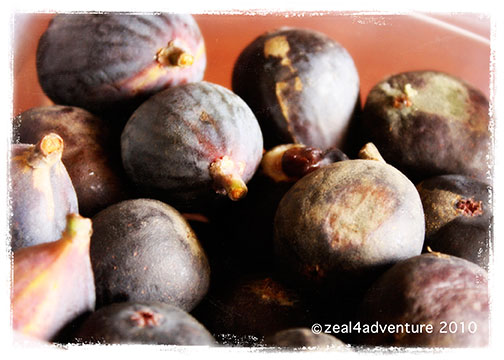
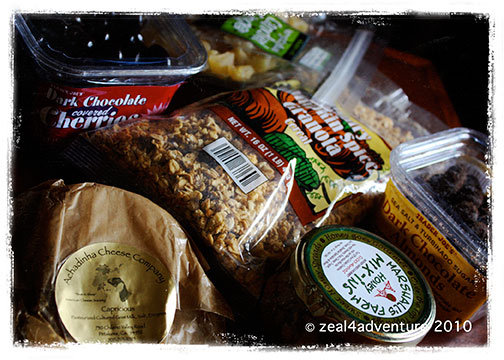
But all is not lost, my best friend may be taking a trip somewhere in the US soon courtesy of my $400 voucher.  NYC was incredible (more than a few posts is definitely coming up sometime in the future).  And my pantry is stuffed with these loots from San Francisco.

Glorious Figs!!

All my favorite things…

All’s well that ends well but as the saying goes… Acts of kindness may soon be forgotten, but the memory of an offense remains.


A Glimpse of Beijing’s Ancient Neighborhoods

A hutong is an architecture and structure unique to Beijing and visiting one of this (either by walking or a rickshaw) is one of Beijing’s attractions especially to people wanting to know more about its history.  Going around a hutong will let one experience the remnants of Beijing’s ancient culture.

In old China, there were clear definitions of what streets and lanes are.  A 36-meter-wide road was called a big street while an 18-meter-wide road was called a small street.  And a 9-meter-wide lane was called a hutong.

According to history records, these hutongs came to existence during the Yuan Dynasty when the Mongols – led by Genghis Khan, occupied Beijing.  The city had to be rebuilt after it was demolished during the take over, thereby creating hutongs.  The word “hutong” is Mongolian in origin, which means, “water well”.  People tend to gather where there is water so with the digging of new wells; new communities are not far behind.  Hutongs are alleys formed by lines of “Siheyuans” (traditional courtyard residences).

Hutongs were established surrounding the Imperial palaces throughout the Yuan, Ming and Qing Dynasties.

Since the mid- 20th century however, new roads and buildings have replaced many of the hutongs.  Some hutongs though still survive today, thanks to their local government’s protection policy.  Most in existence today date from the Ming (1368-1644) and Qing (1644-1911) dynasties.

Walking through the hutongs, it is common to see groups of elderly citizens playing cards, mahjong or Chinese chess together.

Also important to hutong life is the traditional foods sold in carts or small stalls.  These ancient neighborhoods today provide a glimpse of the life in old Beijing.  To live in a hutong would mean no baths and toilets in their homes.  Public baths and toilets are provided and imagine having to trudge your way to the toilet in the middle of the night at below zero degree.

And yet there are still many living in these ancient neighborhoods, perhaps it is the way of life these folks are accustomed to, real life as it has been for generations.


A Taste of Ancient China

Credits:

Although the Tian An Men (Men meaning gate) Gate was built in 1417 during the Ming Dynasty to compliment the Forbidden City, what first came to mind as I was walking through the humungous complex was the 1989 protest known to the world as the Tiananmen Square Massacre.  This was where the heroic flight of thousands of young men and women played a crucial role in the events that ultimately led to the collapse of communism.

The largest city space in the world at 40,000 square meters the square was packed with people wandering about.  It held the monument of the National Heroes, the Great Hall of the People, the National Museum of China and the Mausoleum of Mao Zedong.  It also is the gate connecting to the Forbidden City, which sits on its north.

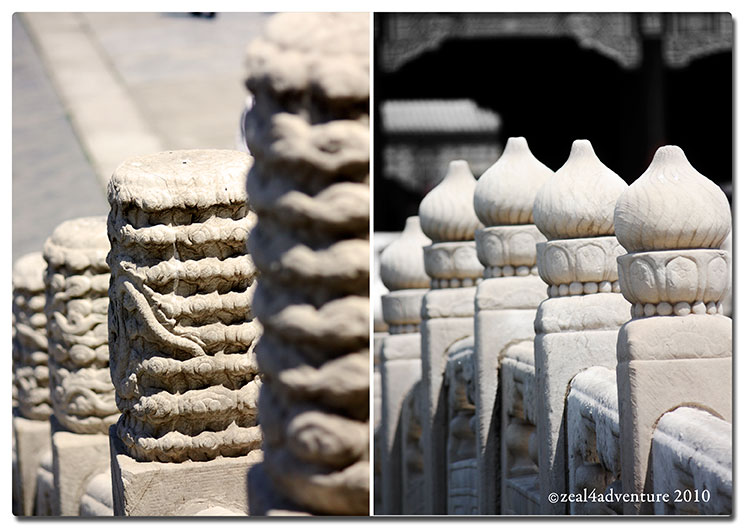
The large white marble column seen all around the square was constructed in 1420 as part of the Forbidden City ‘s grand design, which took 14 years to complete.

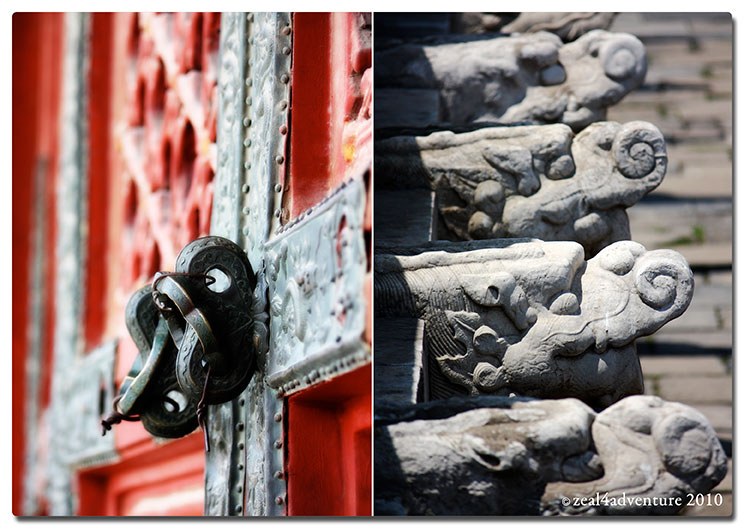
This Chinese inspired palace is located in the middle of Beijing and now houses the Palace Museum.  For almost 500 years (from the Ming Dynasty to the end of the Qing Dynasty), it served as the home of emperors and their households.  It likewise was the economic and political center of the Chinese government.  The construction began under the Ming Emperor Yongle in 1406 and is the largest and the most well preserved imperial residence in China today.

Walking through the city gives an idea of the grandiose lifestyle of the former emperors.  During these times, common Chinese were not allowed to enter the city at all, a big contrast to today’s millions of people entering daily.

The entrance of the Palace is through Tiananmen gate and once you reach the Wumen (Meridien Gate),

you enter the heart of the complex where you fall in line or wait for your guide to purchase your ticket.

It was chaotic and it continues to be so until you leave the complex.   The rooms are now off-limits and one can only take a peak from the outside, unlike a decade ago when one could actually enter and have a feel of the old splendor.  The price of commercialization, I guess.

Despite the chaos, a visit to the Forbidden City is a must especially if it is your first time.

Because of the size, allow at least 3 hours to walk the complex, wear comfy walking shoes and best to get those audio guides for a thorough walk through.

Forbidden City
North of Tiananmen Square
Dong Cheng District
Opens from 8:30am – 4pm daily
Price:  ¥ 40-60 / ticket

The Art of Bargaining

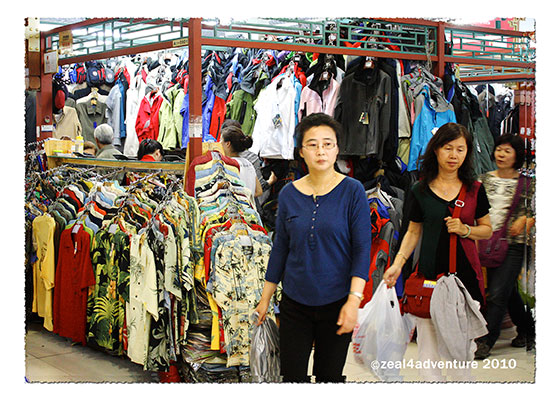
All these name brands that you of course know are fake but sometimes wonder if they really are.  They look and feel like the real thing.  You make eye contact and hold that shirt and ask, “how much?” then she types a price on a calculator that can’t possibly be right but validates what you already know.  So you pretend disbelief, and show a “you must be kidding” face. She goes, “how much you want?”  Then you offer a price 70% lower than what she asked for.  And then she gives you the same look you just gave her and adds, “you joking!”  You look her straight in the eye, “no”, you say.  Then she brings down the price a bit while you do not budge.  The game goes on for a bit longer; by this time her price is about 30% lower than her original quote.  You walk away and she grabs your arm and asks you once more, “how much you want?” in a more irritated manner, you try to break free and walk away, she follows and continues to ask, “how much you want? enough joking.” you tell her your price, which by now is 20% higher than your first offer, sometimes she will offer to a price a tad higher than yours and you finally compromise and concede.   Everyone’s happy; the vendor will even praise your bargaining skills.   Sometimes though they will walk away grudgingly and call you crazy.  Don’t fret, there are at least 500 stalls (the whole building is reported to have 1,500 stalls) with more or less the same merchandise and if you really like it, you can repeat the same exercise with another vendor.   After a few hours of this, you feel exhausted but happy.  You feel like a cup of coffee or a bottle of beer to reward you for a job well done.

Many coffee shops and restaurant chains on the first floor

My mama always say, “They will never sell you anything at a loss, so don’t feel bad.”  You see she has been going back to the silk market and similar markets in Shanghai and Guangzhou for more than a decade.  She IS the expert when it comes to bargaining with the Chinese.  I take to heart her practical advice and oftentimes end up with a good bargain – that is if my impatience doesn’t get the better of me.  Here are some advices from the expert herself.

  1. Don’t want the item too much.  They are fakes after all.
  2. You will most likely find the same item in the stalls next door.
  3. Always start at least 70% below the asking price.
  4. Do not concede unless it is at least half the asking price.
  5. If you happen to break rule no. 1, then at least concede only if the price is 40% lower than their asking price.
  6. Bargain hard.
  7. Pretend to know what you’re doing, don’t be wishy-washy.
  8. Be prepared for some abuse, some will grab you and drag you back to their store, even if you’re already 3 stores down.

The Silk Market is a 5-story building that offers more than just silk.  There are garments, jackets, jeans, leather goods, shoes, bags, watches, handicrafts, jewelries, toys, you name it.  It opened its doors in 2005 replacing the original outdoor Xiu Shui Market.

Try it… it can be fun.  It’s a game not everyone can play well though but practice makes perfect.   😉

Useful Info:

The Silk Street Market
Chaoyang District, No 8 Xiu Shiu East Road
To get there: take the subway line 1 – Yong Anli Station

Parma Ham & Quinoa

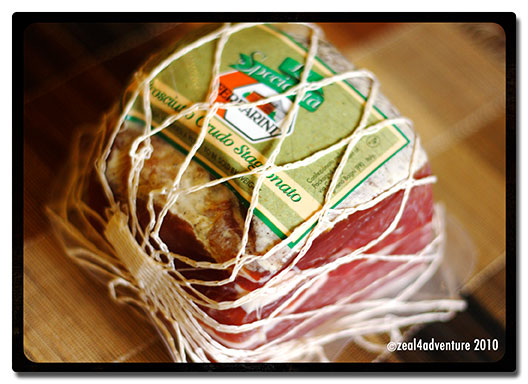
A colleague came back from Parma, Italy and brought home for me a whole chunk of… Parma ham, what else?  Oh my!  How the hell do I slice this beauty nice and thinly?  So it sat on my ref for forever.  But hooray to Santis… they agreed to slice this whole slab for me (for a fee of course but who cares for as long as I get to partake of it and not just drool whenever I open the ref) and so this has become a usual fare lately.

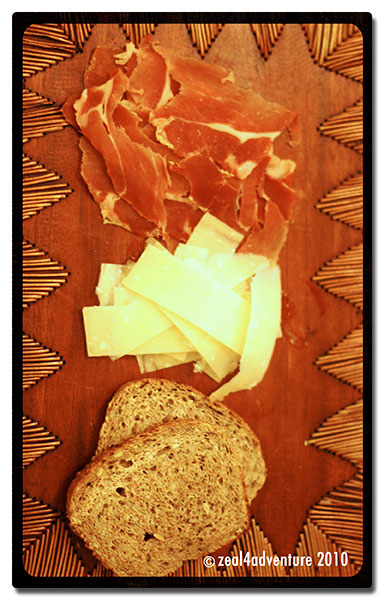
Team it up with cheese and bread, eaten either as is or as a sandwich… heaven.  Love it and could never tire of it.  Vacuum packed, it goes a long way too.

The very nice staff of Santis asked me if I wanted the ends.  “It’s good for soups and stews”, they suggested, so I asked them to throw that in too.  And this is how I used it.

Not (yet) on a soup or stew dish.  I always have veggies that needed to be eaten yesterday.

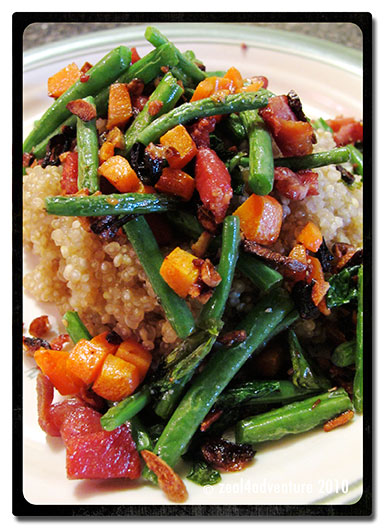
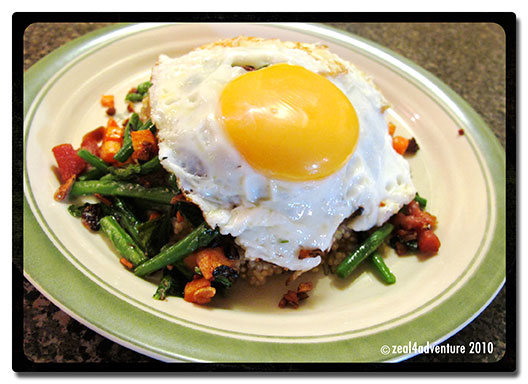
So some cubed ends of the ham got thrown into a medley of stir-fried veggies (carrots and string beans) for flavor and some guilty pleasure to an otherwise healthy dish.  Instead of rice, I felt like having it with quinoa.  It’s a highly nutritional seed that is prepared and eaten like whole grain such as rice or barley.  I like it because I like the firm and slightly chewy texture.  I usually cook it with milk and sweetened with honey or Agave syrup. But I came across a savory recipe that piqued my curiosity.

Topped with fried egg… super yum!

Boil with chicken or pork stock then top with the stir-fried veggies (with the ham) and you’ll be hooked.  How to cook quinoa:  you can either follow the instructions on the label or watch this:

Useful Info:

Where to find Quinoa in the Philippines?  You can find it in any Healthy Options store in the metro.

Beijing at Night

Credits:  Kitschy Digital (You are awesome kit) Chevron and Yellow Houndstooth papers, Knotty girl’s pp1 paper;  Caro 752 Marquee 1 & 2 brushes, KPertiet Grungy clusters and LivE Sing for Spring Page overlay;  LivE TW01 Tag;  K Pertiet Academic Alphas.

A “Snack Street” and a “Bar Street”, both alive till the wee hours of the morning, both swarming with street food – some made me squeamish while some whetted my appetite.  Two popular night scenes not to be missed when in Beijing.

Wangfujing Night Food Market

Just off Wangfujing St., located pretty much in the center of Beijing and a 10-minute walk from where we stayed.

After a hotpot dinner at a nearby mall, we walked along Wangfujing St., a portion of it is off limits to cars and other motor vehicles.

The food market was crowded with people, but they say this is quite normal as it is a famous snack street among locals and foreigners alike.  I was not prepared for what’s to come though.

The first few food stalls had as displays bugs and scorpions on a stick, bizarre foods that would probably delight Andrew Zimmern no end but not me.

Even beautiful sea creatures such as seahorses and starfishes.  I was horrified.  Poor creatures.  I now know that there are foods that I cannot eat, what a revelation!!  But not all food stalls are alike,

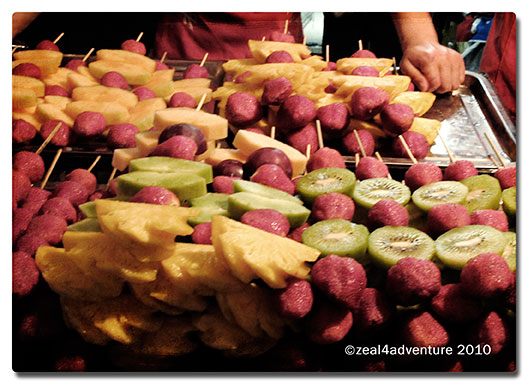
Candied fruits

there were others that had me wish we skipped the hotpot meal and went straight here.

Lamb Shawarma

There were wonderful smells of lamb kebabs, shawarmas, grilled meats, roasted chestnuts and many, many more.

A great place for a cheap sumptuous dinner, sans the bizarre foods of course.

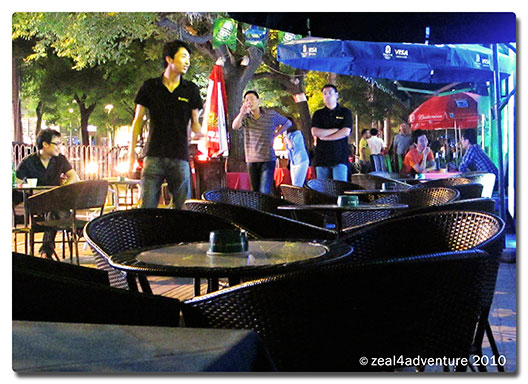
Sanlitun Bar Street

One of the best known bar street in Beijing, Sanlitun is located in Eastern Beijing in the Chaoyung District.

Hidden away in the small alleys of Sanlitun are many small bars and cafes.

This has been one of the most popular entertainment area for foreign expats, recounts my brother who used to work in Beijing in the late ‘90s.  What used to be a small street with bars has turned into stretches of bars and trendy restaurants.  Hardly recognizable, he says, as we weave through the streets in search of his favorite hangout spot 12 years ago.

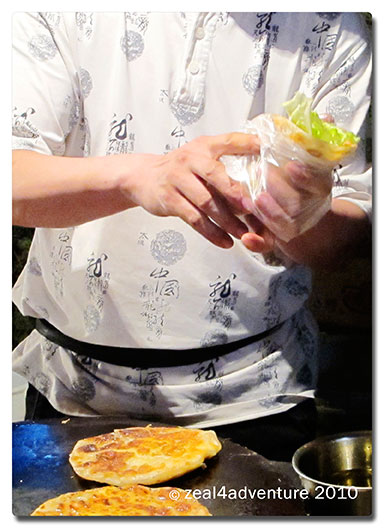
Before taking a cab back to our hotel, we came across this stall selling some sort of a wrap

made up of char siu pork and fried egg with some sort of sweet-savory sauce and lettuce to finish off.

Better then the breakfast offerings at the hotel.